Carl Ditters von Dittersdorf – Double Bass Concerto no 2 (Soloist: Ödön Rácz)
Автор: ContrebasseClassique
Загружено: 2026-03-07
Просмотров: 99
Описание:
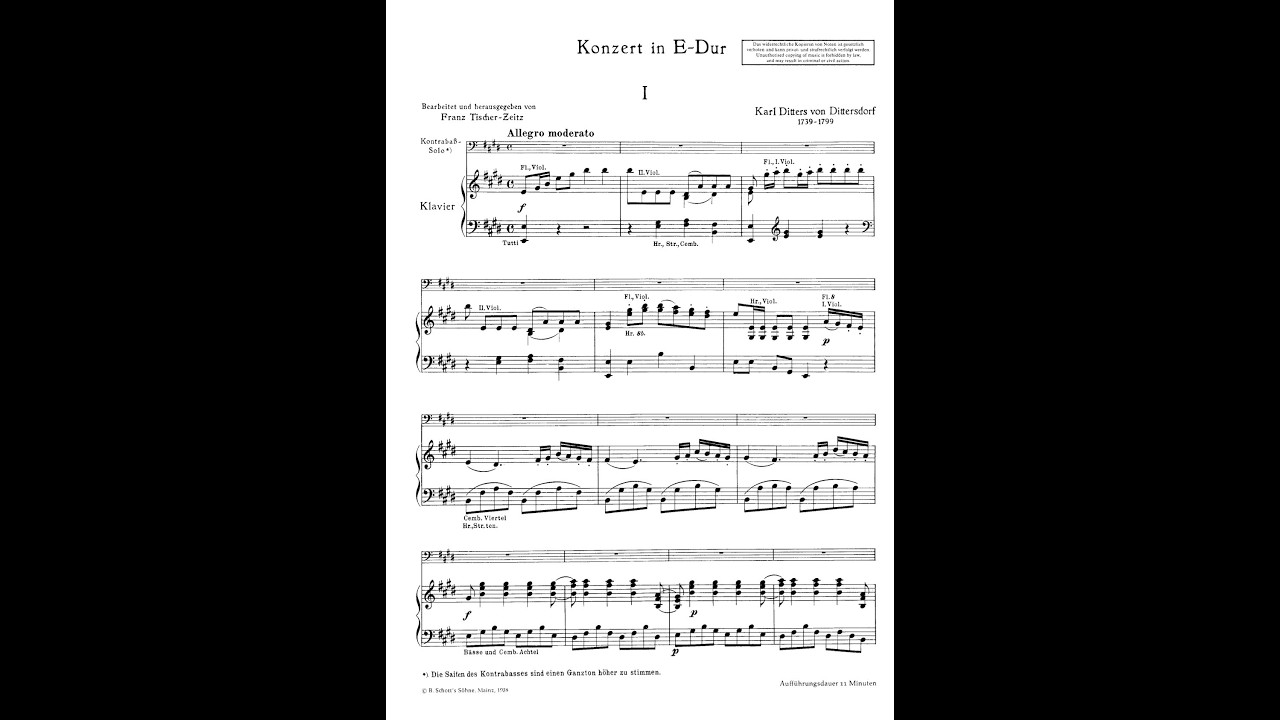
Carl Ditters von Dittersdorf (1739-1799) – Concerto no 2 for Double Bass and Orchestra in E-Major, Kr. 172 (1767)
Franz Liszt Chamber Orchestra
Conductor – Speranza Scappucci
Double Bass – Ödön Rácz
Audio:
I. • Dittersdorf: Concerto in E major for Doubl...
II. • Dittersdorf: Concerto in E major for Doubl...
III. • Dittersdorf: Concerto in E major for Doubl...
Score:
https://www.alfred.com/search/product...
Looking for new chamber music repertoire? Go take a look at the ContrebasseClassique website: https://www.contrebasseclassique.com/
Details by Wikipedia: https://en.wikipedia.org/wiki/Carl_Di...
Dittersdorf was born in Vienna, as Johann Carl Ditters. His father was a military tailor in the Austrian Imperial Army of Charles VI. After retiring from his military obligation, he was provided with royal letters of reference and a sinecure with the Imperial Theatre. In 1745, the six-year-old August Carl was introduced to the violin and his father's moderate financial position allowed him a good general education and private tutelage in music, violin, French and religion. After leaving his first teacher, Carl studied violin with J. Ziegler, who secured his pupil's appointment as a violinist in the orchestra of the Benedictine church on the Freyung.
Prince Joseph of Saxe-Hildburghausen soon noticed young Ditters, and hired him for his court orchestra. Under princely auspices he studied violin with Francesco Trani who, impressed with the ability of his pupil in composition, commended him to Giuseppe Bonno who instructed him in counterpoint and composition. After a few years Prince Joseph disbanded the orchestra, since he had to leave Vienna to assume the regency in Hildburghausen, and the Austrian Empress hired Dittersdorf for her own orchestra through Count Durazzo, Theatre Director at the Imperial Court. In 1761 he was engaged as violinist in the Imperial Theatre orchestra, and in 1762 as its conductor. It was during this period that he became acquainted with Christoph Willibald Gluck, who had just achieved greatness as an opera composer. In 1763 he traveled to Bologna with Gluck to see the opera Il trionfo di Clelia, an Italian tour that was to leave the greatest impression on his future work as a composer from Gluck and the contemporary Italian musical scene. Back in Vienna in 1764, he met the great Joseph Haydn and became one of his closest friends.
In 1764, Dittersdorf assumed the post of Kapellmeister at the court of Ádám Patachich, Hungarian nobleman and Bishop of Oradea, Romania. The following year he was introduced to the Prince-Bishop of Breslau, who was in the process of creating a cultural centre around his court based at Château Jánský vrch in Javorník. He accepted the post of Hofkomponist in 1771, and it was during his tenure at Johannesberg that most of his creative output was produced. Over the next twenty years he wrote symphonies, chamber music, and opere buffe. In 1773 the prince-bishop appointed him Amtshauptmann of nearby Jeseník, one of several measures to help entice the composer to remain at isolated Johannesberg. Since this new post required a noble title, Ditters was given the title of von Dittersdorf. His full surname thus became "Ditters von Dittersdorf".
Johann Baptist Wanhal was Dittersdorf's most eminent pupil. About 1785, Haydn, Dittersdorf, Mozart and Wanhal played string quartets together. Irish tenor Michael Kelly noted of their performance of Stephen Storace's String Quartet that, although they played well, their performance as a whole was not outstanding; but the image of four of the greatest composers of their time joining in common music-making remains an unforgettable vignette of the Classical era.
In 1794, Dittersdorf, after a serious clash with von Schaffgotsch, was expelled from his palace. Sometime the following year, he was invited by Baron Ignaz von Stillfried to live in his spare château in southern Bohemia. His final decade was occupied with overseeing operatic productions in addition to compiling and editing his own music for publication.
He died at Nový Dvůr where Château Červená Lhota stood.
Ditters' early work laid the groundwork for his later compositions. His symphonic and chamber compositions emphasize sensuous Italo-Austrian melody instead of motivic development, which is often lacking in his works. After some early Italian opere buffe, he turned to writing German Singspiele, with Der Apotheker und der Doktor in particular being a tremendous success in his lifetime, playing in houses all over Europe and recorded almost two centuries later. Among his 120 symphonies are twelve programmatic ones based on Ovid's Metamorphoses, although only six have survived. He also wrote oratorios, cantatas, concertos, chamber music, piano pieces and other miscellaneous works.
#dittersdorf #doublebassconcerto #bassconcerto #franzlisztchamberorchestra #odonracz
Повторяем попытку...
Доступные форматы для скачивания:
Скачать видео
-
Информация по загрузке: