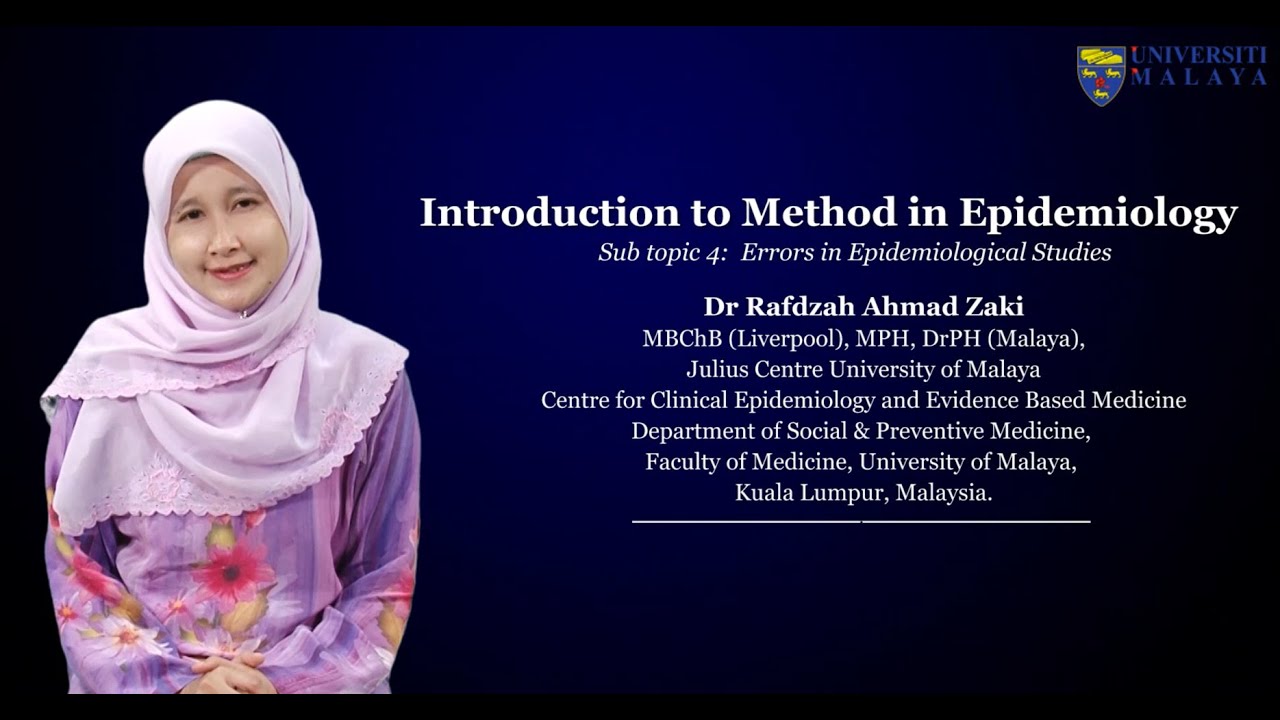
Introduction to Methods in Epidemiology: Errors in Epidemiology Studies (L37)
Автор: Public Health Universiti Malaya
Загружено: 2025-04-06
Просмотров: 80
Описание:
Introduction to Methods in Epidemiology
Sub Topic 4: Errors in Epidemiology Studies
By Associate Professor Dr Rafdzah Ahmad Zaki
Department of Social and Preventive Medicine
Faculty of Medicine, Universiti Malaya
Copyright 2015 Universiti Malaya
In this lecture, we explore the pitfalls in epidemiologic research—how study results can be affected by random error, bias, or confounding. Understanding and minimizing these errors is essential to interpreting research accurately and getting closer to the true effect.
📌 Key Topics Covered:
🎯 What Are We Really Trying to Find?
The goal in epidemiology is to estimate the true relationship between exposure and disease.
But findings can be distorted by:
Random Error
Systematic Error (Bias)
Confounding
🎲 1. Random Error
Arises from sampling variability—just by chance
Can be quantified with p-values and confidence intervals
Reduced by:
▸ Increasing sample size
▸ Improving instrumentation
▸ Better study design
🧠 2. Systematic Error (Bias)
Unlike random error, bias consistently distorts the results—often without the researcher's awareness.
⚖️ Types of Bias:
📏 A. Information Bias (Measurement Bias)
Occurs when data collection methods introduce errors.
Non-differential misclassification: Affects all groups equally → bias toward no association
Differential misclassification: Affects groups differently → may exaggerate or underestimate risk
🛠️ Sources:
Subject recall (e.g., recall bias)
Observer differences
Faulty tools or inconsistent procedures
Hawthorne effect (participants change behavior because they know they’re observed)
✅ Prevention:
Use standardized procedures
Blind interviewers and participants
Use multiple data sources and neutral survey tools
👥 B. Selection Bias
Occurs when study groups differ systematically in ways that affect the outcome.
🛠️ Sources:
Unrepresentative control groups
Self-selection or non-response
Loss to follow-up in cohort studies
Healthy worker effect in occupational studies
✅ Prevention:
Careful group selection
Clear definition of source population
Control selection should be independent of exposure status
🧩 C. Confounding
A third variable that is associated with both the exposure and the outcome, but is not a consequence of the exposure.
🧪 Example:
Studying birth order and Down syndrome
Confounder: Maternal age (affects both birth order and Down syndrome risk)
✅ Control Strategies:
In Study Design:
Restriction (include only certain groups)
Matching (e.g., same age, sex in case-control)
Randomization (in trials to distribute confounders evenly)
In Data Analysis:
Stratification (e.g., Mantel-Haenszel method)
Multivariable regression models
Compare crude vs. adjusted estimates
🔗 Association ≠ Causation
Epidemiologic studies often show associations, not definite causation.
Use the Bradford Hill criteria to assess if an association is likely causal:
Strength
Consistency
Specificity
Temporality
Biological gradient (dose-response)
Plausibility
Coherence
Experimental evidence
Analogy
💡 Final Takeaway:
To get reliable epidemiologic results, we must recognize, reduce, and account for errors—whether they’re from random variation, biased methods, or confounding factors. This improves the credibility and validity of our findings and helps guide better public health actions.
📺 Watch this lecture to sharpen your skills in critical appraisal and understand the fine line between true findings and misleading results.
#EpidemiologyErrors #BiasInResearch #Confounding #InformationBias #SelectionBias #RandomError #PublicHealthMalaysia #UniversitiMalaya #BradfordHill #CriticalAppraisal #EvidenceBasedMedicine
Повторяем попытку...
Доступные форматы для скачивания:
Скачать видео
-
Информация по загрузке: