Power quality harmonic control standard Changes in IEEE-Std 519 from 1992, 2014 to 2022
Автор: Enjoypowers, Energy Storage & Power Quality Expert
Загружено: 2024-01-15
Просмотров: 763
Описание:
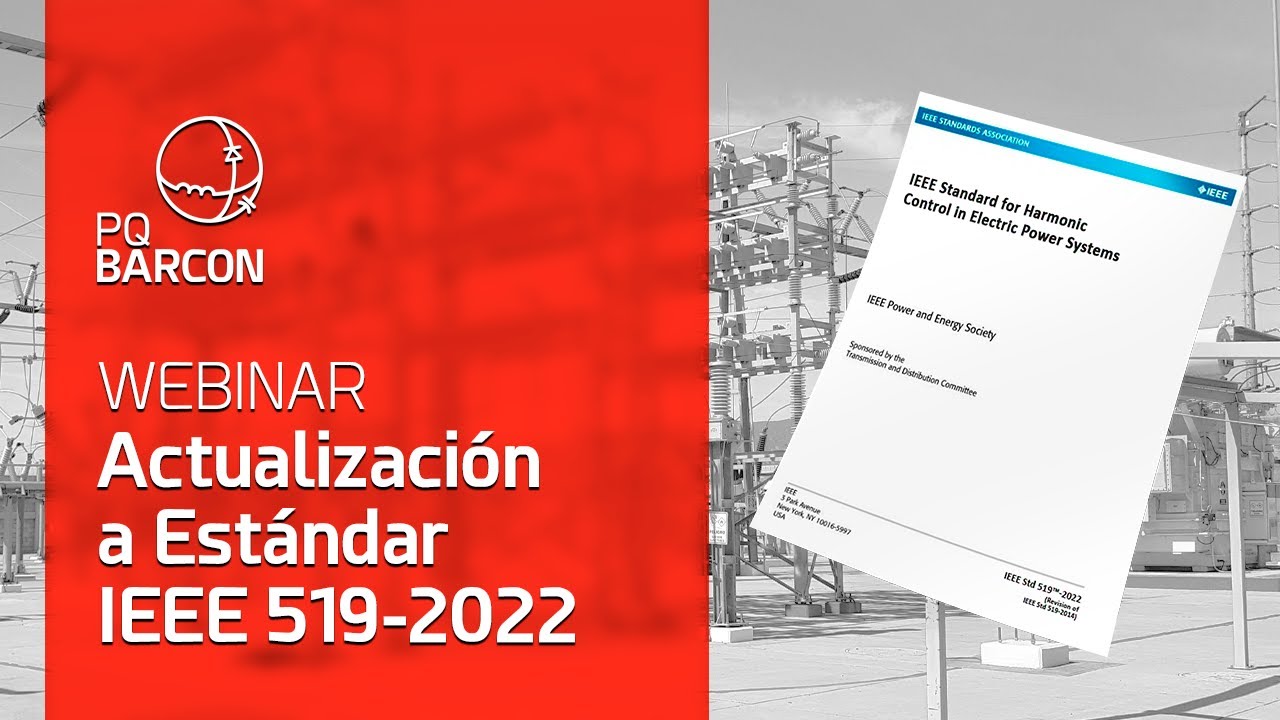
IEEE-Std 519 is renowned among documents addressing power quality limitations, serving as a highly recognized and referenced standard, not only within the United States but also internationally. The widely circulated versions currently include the 1992, 2014, and the recently refreshed 2022 versions. What differentiates these three versions?
1. Title Evolution:
Firstly, looking at the document titles, the names of the first two versions are identical: "IEEE Recommended Practice and Requirements for Harmonic Control in Electric Power Systems." In contrast, the latest 2022 version transforms into "IEEE Standard for Harmonic Control in Electric Power Systems." This change indicates that the 2022 version has officially become a standard, even though the use of IEEE Std 519 remains entirely voluntary.
2. Point of Common Coupling (PCC) Definition:
The definition of the Point of Common Coupling (PCC) underwent changes. In the 1992 version, harmonic restrictions applied at the PCC, a point of metering, or any point. In the 2014 version, PCC is more precisely defined as the point in the power system closest to the user, where the system owner or operator could offer service to another user. Locations within the factory that do not meet the harmonic limit requirements, as defined by the new PCC, are not required to comply with IEEE-519.
Moreover, in the 2014 version, recommended limits apply only at the PCC and should not be applied to either individual pieces of equipment or at locations within a user’s facility.
3. Total Demand Distortion (TDD) Definition:
The definition of Total Demand Distortion (TDD), a critical metric in determining harmonic percentage limitations, evolved. In the 1992 version, TDD was the percentage of total harmonic current to the maximum demand load current. In the 2014 version, TDD considers only the highest 50 harmonics, excluding intermittent waves.
4. Harmonic Measurement Methods:
Changes in the harmonic measurement methods are evident. The 1992 version introduced instruments and techniques required for accurate harmonic measurement, including oscilloscopes, spectrum analyzers, harmonic analyzers, and digital harmonic measurement devices. The 2014 version introduced new requirements for harmonic measurement methods, including clearly defined "very short time harmonic measurement," "short time harmonic measurement," and "statistical evaluation." These technologies reduce the impact of anomalous data points, with an increased emphasis on statistical analysis over instrument analysis.
5. Voltage Distortion Limit:
In the 1992 version, three allowable Total Harmonic Distortion (THD) levels were established based on system classification: Special (3%), General (5%), and Dedicated (10%). In the 2014 version, voltage distortion limits were established based on the bus voltage at the PCC, ranging from 8% for V ≤ 1.0 kV.
The 2014 version approach enhances practicality.
6. Maximum Harmonic Current Distortion:
Compared to 1992, the 2014 version restricted harmonics beyond 35, limiting them between 35 and 50. In the 2022 version, even-order harmonic current limits have been relaxed. Previously limited to 25%, even-order harmonics now have increased limits: 50% for h ≤ 6 and 100% for h ≥ 7.
With the proliferation of Distributed Energy Resources (DER) and Inverter-Based Resources (IBR), if their generation exceeds 10% of the annual average load demand, current limits from standards such as IEEE Std 1547 or IEEE Std 2800 should be applied.
The 2022 version's scope is expanded to include Inverter-Based Resource (IBR) and/or Distributed Energy Resource (DER) installations, directing users to IEEE Std 15473 or IEEE Std 28004 for current distortion limits if the combined site-rated generation is ≥10% of the annual average load demand. A Decision Tree (Figure 1 in the standard) is provided to determine whether IEEE Std 519 current limits apply at the PCC.
Повторяем попытку...

Доступные форматы для скачивания:
Скачать видео
-
Информация по загрузке: