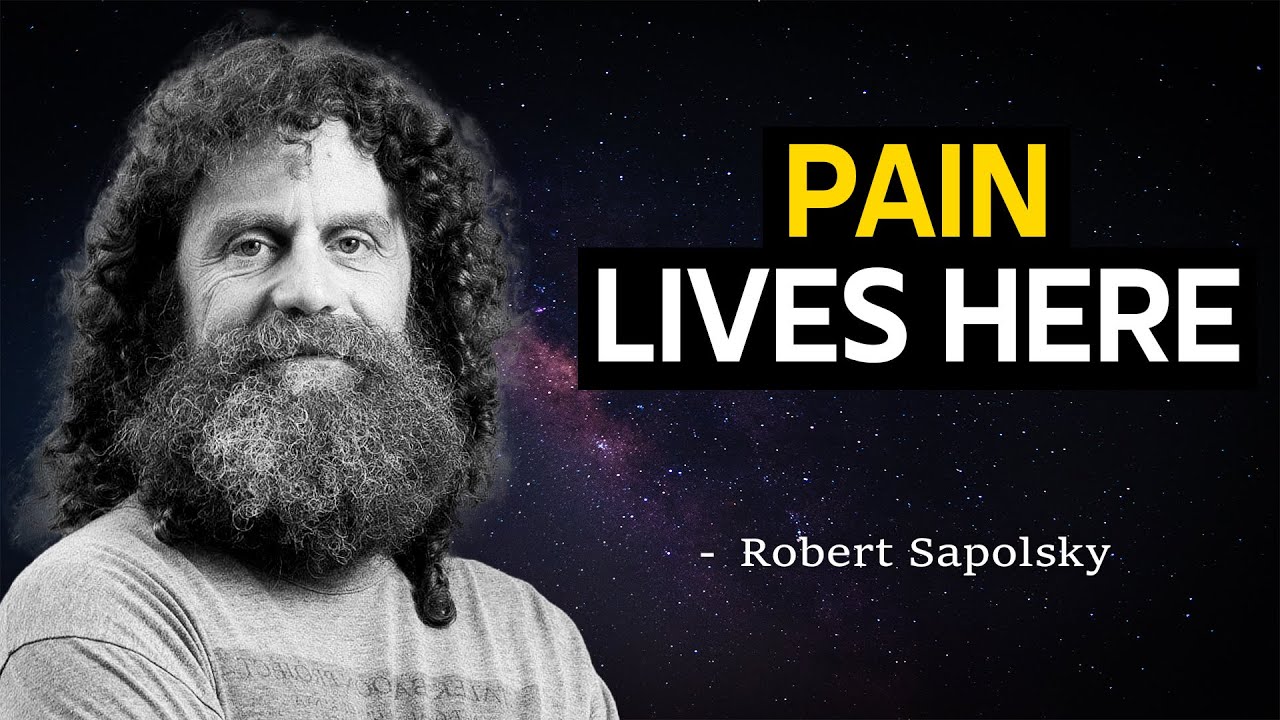
Why Does Heartbreak Hurt Physically? Robert Sapolsky’s Answer Will DESTROY Your Reality
Автор: jahjahfue
Загружено: 2026-01-21
Просмотров: 6
Описание:
Why Does Heartbreak Hurt Physically? Robert Sapolsky’s Answer Will DESTROY Your Reality
You think heartbreak is something you feel.
Sadness. Loss. Missing someone.
Fine.
But why does your chest hurt like it’s being squeezed?
Why does your stomach drop like you just stepped off a ledge?
Why does your throat tighten… before you even decide what you’re feeling?
Most people don’t ask.
They say “emotion.”
They say “stress response.”
But that’s not an answer.
When you really ask why…
you find something that changes how you see your own body.
Not as something that reacts to emotion…
but as the thing generating it.
Claim: “Social exclusion activates neural circuitry linked to physical pain distress (including dorsal anterior cingulate cortex), and this activity tracks how distressed people feel.”
Source: Eisenberger, N. I., Lieberman, M. D., & Williams, K. D. (2003). Does rejection hurt? An fMRI study of social exclusion. Science, 302(5643), 290–292. https://doi
Claim: “Social rejection can activate somatosensory pain-related brain regions, showing overlap with the sensory representation of physical pain.”
Source: Kross, E., Berman, M. G., Mischel, W., Smith, E. E., & Wager, T. D. (2011). Social rejection shares somatosensory representations with physical pain. Proceedings of the National Academy of Sciences, 108(15), 6270–6275. https://doi
Claim: “The Trier Social Stress Test (TSST) is a validated laboratory protocol for reliably inducing psychosocial stress and measuring physiological stress responses.”
Source: Kirschbaum, C., Pirke, K. M., & Hellhammer, D. H. (1993). The “Trier Social Stress Test”—A tool for investigating psychobiological stress responses in a laboratory setting. Neuropsychobiology, 28(1–2), 76–81. https://doi
Claim: “Cortisol responses to acute psychosocial stress follow a delayed time course, typically peaking roughly ~20–30 minutes after the stressor begins.”
Source: Allen, A. P., Kennedy, P. J., Dockray, S., Cryan, J. F., Dinan, T. G., & Clarke, G. (2017). The Trier Social Stress Test: Principles and practice. Neurobiology of Stress, 6, 113–126. https://doi
Claim: “Physical contact/presence of a close partner can measurably reduce threat-related neural activation (social buffering of threat).”
Source: Coan, J. A., Schaefer, H. S., & Davidson, R. J. (2006). Lending a hand: Social regulation of the neural response to threat. Psychological Science, 17(12), 1032–1039. https://doi
Claim: “Internal bodily signals (interoception/visceral input) continuously influence brain function, cognition, and subjective experience—linking body state to what becomes conscious.”
Source: Critchley, H. D., & Harrison, N. A. (2013). Visceral influences on brain and behavior. Neuron, 77(4), 624–638. https://doi
Song: Undertow Composer: Scott Buckley Website: Scott Buckley License: Free To Use YouTube license youtube-free Music powered by BreakingCopyright: https://breakingcopyright
Повторяем попытку...
Доступные форматы для скачивания:
Скачать видео
-
Информация по загрузке:


![Роберт Сапольски — Депрессия [Vert Dider]](https://image.4k-video.ru/id-video/_UtA0dwGoUQ)


