Symphony of Psalms - Igor Stravinsky
Автор: Sergio Cánovas
Загружено: 2025-09-04
Просмотров: 812
Описание:
Czech Philharmonic Orchestra conducted by Karel Ančerl. Prague Philharmonic Choir conducted by Josef Veselka.
I - Tempo 𝅘𝅥 = 92 - (attacca): 0:00
II - Tempo 𝅘𝅥𝅮 = 60 - (attacca): 3:06
III - Tempo 𝅘𝅥 = 48 - Tempo 𝅗𝅥 = 80 - Tempo I (𝅘𝅥 = 48) - Tempo 𝅗𝅥 = 80 - Tempo 𝅗𝅥 = 48 - Doppio movimento (𝅘𝅥 = 48): 9:20
Stravinsky's Symphony of Psalms was composed between December 1929 and August 1930, commissioned by conductor Serge Koussevitzky to celebrate the 50th anniversary of the Boston Symphony Orchestra. It was premiered in Brussels at the Palais des Beaux-Arts on December 13 of 1930, performed by the Chorus and Orchestra of the Société Philarmonique de Bruxelles conducted by Ernest Ansermet. Its Boston performance (and American premiere) took place on December 19, with the Boston Symphony Orchestra with the chorus of the Cecilia Society, all under the direction of Koussevitzky. It was revised in 1948 with slight changes in dynamics, articulation and orchestration.
Stravinsky, who had abandoned the Russian Orthodox Church in his teenage years, had a spiritual crisis in 1925. After meeting Father Nicolas in 1926 and reconnecting with his faith, he began regularly attending services. The composer later wrote that he was contacted by God at a service at the Basilica of Saint Anthony of Padua, leading him to write his first religious composition, the Pater Noster for a cappella choir. It was this spiritual awakening that led Stravinsky to include several psalms from the Vulgate. Stravinsky saw in these poems "exultation, but also of anger and judgement, and even of curses". In order to differentiate the work from a standard choral symphony, Stravinsky said that it is not "a symphony in which I have included psalms to be sung" but "it is the singing of psalms that I am symphonizing".
Stravinsky intentionally choose a very distinctive orchestration, with no upper strings (violins and violas) and clarinets. Influences of the sacred music from the Renaissance and Baroque era is perceptible in the score, as well as the austere music of the Russian Orthodox Church. The work is divided in three movements that are played continuously. The harmonic framework of the piece is the key of C as the tonal centre. The C major and minor scales form the skeleton of the three movements. Partial transitions to other tonalities such as the D-flat major or E-flat major scales occur. Evidence supporting this view includes the use of A-flat and F-sharp; the key of E minor; and the beginning and closing chords of each movement, all of which allude to C.
The first movement is a prelude structured in ternary form, setting verses 13-14 of Psalm 38, which is a desperate plea to God for forgiveness and restoration. It begins with a striking introduction composed by E minor chords and G minor figures on oboe and bassoon. The octatonic scale, passed down from Rimsky-Korsakov, is extensively used by Stravinsky in this piece. An expressive main theme is introduced by cello, pianos and horns in the mode of E Phrygian. The chorus then enters with the first stanza ("Hear my prayer, O Lord, and with Thine ears consider my calling") Supported by an acid bitonal accompaniment of oboes and bassoons. The chorus also introduces the second theme in E minor ("For I am a stranger with Thee") which builds towards a brief climax. The main theme is then recapitulated, modulating to D minor before reaching an ecstatic G major climax, which gives way to the next par.
The second movement takes the form of a double fugue, setting verses 2-4 of Psalm 39. It opens with the oboe introducing the first subject in the key of C minor, to which the rest of the instruments are added as contrapuntal entries while moving to G minor. The second fugue then begins with the entrance of the chorus in E-flat minor, presenting the second subject while the main is on the basses. The voices follow the same dynamic as the instruments, the chorus telling us that God "heard my prayers, and brought me out of the pit of misery". After modulating to B-flat minor, the double fugue ends with an F minor stretto, followed by an ambiguous passage in both B-flat major and minor, then C minor. A powerful G minor climax is reached as the chorus sings "And he put a new canticle into my mouth, a song to our God. Many shall see, and shall fear". The movement then ends with a consolatory E-flat major coda with the words "and they shall hope in the Lord".
[Musical analysis continued in the comments section].
[Activate subtitles to see the lyrics in Latin/English].
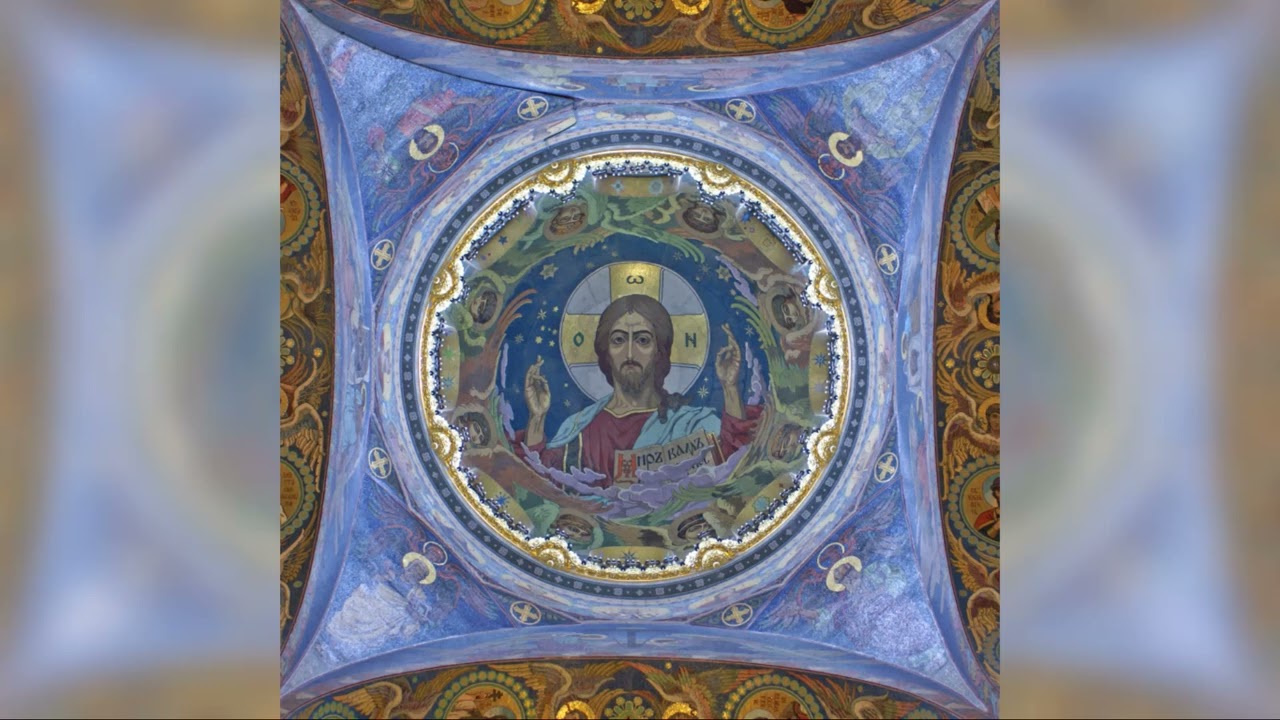
Picture: Photograph of the Christ Pantocrator inside the dome of Church of the Saviour on the Blood (Храм Спаса на Крови), St. Petersburg.
Sources: https://tinyurl.com/294loggd and https://tinyurl.com/2933q2tf
To check the score: https://tinyurl.com/25ymfmmg
Повторяем попытку...
Доступные форматы для скачивания:
Скачать видео
-
Информация по загрузке:


![The Shadow of Calvary: Vivaldi Filiae maestae Jerusalem, RV 638 | [MuseLAB]](https://image.4k-video.ru/id-video/0sj824OYRoI)