Productivity Shocks with Investment: Goods Market Equilibrium
Автор: Everything Econ
Загружено: 2020-05-10
Просмотров: 1028
Описание:
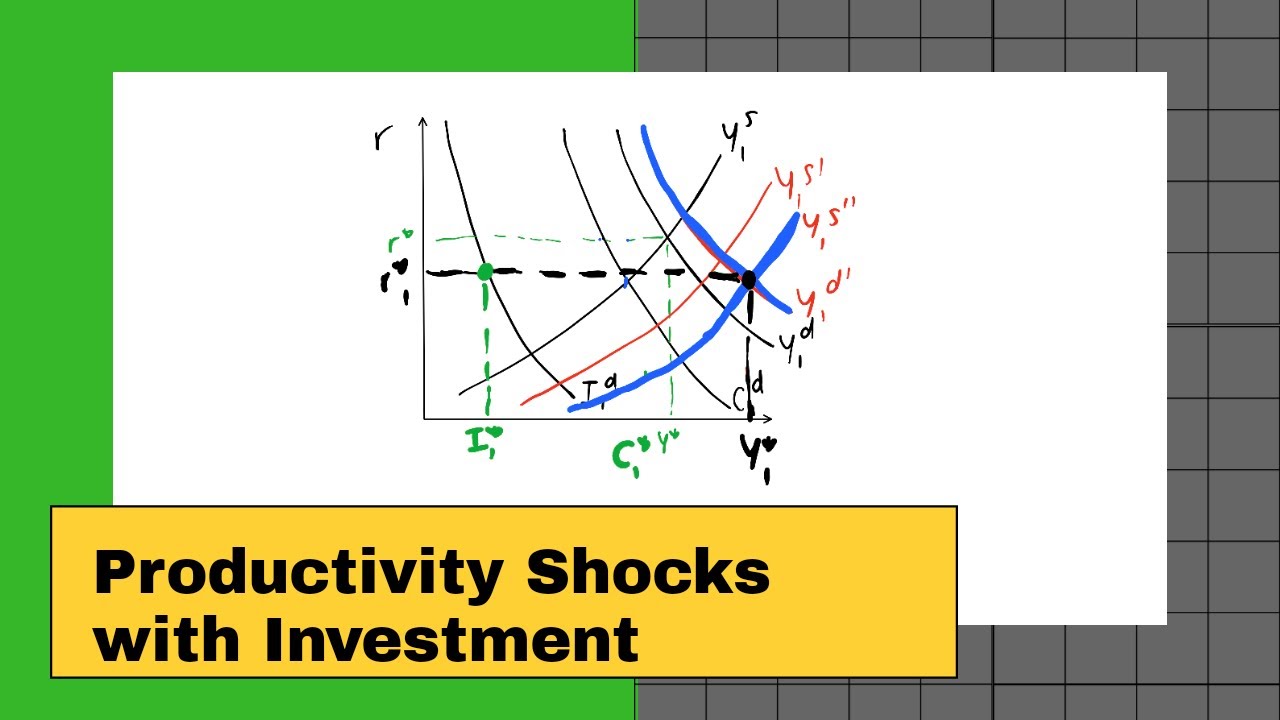
I examine the effects of temporary and permanent productivity shocks on goods market equilibrium in the intertemporal model with investment. The effects of these shocks differ from the shocks when we did not consider investment.
A permanent productivity shock now increases the future productivity of units of capital, so we increase investment in the economy. This, in turn, shifts out the demand curve and so we have an increase in the interest rate and output in equilibrium.
With a temporary productivity shock, we do not have this increase in investment, as future units of capital are not more productive. Thus, the interest rate falls.
In previous videos, I derive the intertemporal budget constraint for a two-period model of intertemporal choice. I shall derive this for more periods. Check out the playlist for intertemporal macroeconomics as a whole, linked at the end of this video.
We discuss the assumptions of the two-period model of intertemporal choice. This involves consumers living for 2 periods. They can consume, save or borrow in these time periods, allowing for consumption that differs from their income in that period. In order to defer income to other periods, they can buy or sell one-period bonds with interest r.
We can then mathematically write the budget constraint for each of these periods. With a bit of substitution and rearranging, this gives us the intertemporal budget constraint. This says that the present value of consumption is equal to the present value of income. The consumer can thus not spend more than she earns, but will spend all of her income since more consumption is always assumed to increase her utility.
In future videos we shall add the Government to this model, with government spending G.
Subscribe for more videos looking at games of chance, tutorials, and everything to do with the industry. Put suggestions for video ideas in the comments section below and any feedback offered would be greatly appreciated.
My videos are intended for educational and entertainment purposes. I try to credit the relevant parties for any work that I refer to in my videos (for example, citing relevant academic papers). If you believe a video does not observe good academic practice, please do not hesitate to contact me by email at [email protected]
Learn economics, one question at a time.
Bitesize modules on economic history, theory, and the world.
https://ceteris.app/?s=yt
Повторяем попытку...
Доступные форматы для скачивания:
Скачать видео
-
Информация по загрузке: