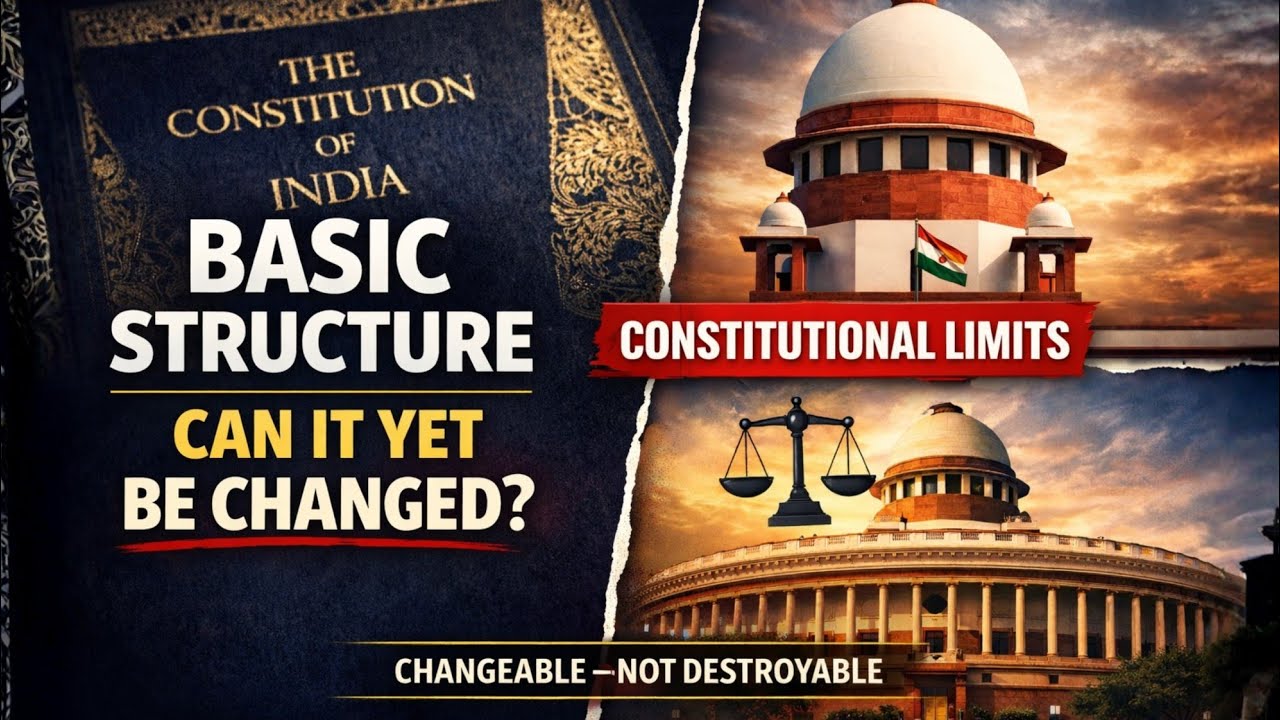
Basic Structure Doctrine: Can It Yet Be Changed? | Constitutional Limits Explained - Lec. 154
Автор: Ashishians Law Classes
Загружено: 2025-12-25
Просмотров: 80
Описание:
The Basic Structure Doctrine ⚖️ places substantive limits on Parliament’s amending power under Article 368, ensuring that the core constitutional values remain intact. One of the most significant components of this doctrine is judicial review 🔍, which acts as a safeguard against constitutional excesses.
In this video, we trace the judicial evolution of the Basic Structure Doctrine, beginning from Waman Rao v. Union of India (1981) and culminating in L. Chandra Kumar v. Union of India (1997), with a special focus on the status of judicial review and tribunalisation in Indian constitutional law 📚.
📌Waman Rao v. Union of India (1981)
The Supreme Court reaffirmed that Parliament cannot amend the Constitution in a manner that destroys its basic features, thereby reiterating the doctrine laid down in Kesavananda Bharati. This judgment reinforced the principle that the Constitution is changeable, but not destroyable.
📌In Raghunath Rao v UOI (1993),
The Supreme Court has reiterated the proposition that the basic features of the Constitution cannot be amended by following the procedure laid down in Article 368. The Court has observed that the Constitution is the supreme law of the land and all organs of government-executive, legislative and judiciary derive their powers and authority from the Constitution..
📌 S. P. Sampath Kumar v. Union of India (1986), The Supreme Court held that judicial review forms part of the basic structure ⚖️, but its exercise by the High Courts may be transferred to an alternative institutional mechanism such as Administrative Tribunals, provided the substitute forum is equally effective and efficacious. While the jurisdiction of the Supreme Court under Article 32 cannot be excluded ❌, the conditional exclusion of High Court jurisdiction was held to be constitutionally permissible.
📌P. Sambamurthy v. State of Andhra Pradesh (1987)
This requirement of effectiveness was reaffirmed in this case , where the Court struck down executive interference with tribunal decisions. It held that such interference violates the rule of law, judicial independence, and separation of powers 🏛️—all of which form part of the basic structure. A tribunal can replace the High Court only if it provides equally effective judicial review.
📌 L. Chandra Kumar v. Union of India
The constitutional position was conclusively settled in this Case. The Supreme Court held that judicial review under Articles 226 & 227 (High Courts) and Article 32 (Supreme Court) is an integral part of the Basic Structure 🔒 and cannot be excluded even by a constitutional amendment. Accordingly, provisions excluding High Court and Supreme Court jurisdiction under Articles 323A and 323B were declared unconstitutional. Tribunals may act as courts of first instance, but their decisions remain subject to High Court scrutiny.
📌 The Court has also reiterated, including in Subhesh Sharma v. Union of India (1991), that judicial review is a core feature of Indian constitutional policy and an essential element of the basic structure ⚖️.
📌 The Constitution (Forty-fifth Amendment) Bill,1978 proposed to introduce a referendum requirement for amending certain core features of the Constitution, the Bill was never enacted.
📃 This video explains how the Constitution remains flexible yet supreme, and how judicial review continues to operate as the final constitutional check on Parliament’s amending power.
👨🎓 Who Should Watch This Lecture?
🔸Judiciary aspirants
🔸LLB / LLM students
🔸UPSC & State PSC aspirants
🔸UGC NET / Political Science students
🔸Anyone studying Indian Constitutional Law & Polity
📖 Exam Relevance
UPSC | State PSC | Judiciary | LLB | Political Science | Constitutional Law
👍 If you find this lecture useful
✔ Like the video
✔ Share with fellow aspirants
✔ Subscribe for more Indian Polity & Constitutional Law content
🔗 Fundamental Rights: • Constitution (Fundamentals)
📘 #BasicStructureDoctrine #JudicialReview ⚖️ #IndianConstitution #Article368 #Tribunals #ConstitutionalLaw #LawStudents #UPSCPolity
Повторяем попытку...
Доступные форматы для скачивания:
Скачать видео
-
Информация по загрузке: