3. Vitamin A 👁️Functions, Deficiency & Toxicity, Fat-Soluble Vitamins | MBBS Biochemistry USMLE
Автор: Medsimplified AI
Загружено: 2025-09-12
Просмотров: 343
Описание:
𝐒𝐮𝐛𝐬𝐜𝐫𝐢𝐛𝐞 𝗙𝐨𝐫 𝗠𝐨𝐫𝐞 𝗜𝐧𝐟𝐨𝐫𝐦𝐚𝐭𝐢𝐨𝐧 𝐨𝐧 𝗛𝐞𝐚𝐥𝐭𝐡 👩⚕ 𝐚𝐧𝐝 𝗠𝐞𝐝𝐢𝐜𝐢𝐧𝐞💉🩺💊
📌𝗜𝗻𝘀𝘁𝗮𝗴𝗿𝗮𝗺 : / clinical.learning
👁️ Vitamin A | Chemistry, Functions, Deficiency & Toxicity | Fat-Soluble Vitamins | MBBS Biochemistry | USMLE Step 1
📜 Detailed YouTube Description:
👋 Hello future doctors and biochem learners! Vitamin A is the vision vitamin, but its role goes far beyond eyesight — it is essential for epithelial integrity, reproduction, immunity, and growth. Both its deficiency and toxicity have serious clinical consequences, making it a must-know vitamin for MBBS, NEET PG, FMGE, and USMLE Step 1.
This lecture explains the chemistry, absorption, transport, functions, deficiency, toxicity, and clinical aspects of Vitamin A in a simplified, exam-oriented way. 🧬📚
🌟 Chemistry & Sources
Forms (Retinoids):
• Retinol (alcohol form, storage/transport).
• Retinal (aldehyde form, vision).
• Retinoic acid (acid form, gene regulation).
Provitamin A: β-carotene (plant source).
Sources:
• Animal: liver, fish oils, egg yolk, milk.
• Plant: green leafy vegetables, yellow/orange fruits (carrots, mango).
🌟 Absorption, Transport & Storage
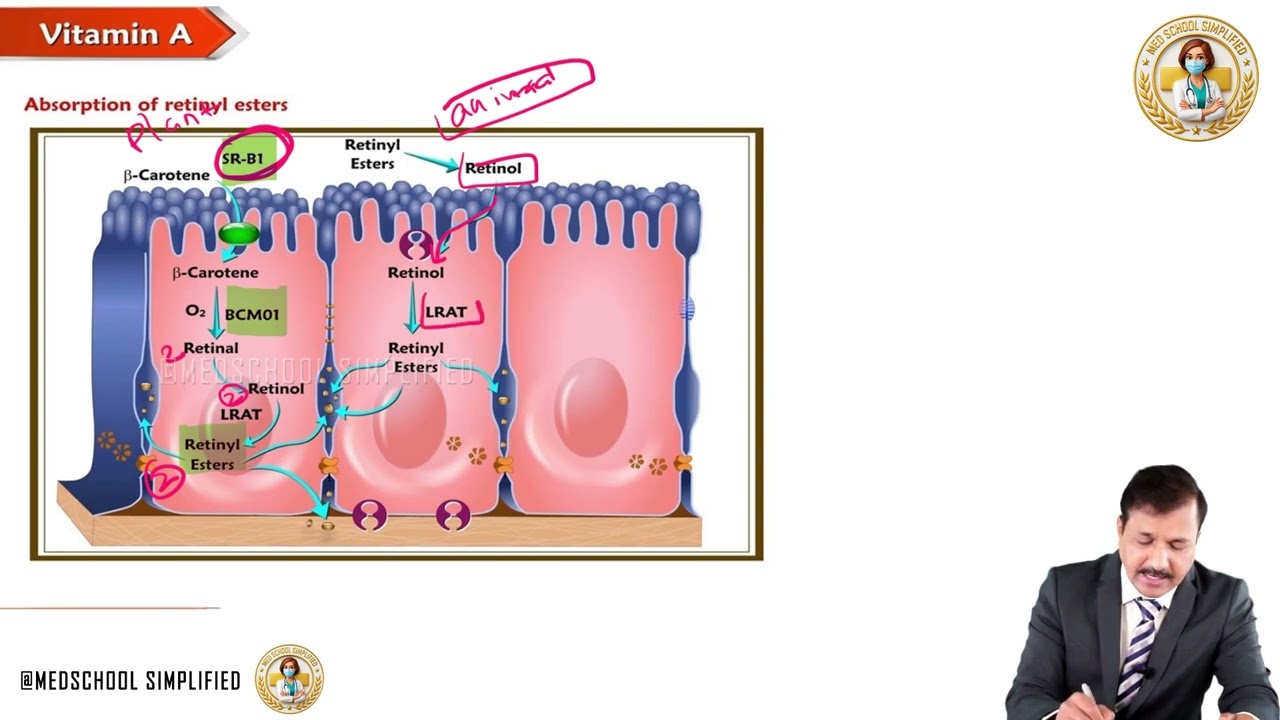
Absorbed in small intestine with dietary fat (needs bile salts).
Transported in blood bound to retinol-binding protein (RBP).
Stored mainly in liver (stellate/ITO cells).
🌟 Functions of Vitamin A
1️⃣ Vision (Retinal):
Component of rhodopsin in rods → night vision.
Visual cycle: 11-cis retinal ↔ all-trans retinal.
2️⃣ Growth & Epithelial Integrity (Retinoic Acid):
Maintains mucous-secreting epithelium.
Promotes growth and bone remodeling.
3️⃣ Reproduction:
Spermatogenesis in males, placental development in females.
4️⃣ Immunity:
Enhances resistance to infections.
5️⃣ Antioxidant (β-carotene):
Protects against oxidative stress.
🌟 Vitamin A Deficiency
Early: Night blindness (nyctalopia).
Ocular changes (Xerophthalmia spectrum):
• Conjunctival xerosis.
• Bitot’s spots.
• Corneal xerosis → keratomalacia → blindness.
Other: Follicular hyperkeratosis, impaired immunity, growth retardation.
High-yield: Common in malnutrition, fat malabsorption, measles infection.
🌟 Vitamin A Toxicity (Hypervitaminosis A)
Acute: Headache, nausea, vomiting, blurred vision.
Chronic: Alopecia, dry skin, hepatosplenomegaly, bone pain, pseudotumor cerebri.
Teratogenic: Causes congenital malformations (avoid excess intake in pregnancy).
🩺 Clinical Uses
Vitamin A supplementation in children to prevent blindness.
Used in acne & psoriasis (retinoic acid derivatives like isotretinoin).
Measles management (WHO recommends Vitamin A therapy).
🎯 Exam Integration
Retinal = vision. Retinoic acid = growth & gene expression.
Deficiency = Night blindness → Xerophthalmia → Keratomalacia.
Toxicity = Pseudotumor cerebri + teratogenic.
RBP = transport protein.
👉 Classic exam vignette: “Child with night blindness and Bitot’s spots = Vitamin A deficiency.”
👉 Don’t forget to Subscribe and hit the 🔔 bell for more high-yield vitamin biochemistry lectures!
👍 If this lecture helps you, please like and share with your classmates. Your support motivates us to keep producing simplified, exam-focused content. 🙌
❓Should we cover Vitamin D (calcitriol, rickets, osteomalacia, toxicity) next as part of the Fat-Soluble Vitamin series? Drop your request in the comments below! 😊
#VitaminA #FatSolubleVitamins #MedicalBiochemistry #USMLEStep1 #MBBSLectures #FMGE #NEETPG #NightBlindness #Xerophthalmia #Keratomalacia #BitotsSpots #Retinol #RetinoicAcid #HypervitaminosisA #BiochemistryLecture #MedicalStudents
Повторяем попытку...
Доступные форматы для скачивания:
Скачать видео
-
Информация по загрузке:


![Почему взрываются батарейки и аккумуляторы? [Veritasium]](https://imager.clipsaver.ru/a3-3R9zwyGY/max.jpg)