Explained: Yes Bank AT-1 Bond Issue!
Автор: Keep it Simple
Загружено: 2023-01-23
Просмотров: 101
Описание:
This video is in Hindi and covers the following topics:
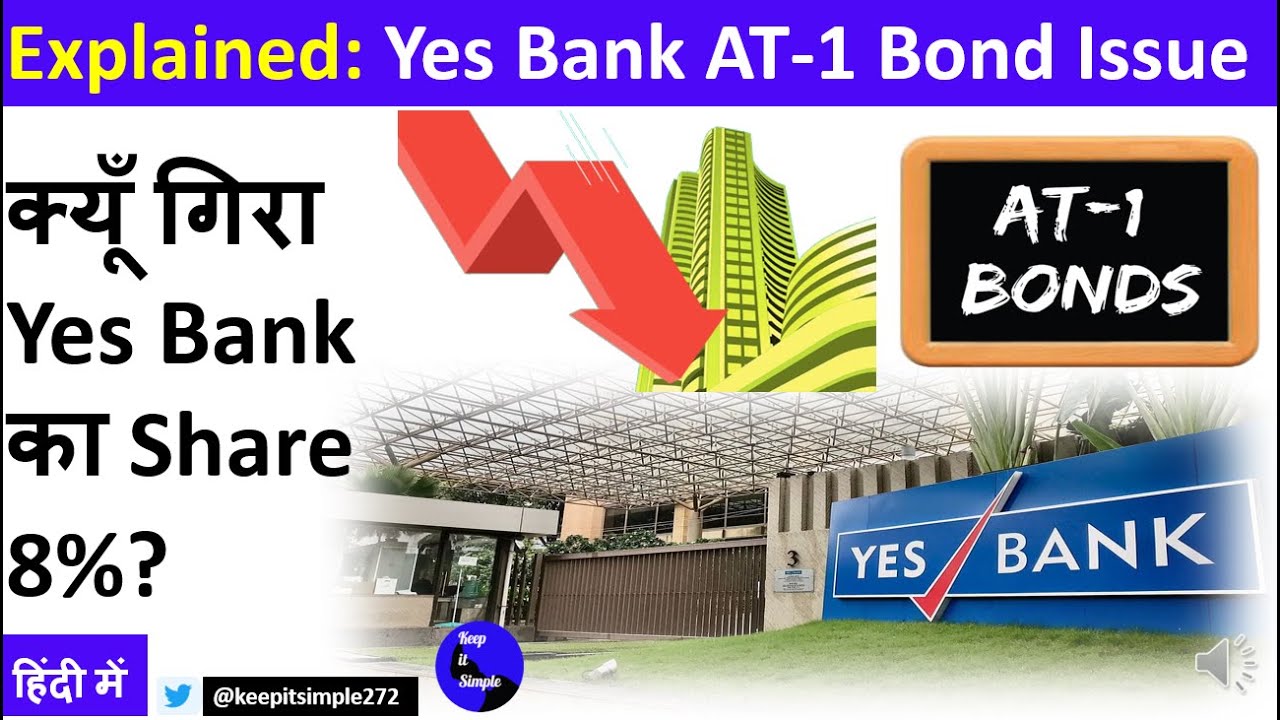
Explained: Yes Bank AT-1 Bond Issue!
क्यूँ गिरा Yes Bank का Share 8%?
Basel norms are the international banking regulations issued by the Basel Committee on Banking Supervision.
The Basel III norms stipulated a capital to risk weighted assets of 8%. However, as per RBI norms, Indian scheduled commercial banks are required to maintain a CAR of 9% while Indian public sector banks are emphasized to maintain a CAR of 12%.
In addition, banks have to maintain a capital conservation buffer of 2.5%
AT1 bonds are a type of perpetual debt instrument with no maturity date.
The issuer possesses the call option that permits them to redeem these bonds after a certain period.
While it offers higher returns to investors compared with other debt products
AT1 bonds are considered high risk because, in case of an institutional failure, the banks are allowed to stop paying interest and, if needed, write off these bonds.
These bonds are also listed and traded on the exchanges. So, if an AT-1 bondholder needs money, he can sell it in the secondary market.
AT-1 bonds are regulated by RBI. If the RBI feels that a bank needs a rescue, it can simply ask the bank to write off its outstanding AT-1 bonds without consulting its investors.
According to the Basel norms, if minimum Tier-1 capital falls below 6%, it allows for a write-off of these bonds.
Yes Bank had collapsed following alleged fraud, financial irregularities and resultant non-performing assets (NPAs)
Soon after RBI realized that Yes Bank may be on the verge of collapsing, it imposed a moratorium on March 5 and a final scheme on reconstruction of the bank was issued on March 13.
Next day, the administrator informed the stock exchanges that AT-1 bonds (8,414 Crore) were extinguished – implying that bondholders will not receive a penny.
The bonds were written off as part of this restructuring plan. Equity holders did not face a similar write-down, but 75% of their shares were subject to lock-in for three years.
The Bombay High Court on January 20 quashed Yes Bank’s March 2020 decision to write off Rs 84,15 crore of additional tier 1 (AT1) bonds but gave the lender six weeks to appeal the decision.
Writing off bonds came as a shock to the AT1 bond holders as write-off punched a big hole in the pockets of several retail investors. These were the life savings of many individuals, particularly retirees.
Yes Bank executives misrepresented the risks the bonds carried and sold them as ‘Super FDs’ to fixed-deposit holders on the promise of higher returns and safety.
Yes Bank executives offered 9-9.5 percent return on these bonds and made them transfer substantially high amounts (in some cases Rs 1 crore to Rs 1.5 crore) to these instruments.
Retail investors allege that this was done without explaining the high risk associated with these bonds, especially the provision that says these bonds would be extinguished and capital lost if the bank failed.
A Sebi probe found that the
Bank facilitated the selling of AT1 bonds from institutional investors to individual investors.
individual investors were not informed about all the risks involved in the subscription of these bonds.
The Sebi investigation also found that Yes Bank represented these bonds as a ‘Super FD’ and ‘as safe as FD’ to the investors.
push from the managing director of Yes Bank to down-sell the AT1 bonds led its private wealth management team to recklessly sell the bonds to individual investors
In September last year, market regulator Securities and Exchange Board of India (Sebi) slapped a Rs 2 crore fine on Yes Bank founder Rana Kapoor
Court said while Yes Bank draft reconstruction scheme contained the clause for AT1 bonds write down, the final scheme sanctioned by the government did not.
After the Bank was reconstituted, the administrator could not have taken such a policy decision of writing off the At-1 Bonds
The final scheme did not authorise the Yes Bank administrator to write off the AT-1 bonds and in doing so, he exceeded his authority the court said.
On January 21, Yes Bank said it will challenge the order in the Supreme Court, which means investors still have a long legal battle ahead.
However, AT-1 bondholders may receive shares of the bank in case the Supreme Court upholds the Bombay High Court order
Повторяем попытку...
Доступные форматы для скачивания:
Скачать видео
-
Информация по загрузке: