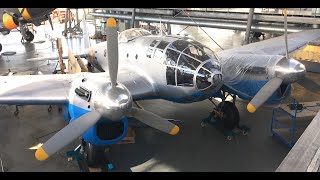
The Soviet Bear Tupolev TU-95 and Its Skeletons in the Closet
Автор: ADC International
Загружено: 2024-01-07
Просмотров: 71735
Описание:
One of the Cold war symbols, the Soviet Bear Tupolev TU-95 might have some Skeletons in the Closet. Tupolev TU-95 is still in service same as its B-52 rival. What really makes it stand out that it is a turboprop airplane, the fastest turboprop ever.
Most of the USSR airplanes were copying Western aircraft. At first glance, the TU-95 appearance looks genuine, was it Soviet from the very scratch? They were not copying anything, or were they?
Searching for the answer I came across the statement that the B-29 bomber was used as its prototype, but how is that possible, they are not even alike.
By the end of the WWII, the Red Army air force used PE-8 as a heavy bomber, however its parameters were compatible to the B-17, but not the B-29, which was a main American strategic bomber at that time. The Soviet government sent numerous requests for the transfer of the B-29s under Lend Lease. However, the Americans left them without any response.
In 1944, when the B-29 pilots were instructed to land on the territory of the USSR in case of an emergency.
Thus, three of them were interned by the USSR, as their return to the United States allegedly violated a non-aggression pact signed with Japan in May 1941. The US demanded to bring airplanes back, but got a refusal. In war time, no one wanted escalation between the Allies. What could Stalin do with three aircraft?
Western analysts realized how wrong they were only 3 August 1947. During the Aviation Day Parade, they saw the B-29 in the sky. It was the Soviet B-29. Tupolev with his design bureau managed to create its copy of the B-29 which was named the TU-4. From 1947-1952 about 1200 aircraft were constructed.
Soviet plane had some modifications, mostly dictated by the use of a metric system, but the copy was very close to original. Tupolev's work was unprecedented, he totally recreated the Soviet Heavy Bomber Design School and took a leading position in it.
In 1950 Tupolev heard from Stalin that the airplanes like the B-29 had become obsolete. He had to propose a new concept that was even more advanced.
Otherwise, he could lose everything in one moment same as in 1937. From 1937 to 1941 he was imprisoned, and had to work in a special NKVD design bureau. He couldn’t afford such a risk. His recently re-established enterprise had been working on two projects of long-range bombers since 1949.
Project numbered “85” had enough range, but its piston engine made it too slow. On the contrary project “88”, equipped with jet engines, consumed too much fuel to provide such a long range.
The TU-85 was to become the world’s last heavy piston bomber, but after the meeting with Stalin Tupolev had to close the project. He had a body with no engine.
The Kuznetsov engine design bureau had a group of specialists able to assist. The group was headed by Alfred Scheibe and Ferdinand Brandner, who worked for the Junkers company before. In 1946 top secret Soviet Osoaviakhim operation was held. More than 2,500 former Nazi German scientists, engineers and technicians were brought into the Soviet Union.
To achieve the necessary capacity a new 12000 HP 2TV-2F engine was developed. The TV-2 engine which was a modernized copy of German "JUMO-022", was taken as a basis. 2TV-2F was to play the role of a spare engine while a single unit 12000 HP NK-12 was in development.
The TU-95-1 was equipped with 2TV-2F engines, which had not passed their full testing process. The authorities pushed the deadlines very hard and its 17th flight ended with an accident and caused the death of the crew.
Later, the TU-95-2 equipped with four NK-12 engines went on flight tests. Serial version was also provided with these engines. This is how Tupolev received a heart for the Soviet bear! The German heart!
So, what the TU-95 has to do with the B-29? There is much more in common between these two. To see this, some airplane prototypes can be much of a help.
The TU-4 was a copy of the B-29. In 1946 a passenger prototype of the TU-4 named TU-70 and a transport version TU-75 appeared. The aircraft bow was radically changed.
The stretched version of the TU-4 named the TU-80 had features of both the TU-4 and the TU-95. The TU-85 was a predecessor of the TU-16 and the TU-95.
Naturally, in the USSR, no one was allowed to mention that the symbol of the Soviet Union's nuclear might had American and German origins. However, in more than 30 years after the USSR collapse, the TU-4 is still associated with the TU-16 or the TU-85, but never with the TU-95 strategic bomber.
00:00 Introduction
00:50 Subscribe
01:10 B-29 pursuit
02:34 Soviet B-29 or Tupolev TU-4
03:40 TU-4 decline
04:07 Tupolev imprisoned
04:32 TU-85 and TU-16
04:51 Myasishev M3 vs TU-16
05:15 In seach for a new engine
05:45 TOP Secret Soviet Osoaviakhim operation
06:18 New engine development
07:14 First flight tests
07:40 Fatal accident
07:58 TU-95-2 with NK-12 engine
08:30 Fastest turboprop
09:18 TU-95 VS B-29
09:42 Prototypes
10:54 Final thoughts
Повторяем попытку...

Доступные форматы для скачивания:
Скачать видео
-
Информация по загрузке: