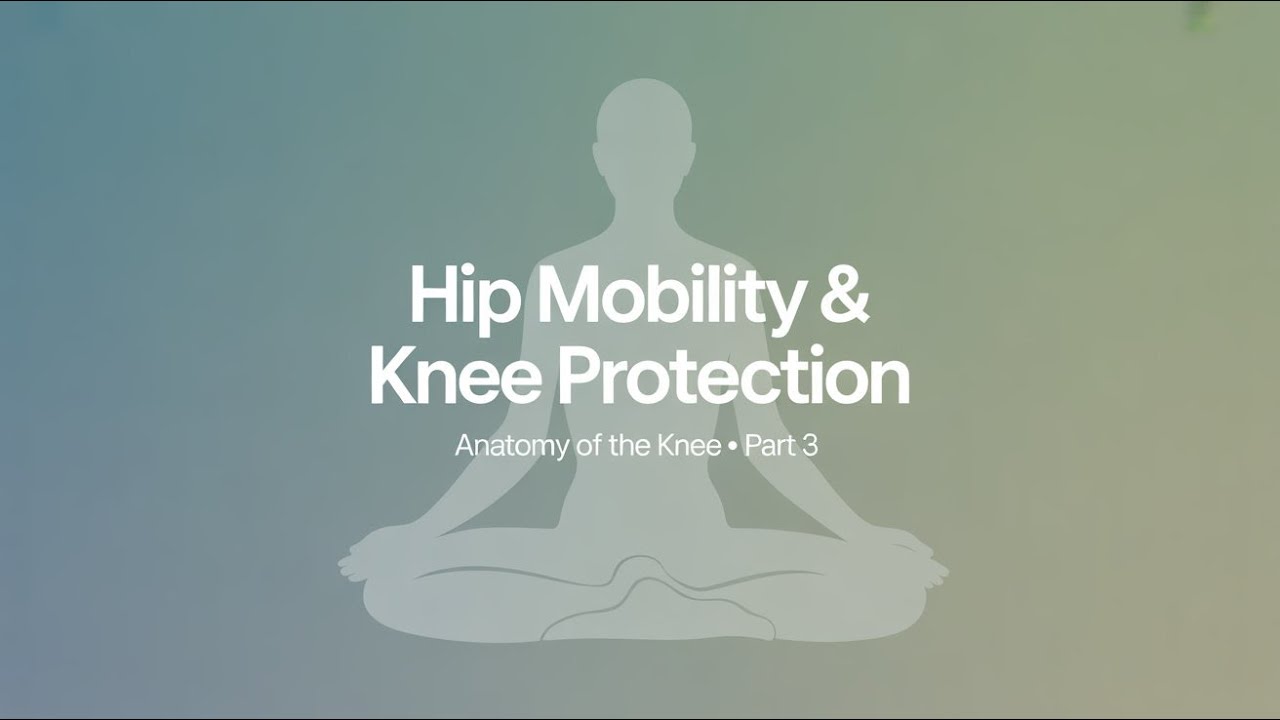
Anatomy of the Knee — Part 3 | Hip Mobility & Knee Protection
Автор: Kathryn Kuppan
Загружено: 2026-01-28
Просмотров: 6
Описание:
In this lesson, we explore how hip openers can become a major source of knee stress, especially when skeletal structure is not respected in yoga practice.
🧠 Anatomy of the Knee — Part 3 | Hip Mobility & Knee Protection
🧘 Hip Openers That May Stress the Knee
Certain poses can place excessive load on the knee when hip or ankle mobility is limited, including:
Pigeon Pose
Hero’s Pose
Lotus Pose
Any bent-knee posture where the hip or ankle lacks range
⚠️ When the hips cannot access the required rotation, the knee often compensates, increasing injury risk.
🦴 Skeletal Variation in Hip Rotation
Not all hips are built the same—and this matters deeply in yoga.
External Rotation (e.g., Pigeon, Lotus):
A pelvis with hip sockets facing more laterally will find these poses more accessible
A pelvis with forward-facing sockets will require conservative variations
💡 Important:
This limitation is bony, not muscular.
It will not change with stretching.
Forcing range here can lead directly to knee injury.
🧘♀️ Treating the Knee Like a Pure Hinge
In poses like Hero’s Pose, knee safety depends on:
Allowing the knee to bend and straighten only in its natural hinge motion
Avoiding torque or rotation through the joint
🎓 A guided experiential activity is provided in the Google Classroom to help students feel this distinction clearly.
🔄 Internal Rotation & Skeletal Structure
Internal Rotation (e.g., Virasana / similar poses):
Pelvises with more forward-facing hip sockets access internal rotation more easily
Pelvises with laterally facing sockets may feel restricted
Again, this is a bony stop, not a flexibility issue.
🚫 Working aggressively into these limits does not increase mobility—it increases injury risk.
💬 Key Teaching & Practice Takeaways
Yoga often celebrates openness and depth, but mobility without respect for structure can harm the knee.
To support safe practice:
Offer modifications for all hip types
Educate students about skeletal variation
Encourage listening to knee sensations:
If the knee whispers → ease back
If the knee yells → stop completely
🧠 Knee sensation is often a precursor to pain—it deserves attention.
🌱 Empowered Yoga Practice
Honor individual anatomy
Normalize modifications
Use inclusive, non-judgmental language
Remember: depth is not the goal—sustainability is
✨ When hips are respected, knees stay healthy—and yoga becomes a truly lifelong practice.
Повторяем попытку...
Доступные форматы для скачивания:
Скачать видео
-
Информация по загрузке: