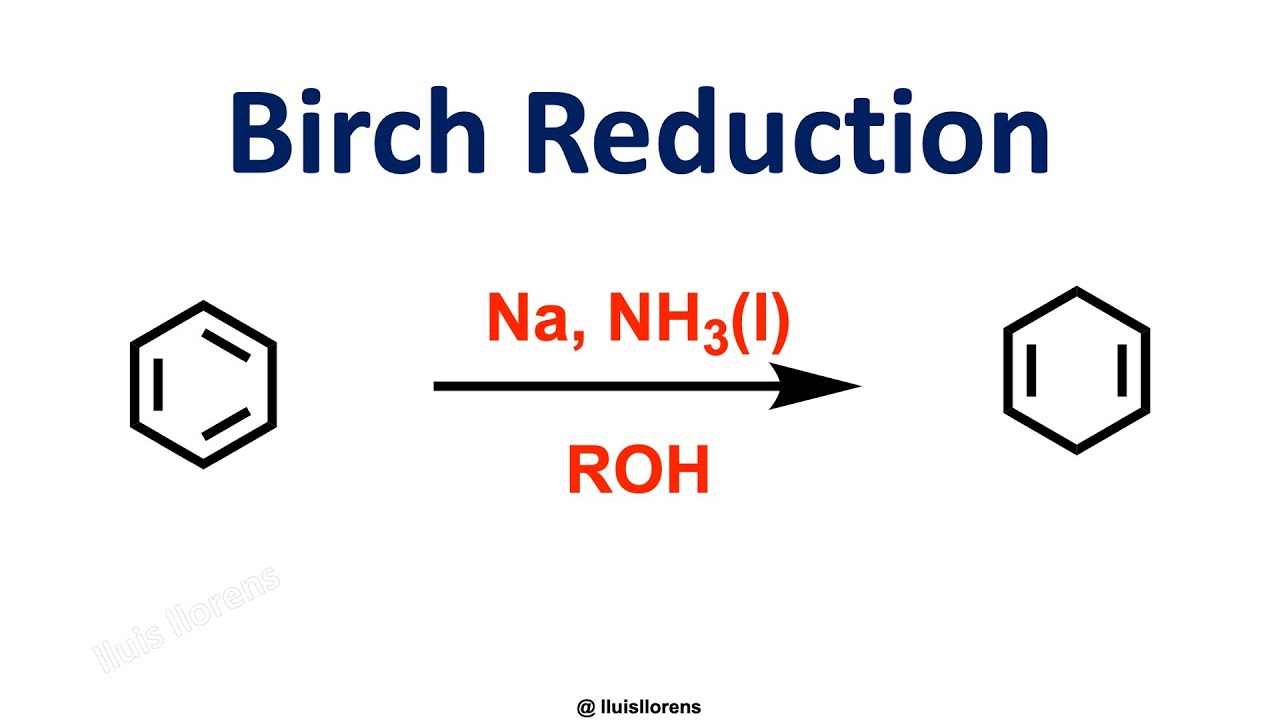
Birch Reduction
Автор: Organic Chemistry with Lluís Llorens Palomo
Загружено: 2021-03-20
Просмотров: 4358
Описание:
The Birch Reaction is the 1,4-reduction of aromatic rings to the corresponding unconjugated cyclohexadienes and heterocycles by alkali metals (Na, Li, K) dissolved in liquid ammonia in the presence of alcohol.
General features:
1. In addition to aryl rings, pyridines, pyrroles, and furans are also reduced.
2. The regioselectivity of the reduction depends on the nature of the substituent.
3. Non-conjugated double bonds are not reduced in these conditions.
4. The rate of the reduction is lower in the presence of electron-donating substituents.
Reaction mechanism:
1. The solution of the metal in ammonia provides electrons. The electrons are taken up by the aromatic ring to form the corresponding radical anion.
2. Protonation by the alcohol to form a cyclohexadienyl radical.
3. Formation of a cyclohexadienyl carbanion by electron transfer.
4. Formation of the unconjugated cyclohexadiene product.
References:
https://nrochemistry.com/birch-reduct...
Seminal publication:
Birch, A. J., J. Chem. Soc. 1944, 430-436. https://doi.org/10.1039/JR9440000430
Related videos:
Barton-McCombie Reaction: • Barton-McCombie Reaction
Clemmensen Reduction: • Clemmensen Reduction
Wolff-Kishner Reduction: • Wolff-Kishner Reduction
Повторяем попытку...
Доступные форматы для скачивания:
Скачать видео
-
Информация по загрузке:


