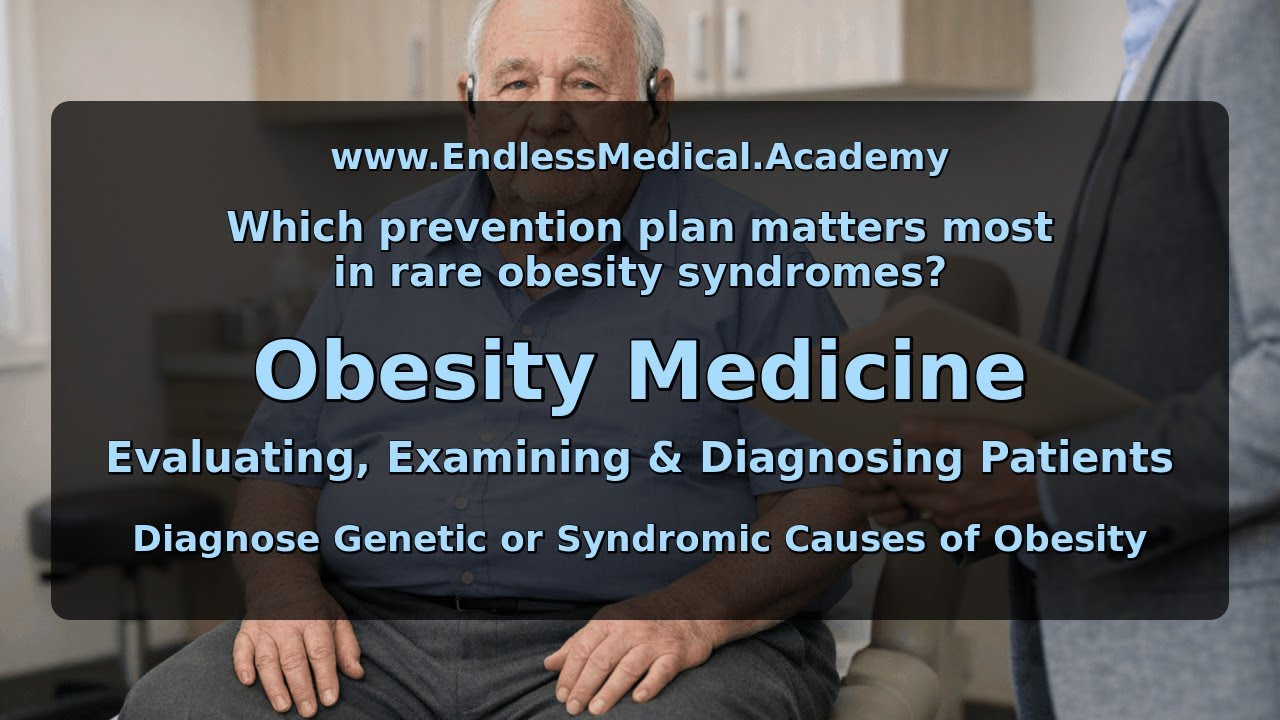
Diagnose Genetic or Syndromic Causes of Obesity, Evaluating, Examining & Diagnosing Patients, Obesit
Автор: EndlessMedical.Academy
Загружено: 2026-02-22
Просмотров: 4
Описание:
An 81-year-old man with lifelong severe obesity, childhood-onset hyperphagia, progressive vision and hearing loss, urinary issues, exertional dyspnea, and a history of consanguinity presents to clinic. What clinical features and family history clues should guide your diagnostic reasoning in complex multisystem obesity? How do these findings shape prevention priorities for minimizing future health risks over the next several years?
VIDEO INFO
Category: Diagnose Genetic or Syndromic Causes of Obesity, Evaluating, Examining & Diagnosing Patients, Obesity Medicine
Difficulty: Expert - Expert level - For those seeking deep understanding
Question Type: Prevention - Preventive measures and screening
Case Type: Typical Presentation
Explore more ways to learn on this and other topics by going to https://endlessmedical.academy/auth?h...
QUESTION
An 81-year-old man is referred to a multidisciplinary obesity genetics conference after decades of severe obesity and progressive multisystem disease, with the referring clinician asking whether a unifying syndromic diagnosis should change prevention priorities for the next several years. He reports that obesity began in early childhood with persistent hyperphagia....
OPTIONS
A. Implement a kidney-risk prevention plan with nephrology co-management, including urine albumin-to-creatinine ratio and serum creatinine/eGFR every 3-6 months, blood pressure optimization with an ACE inhibitor or ARB if tolerated, structured nephrotoxin avoidance (including NSAIDs), and contrast-e...
B. Implement a cardiomyopathy prevention plan with cardiology co-management, including transthoracic echocardiography every 6-12 months, early initiation of guideline-directed medical therapy for LV remodeling (beta blocker plus ACE inhibitor), and ambulatory rhythm monitoring if symptoms recur, coo...
C. Implement a vision-loss prevention plan with retina-specialist co-management, including dilated retinal examination with OCT and fundus autofluorescence every 6-12 months, cataract-surgery referral when functionally limiting, and early low-vision rehabilitation enrollment, coordinated through an ...
D. Implement an obstructive sleep apnea prevention plan with sleep-medicine co-management, including expedited CPAP re-titration, objective adherence downloads monthly for 3 months, repeat nocturnal oximetry within 8-12 weeks, and escalation to bilevel ventilation if persistent hypoxemia is document...
CORRECT ANSWER
A. Implement a kidney-risk prevention plan with nephrology co-management, including urine albumin-to-creatinine ratio and serum creatinine/eGFR every 3-6 months, blood pressure optimization with an ACE inhibitor or ARB if tolerated, structured nephrotoxin avoidance (including NSAIDs), and contrast-exposure planning across all care settings.
EXPLANATION
"Implement a kidney-risk prevention plan with nephrology co-management, including urine albumin-to-creatinine ratio and serum creatinine/eGFR every 3-6 months, blood pressure optimization with an ACE inhibitor or ARB if tolerated, structured nephrotoxin avoidance (including NSAIDs), and contrast-exposure planning across all care settings." This is the best prevention-focused intervention over the next 1-3 years because the confirmed syndromic diagnosis (biallelic BBS10 pathogenic variants consistent with Bardet-Biedl syndrome) meaningfully changes which future complications are most actionable and most morbid in a short time horizon....
Further reading:
Links to sources are provided for optional further reading only. The questions and explanations are independently authored and do not reproduce or adapt any specific third-party text or content.
---------------------------------------------------
Our cases and questions come from the https://EndlessMedical.Academy quiz engine - multi-model platform. Each question and explanation is forged by consensus between multiple top AI models (i.e. Open AI GPT, Claude, Grok, etc.), with automated web searches for the latest research and verified references. Calculations (e.g. eGFR, dosages) are checked via code execution to eliminate errors, and all references are reviewed by several AIs to minimize hallucinations.
Important note: This material is entirely AI-generated and has not been verified by human experts; despite stringent consensus checks, perfect accuracy cannot be guaranteed. Exercise caution - always corroborate the content with trusted references or qualified professionals, and never apply information from this content to patient care or clinical decisions without independent verification.
Clinicians already rely on AI and online tools - myself included - so treat this content as an additional focused aid, not a replacement for proper medical education. Visit https://endlessmedical.academy for more AI-supported resources and cases.
This material can not be treated as medical advice. May contain errors.
---------------------------------------------------
Повторяем попытку...
Доступные форматы для скачивания:
Скачать видео
-
Информация по загрузке: