A wonderful and surprising portrait of the Danish modernist composer Axel Borup-Jørgensen
Автор: OUR Recordings
Загружено: 2026-01-24
Просмотров: 142
Описание:
The Danish composer Axel Borup-Jørgensen (1924-2012) was one of the 20th century’s great “silent individualists.” Although largely self-taught, he was the first Danish composer who attended the Darmstadt Summer Courses for New Music. Without a doubt, the avant-garde of the sixties exerted a strong influence on Borup-Jørgensen’s sound world, but he never embraced any specific “ism,” following instead his own intuition and his extraordinary sense of organizing sound.
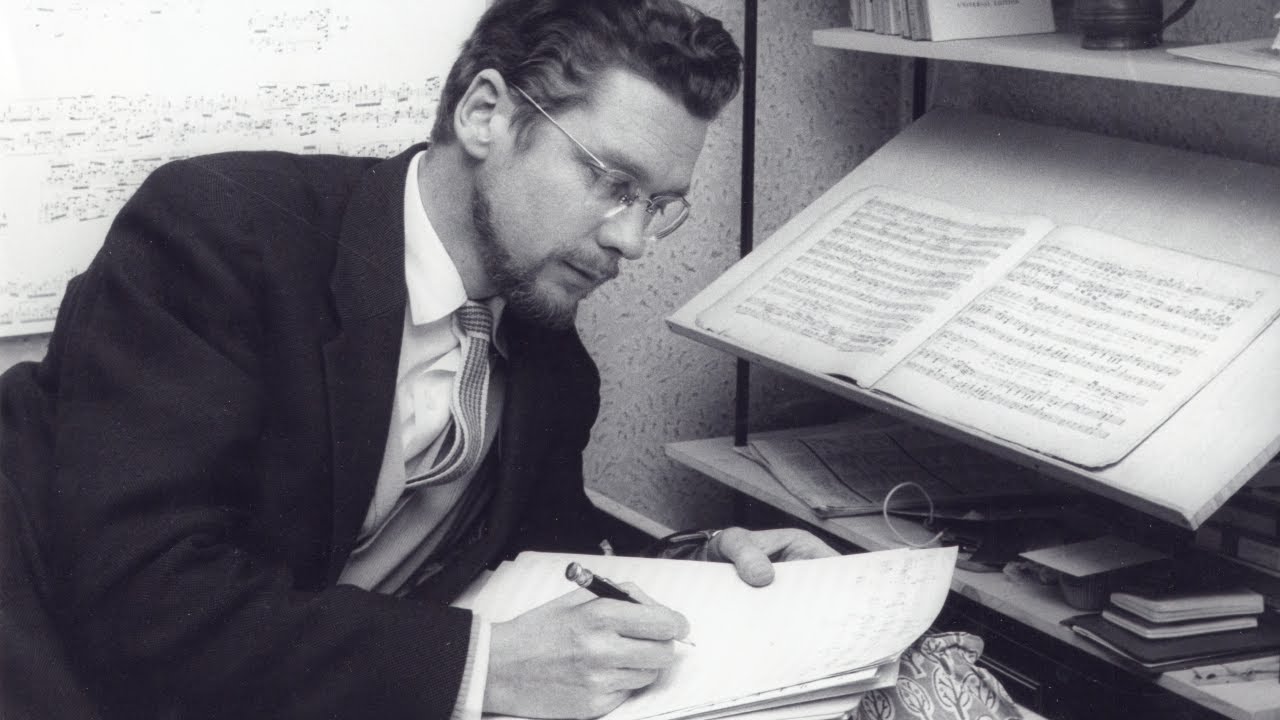
Borup-Jørgensen’s handwritten scores are of almost calligraphic quality and beauty and reveal him to be a meticulous craftsman and magician of tone color, traits on full display on this very special tribute in honor of the composer’s centenary.The vast majority of his work is devoted to chamber music. Here he enjoyed the freedom and inspiration to work closely with the artists and explore new sonic possibilities of their instruments. This album is the final entry in a decade long documentation of the life and work of Axel Borup-Jørgensen’s music, a project that has seen multiple critical triumphs, innovative concert installations and even an award-winning video. The animated short film for his masterpiece MARIN won OPUS Klassik AWARD as best DVD/BLUE RAY as well as the Danish Radio P2 Prize for Best ALBUM.
On the film you will hear composers like Per Nørgård, Pelle Gudmundsen Holmgreen, Ib Nørholm, Bent Sørensen, Sunleif Rasmussen and Finn Savery, musicians Michala Petri, Gert Mortensen, Lars Hannibal and his daughter Elisbet Selin, conductor Thomas Søndergård and producer Preben Iwan talk about Axel. You will also hear alot of LIVE MUSIC: ENJOY!
Spared the horrors and destruction of the war on the continent, the musical situation
in post-war Denmark was still very much a work-in-progress with composers
struggling to find their own contemporary voices reconciling “Danishness” with
modernity. The greatest challenge facing Danish composers even at this late date
was neither the powerful influence of continental avant-garde nor the colorful nationalism
of their Scandinavian neighbors but rather the overpowering legacy of their
own great national composer, Carl Nielsen. During this period the prolific composers
Vagn Holmboe (1909-1996) and Niels Viggo Bentzon (1919-2000) emerged as
the leaders whose individual theories of composition would assume distinctive and
influential roles. Among Holmboe’s students were Per Nørgård (1932-), Ib Nørholm
(1931-2019) and Pelle Gudmundsen-Holmgreen (1932-2016), who together with
Axel Borup-Jørgensen would shape contemporary Danish music in the years after
1950, each charting an individual path through modernity.
The cultural milieu at this time embraced the musical aesthetics of the German philosopher
Thomas Adorno, epitomized in the works of composers like Pierre Boulez and
Karlheinz Stockhausen. In response to the atrocities of the war, composers sought intellectual
refuge in varieties of revolutionary programs of artistic and social change to
completely reshape music. For the most part, the legendary Darmstädter Ferienkurse
(“Darmstadt Summer Course”) and its influence were but a brief distraction for most
Danish composers, who after writing a couple of serial works were off on their own
more personal explorations. It was during this period of exploration and experimentation
that Axel Borup-Jørgensen began his own musical journey, creating an intensely
personal music carefully etched upon the surface of silence with inspiration from
modern Swedish poetry and the Swedish landscape.
Born on November 22.1924, in Hjørring, Denmark, Axel Borup-Jørgensen was by
any definition, a unique figure in Danish music. Whereas many Danish composers
dabbled in the continental avant-garde to later depart, Borup-Jørgensen was one
of the few who remained faithful to the modernist ideal throughout his career, never
looking back neither in nostalgia nor irony. Yet, there is an organic lyricism in his music,
a unique “Scandinavian” sensibility, and intuitive quality to his works that sets it
apart from that of more rigorous adherents of the Post-Webern School.
When Axel was 2 1⁄2 years old, his family moved to Sweden, eventually settling in
Mjölby, located about 230 kms south of Stockholm. In 1942 the family acquired the
small island of Björkö in Lake Sommen on the border between Östergötland and
Småland.As a child, Axel displayed an early interest in both music and art and taught
himself to play a number of instruments including accordion, mandolin and piano and
often performed with his school mates. He also had a natural gift as a draughtsman,
a talent he carried into adulthood and in full evidence in his intricate and beautiful,
calligraphic scores. By Joshua Cheek
Повторяем попытку...
Доступные форматы для скачивания:
Скачать видео
-
Информация по загрузке: