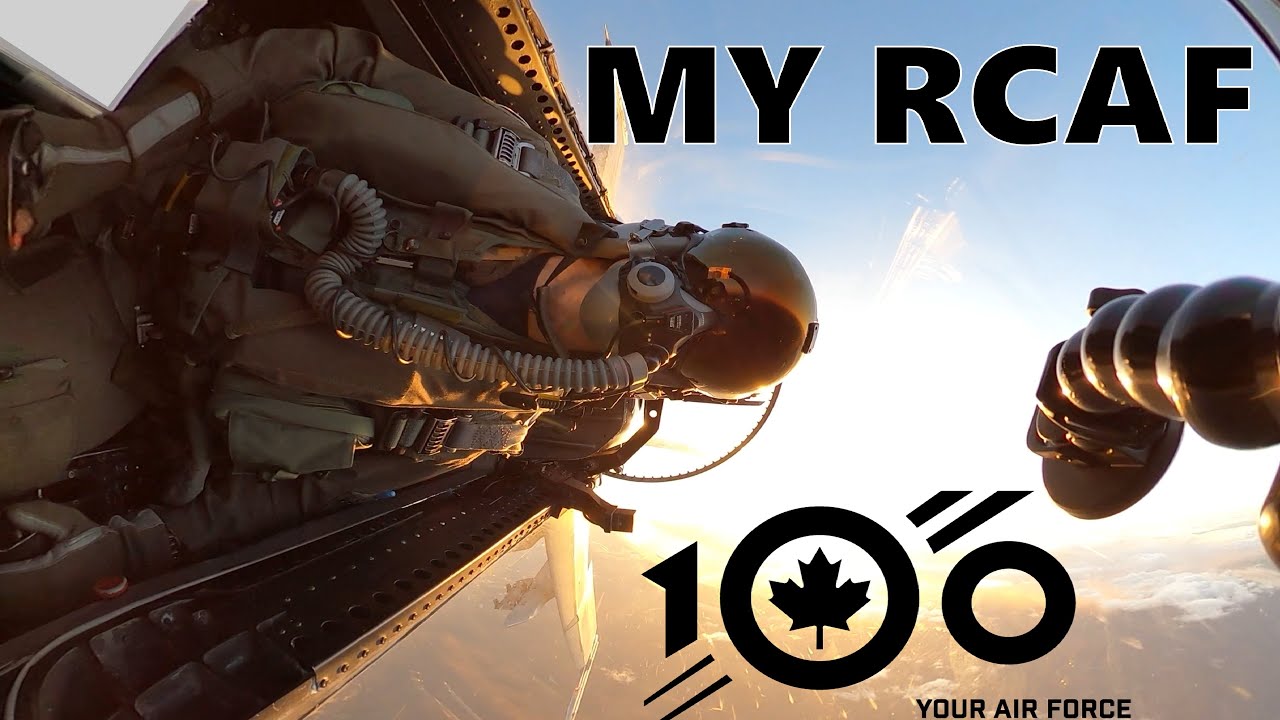
CF-18 Hornet Low Altitude Fly by
Автор: KBDProductionsTV
Загружено: 2012-06-11
Просмотров: 3353
Описание:
This is what we saw at the CFB Borden Air Show June 10th 2012.
McDonnell Douglas F/A-18 Hornet
From Wikipedia, the free encyclopedia
http://en.wikipedia.org/wiki/McDonnel...
A U.S. Marine Corps F/A-18C
Role Multirole fighter
National origin United States
Manufacturer McDonnell Douglas / Boeing
Northrop
First flight 18 November 1978
Introduction 7 January 1983
Status In service
Primary users United States Navy
United States Marine Corps
Royal Australian Air Force
Spanish Air Force
Number built F/A-18A/B/C/D: 1,480[1]
Unit cost US$29--57 million (2006)[2]
Developed from Northrop YF-17
Variants McDonnell Douglas CF-18 Hornet
High Alpha Research Vehicle
Developed into Boeing F/A-18E/F Super Hornet
Boeing X-53 Active Aeroelastic Wing
The McDonnell Douglas (now Boeing) F/A-18 Hornet is a twin-engine supersonic, all-weather carrier-capable multirole fighter jet, designed to dogfight and attack ground targets (F/A for Fighter/Attack). Designed by McDonnell Douglas and Northrop, the F/A-18 was derived from the latter's YF-17 in the 1970s for use by the United States Navy and Marine Corps. The Hornet is also used by the air forces of several other nations. It has been the aerial demonstration aircraft for the U.S. Navy's Flight Demonstration Squadron, the Blue Angels, since 1986.
The F/A-18 has a top speed of Mach 1.8. It can carry a wide variety of bombs and missiles, including air-to-air and air-to-ground, supplemented by the 20 mm M61 Vulcan cannon. It is powered by two General Electric F404 turbofan engines, which give the aircraft a high thrust-to-weight ratio. The F/A-18 has excellent aerodynamic characteristics, primarily attributed to its leading edge extensions (LEX). The fighter's primary missions are fighter escort, fleet air defense, Suppression of Enemy Air Defenses (SEAD), air interdiction, close air support and aerial reconnaissance. Its versatility and reliability have proven it to be a valuable carrier asset, though it has been criticized for its lack of range and payload compared to its earlier contemporaries, such as the Grumman F-14 Tomcat in the fighter and strike fighter role, and the Grumman A-6 Intruder and LTV A-7 Corsair II in the attack role.
The F/A-18 Hornet provided the baseline design for the Boeing F/A-18E/F Super Hornet, a larger, evolutionary redesign of the F/A-18. Compared to the Hornet, the Super Hornet is larger, heavier and has improved range and payload. The F/A-18E/F was originally proposed as an alternative to an all-new aircraft to replace existing dedicated attack aircraft such as the A-6. The larger variant was also directed to replace the aging F-14 Tomcat, thus serving a complementary role with Hornets in the U.S. Navy, and serving a wider range of roles including refueling tanker. The Boeing EA-18G Growler electronic jamming platform was also developed from the F/A-18E/F Super Hornet.
Canada
Canadian CF-18A Hornet off the coast of Hawaii. Note the "false cockpit" painted on the underside of the aircraft, intended to confuse enemy pilots during dogfights.
Main article: McDonnell Douglas CF-18 Hornet
Canada was the first export customer for the Hornet, replacing the CF-104 Starfighter (air reconnaissance & strike), the McDonnell CF-101 Voodoo (air interception) and the CF-116 Freedom Fighter (ground attack). The Canadian Forces Air Command ordered 98 A models (Canadian designation CF-188A/CF-18A) and 40 B models (designation CF-188B/CF-18B).
In 1991, Canada committed 26 CF-18s to the Gulf War, based in Qatar. In June 1999, 18 CF-18s were deployed to Aviano AB, Italy, where they participated in both the air-to-ground and air-to-air roles in the former Yugoslavia.
62 CF-18A and 18 CF-18B aircraft took part in the Incremental Modernization Project which was completed in two phases. The program was launched in 2001 and the last updated aircraft was delivered in March 2010. The aims were to improve air-to-air and air-to-ground combat abilities, upgrade sensors and the defensive suite, and replace the datalinks and communications systems on board the CF-18 from the F/A-18A and F/A-18B standard to the current F/A-18C and D standard.
In July 2010 the Canadian government announced plans to replace the remaining CF-18 fleet with 65 F-35 Lightning IIs, with deliveries scheduled to start in 2016.
Повторяем попытку...

Доступные форматы для скачивания:
Скачать видео
-
Информация по загрузке: