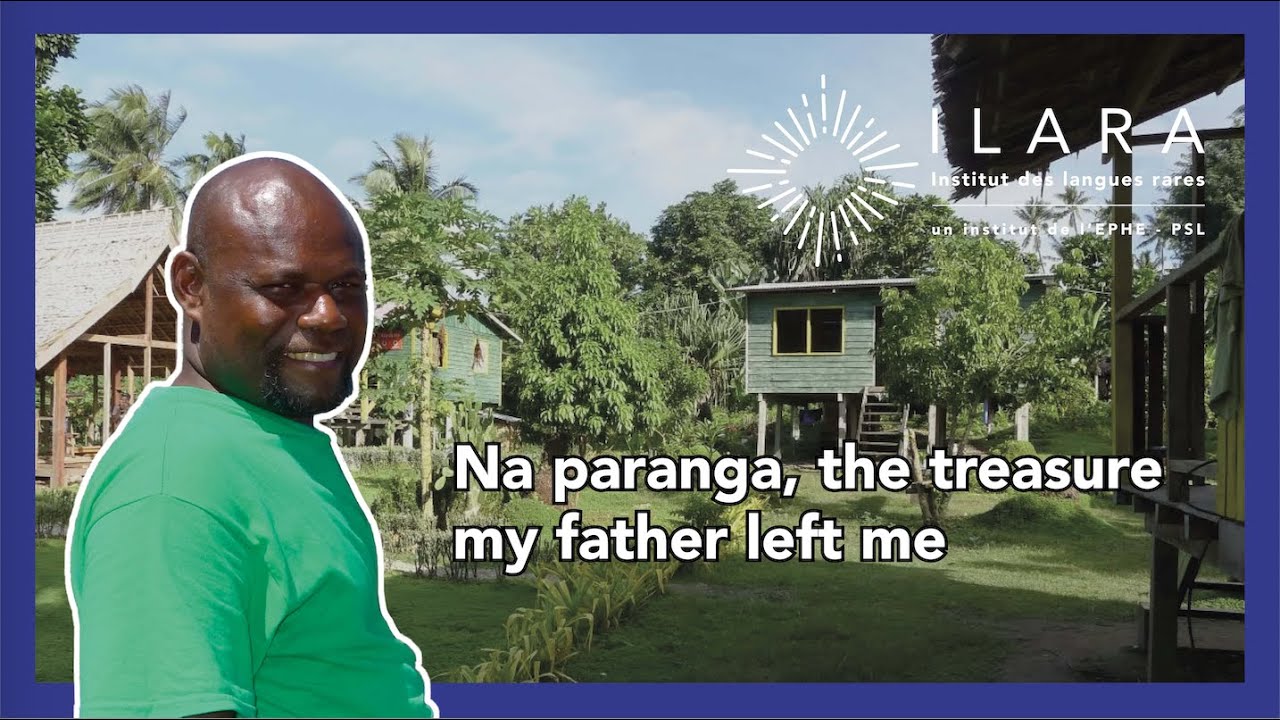
Na paranga, the treasure my father left me | the Luqa language of
Автор: ILARA
Загружено: 2026-01-10
Просмотров: 117
Описание:
The #Speakers series of ILARA Online features women and men who speak rare and precious indigenous languages. Through their testimony, and stories, we can relate to what this means for them, and connect with their intimate experience.
In this video, Alpheaus Zobule talks about his relationship to his native language, #Luqa. Na paranga means 'Language' in Luqa.
Dr. Alpheaus Graham Zobule is a native speaker of Luqa (also spelled Luga, Lungga), a Malayo-Polynesian language spoken by approximately 3,900 people in the southern half of the island of Ranongga, in the Solomons Islands. He comes from Saevuke and Lale villages on Ranongga, and is the founder and executive director of Kulu Language Institute.
He holds a PhD in theology (Union Seminary, VA, USA) and is currently undertaking a second PhD in linguistics at the Australian National University, titled Developing and documenting a system for using the Luqa vernacular as its own grammatical metalanguage, and its use by Luqa speakers to study and analyze their own language in the Solomon Islands.
In collaboration with other Luqa speakers, he developed a Luqa-language vocabulary for linguistic concepts and an eight-volume monolingual pedagogical grammar.
More information
🟣 On Alpheaus Zobule:
https://evolutionofculturaldiversity....
https://kululanguage.com/about/
🟡 On the Kulu Language Institute:
https://kululanguage.com/
🟢 On Alpheaus Zobule's work on Luqa:
▶️ • Studying the vernacular in the vernacular ...
🟠 On Luqa:
https://glottolog.org/resource/languo...
🔵 On the languages of the Solomons Islands:
https://kululanguage.com/solomon-isla...
http://sealang.net/archives/pl/pdf/PL...
🔴 On the Solomons Islands:
https://en.wikipedia.org/wiki/Solomon...
Education in Oceania tends to orient students to distant shores. Schooling is a path away from home places and often away from home languages. But a vernacular language movement has grown over two decades on Ranongga, a mountainous island on the far western edge of Solomon Islands. Named the Kulu Language Institute after the two languages spoken on the island (Kubokota and Luqa), the movement has as its emblem a sprouting nut, a resonant symbol of one of the island's most important foods and trees, and its motto is "All read well." In Ranongga, the English word "read" is translated to "tiro," a word that encompasses many other forms of searching for signs in the environment, including searching for nuts under the forest litter. This metaphor runs through the curriculum materials, encouraging students to look under the surface of words for their deeper meaning. Today, approximately 20 percent of the island's population has studied writing and reading in Kubokota or Luqa, and a growing number of young people have undertaken an intensive series of courses focusing on the grammatical structures of Luqa. Students and teachers at the school speak of how studying their own language has anchored them intellectually. In contrast to the English-language instruction of primary and secondary school, learning in their own language has given them a sense of being firmly connected to the ground, no longer flailing toward an uncertain future. (Adapted from McDougall, D., and Zobule, A. G. 2021. “All Read Well”: Schooling on Solid Ground in a Solomon Islands Language Movement. The Contemporary Pacific 33 (2): 410–439. )
Повторяем попытку...
Доступные форматы для скачивания:
Скачать видео
-
Информация по загрузке: