From Cathode Rays to the Electron Scattered Ideas to a Unified Picture 1890s–1900s
Автор: CBSE & JEE Physics | Dr Kedar Pathak
Загружено: 2026-01-16
Просмотров: 9
Описание:
In this calm, conceptual video we walk through the real story of how the electron was discovered – not just “1897 = J. J. Thomson”, but the broader landscape around it. By the late 19th century, chemists were already using atoms, but atoms were treated as solid, indivisible balls with no internal structure. Electric charge was often thought of as a continuous fluid. Discharge tubes, cathode rays, Faraday’s electrolysis experiments, X‑rays and radioactivity all looked like separate, disconnected phenomena.
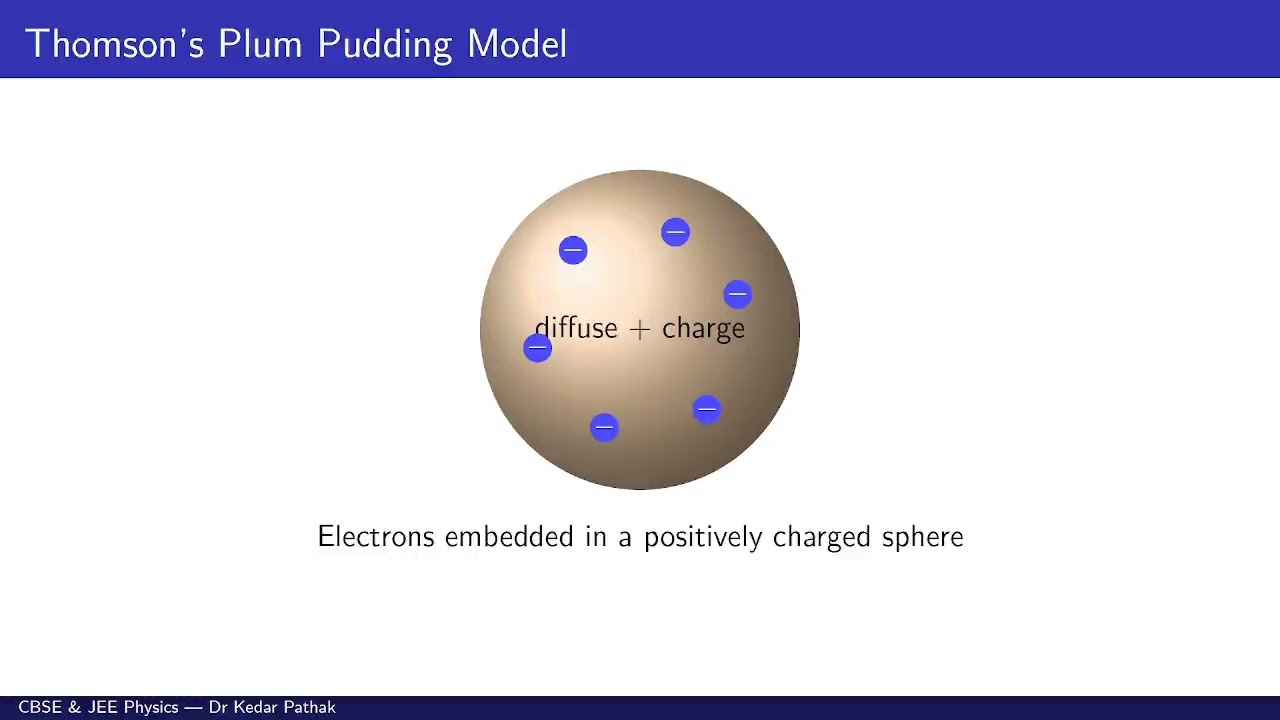
Thomson’s cathode‑ray experiments in 1897 showed that these mysterious rays are actually streams of fast, negatively charged particles with an ( e/m ) about 1800 times larger than that of a hydrogen ion – pointing to a very light, universal particle. At the same time, Stoney’s abstract “unit of charge” (which he had already named the electron) gradually became identified with this real particle, and Millikan’s oil‑drop experiment later measured its charge precisely. One particle – the electron – started to explain metallic conduction, cathode rays, beta radiation and more.
But the discovery of the electron also created new puzzles: Why are atoms stable if electrons are accelerating charges? Why do atoms emit light at discrete spectral lines instead of a continuous spectrum? The need to answer these questions pushed physicists toward quantum ideas – Einstein’s light quanta in the photoelectric effect, Bohr’s model of quantized orbits, and eventually full quantum mechanics. This video is for inquisitive students who want to see the thinking and experiments behind the electron, beyond the standard CBSE/JEE syllabus bullet points.
Повторяем попытку...
Доступные форматы для скачивания:
Скачать видео
-
Информация по загрузке:


