CELL TRANSPORT: PASSIVE AND ACTIVE
Автор: Neural Academy
Загружено: 2023-11-20
Просмотров: 21859
Описание:
Cell transport can be passive, requiring no energy, or it can be active, requiring energy, as well as vesicles or pumps.
Passive transport includes simple diffusion, osmosis, and facilitated diffusion. For all three types of passive transport, transported substances go from high to low concentration. A concentration gradient means that there is a disbalance in the distribution of particles of a substance, and so there is an area of higher concentration and an area of lower concentration.
There are chemical gradients, electrical gradients, and electrochemical gradients. A chemical gradient forms due to a difference in concentration on different sides of a membrane. On the side with a higher concentration, particles collide more frequently and thus are pushed across the membrane to the other side more often. Eventually, a dynamic equilibrium is reached. The particles keep moving, but most of the time, they’re about evenly distributed on either side of the membrane. Similarly, an electrical gradient forms due to a difference in charge on either side of a membrane. An electrochemical gradient combines the effects of electrical and chemical gradients to determine the direction that ions will flow across a membrane.
In simple diffusion, substances just go straight through the cell membrane. The cell membrane is a gatekeeper – it’s a semipermeable membrane, which means that it is only permeable to certain substances. Facilitated diffusion is similar to simple diffusion, but substances cross the cell membrane via transport proteins which bridge it. Lastly there’s osmosis, which is a type of diffusion in which water molecules cross a semi-permeable membrane from a solution with a high concentration of water molecules to one with a low concentration of water molecules.
A concept related to osmosis is the labelling of a solution as isotonic, hypertonic, or hypotonic.
An isotonic solution has the same solute concentration as another solution, so if the two were separated by a semi-permeable membrane, there would be no net movement of water. A hypotonic solution has a lower solute concentration than another solution, so water will flow out of it into the other solution. Meanwhile, a hypertonic solution has a higher solute concentration than another solution, so water will flow into it from the other solution.
Now let’s cover active transport. As a reminder, this kind of transport requires energy and uses either vesicles or pumps.
Active transport pumps come in two flavours – primary and secondary transport. The difference is that while primary transport uses ATP directly, secondary transport uses it indirectly, using energy stored as built-up concentration gradients.
There are four types of primary active transporters. P-type ATPases, such as the sodium potassium pump, F-ATPase, such as ATP synthase in mitochondria or chloroplasts, V-ATPases, such as vacuolar ATPase, and ABC, which stands for ATP binding cassette, transporter, such as MDR.
Secondary transport requires energy stored as a concentration gradient built via primary transport. One substance can only move down its concentration gradient by causing transport of another substance against its gradient. There are two types of secondary transport pumps, and both of them are cotransporters, meaning that they couple the favourable movement of one substance with its concentration gradient and unfavourable movement of another substance against its concentration gradient.
The antiporter moves two molecules across the membrane in opposite directions, while the symporter moves two molecules across the membrane in the same direction.
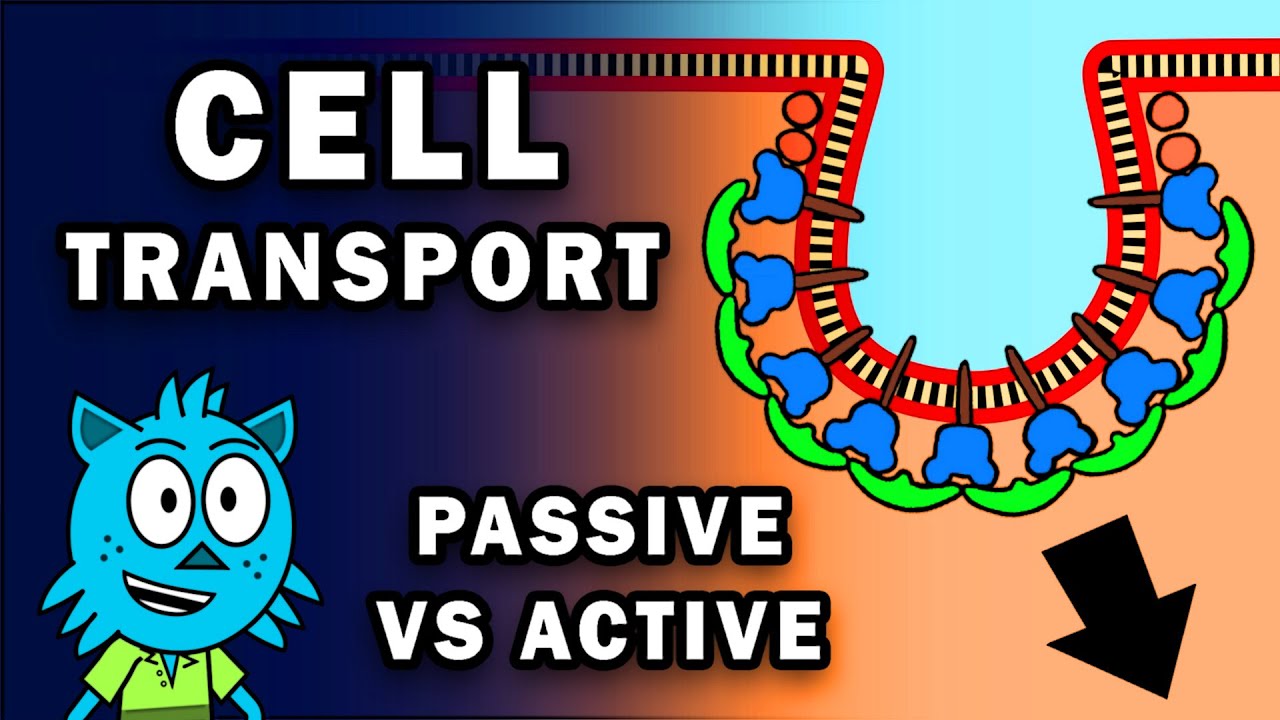
We’ve covered active transport involving pumps, but active transport can also involve vesicles. Vesicle transport includes exocytosis, as well as three types of endocytosis. Phagocytosis is like cellular eating. It is a cellular process by which particles over 0.5 micrometers are ingested. Meanwhile pinocytosis is like cellular drinking, with extracellular fluid and solutes taken up via small vesicles. Lastly there’s receptor-mediated endocytosis, also called clathrin-mediated endocytosis. Clathrin-coated vesicles transiently assemble on the cell membrane, selecting and concentrating cargo when they form a vesicle. In this process, only receptor specific substances can come through. .
If you’d like an easy way to remember this information, check out our song video on the topic!
Повторяем попытку...
Доступные форматы для скачивания:
Скачать видео
-
Информация по загрузке:


![Почему работает теория шести рукопожатий? [Veritasium]](https://image.4k-video.ru/id-video/ggI1xKzoANs)


