Fifth Sunday of Ordinary Time( Fr.Nishantha Cooray TOR)
Автор: Living the Gospel
Загружено: 2026-02-06
Просмотров: 76
Описание:
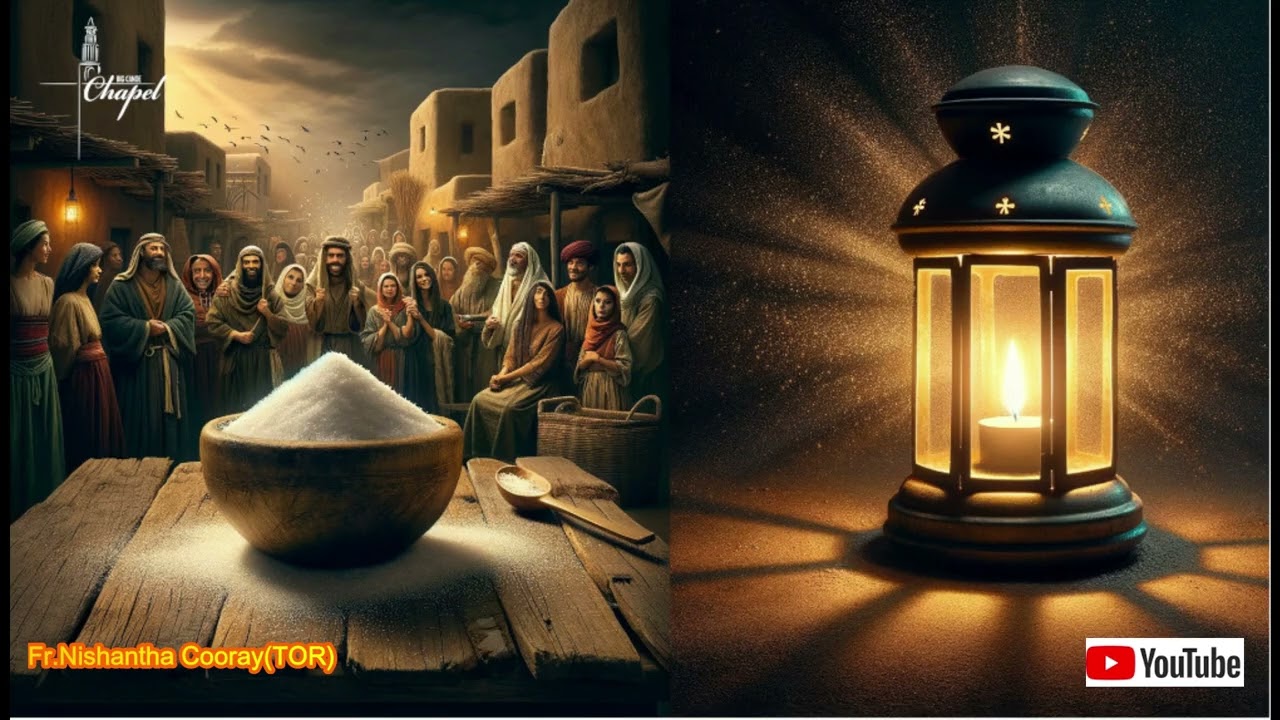
At the conclusion of the Beatitudes, the Lord gives His disciples a deeply personal teaching. According to Him, His discivples are the salt of the earth and the light of the world. There is no substitute for salt, and there is no substitute for light. Likewise, there can be no substitute for the Christian calling. Any attempt to search for alternatives to this calling is itself a sin.
To understand what Jesus truly teaches here, we must understand the historical context in which He spoke. In the ancient world, salt was extremely valuable. According to Jewish understanding, salt was considered the purest substance on earth.In the time of Jesus, every Jewish child over the age of six was required to attend the village synagogue for instruction every day except the Sabbath. Teachers taught them the Word of God. This was not an age of printing or technology. Therefore, the method of teaching involved repeating a verse or several verses of the Law until the child memorized them. Only after memorization would the teacher explain the meaning.
During this process, Jewish teachers gave special attention to a sentence found in the Book of Genesis:“Cursed is the ground because of you” (Genesis 3:17).The Jewish teachers offered a unique explanation of this curse. When God cursed the earth, there were two things that were not affected by the curse: sunlight and the water of the great sea. Therefore, for the Jews of that time, salt—produced through the interaction of sun and sea—was considered the purest substance on earth.This is why Jews mixed salt with all their sacrifices. They called salt melach and used it not only in sacrificial offerings but also as a symbol in divine judgment (Exodus 30:35; Leviticus 2:13; Deuteronomy 29:23; Genesis 19:26; Numbers 18:19).The primary quality of salt was its power to purify. Therefore, Jesus clearly told His disciples that wherever they lived and whatever situation they were in, they must preserve purity to the highest degree. A person becomes pure when his actions, words, thoughts, and attitudes are pure.Secondly, salt has the quality of preservation. In Christian life, purity cannot be something temporary. Holiness must be preserved at all times. It is not enough to begin a holy life and merely maintain it. That life must be broken, dissolved, and offered as a sacrifice. This is the sacrificial nature of Christian life.To understand this more deeply, we must look at how Jews constructed household stoves in those days. To cook meat or bake bread, they needed long-lasting heat. They dug a pit in the floor of the front room of the house and filled it with salt. Then they spread a thin layer of plaster over it and placed a cylindrical stove on top. When firewood was burned, the salt heated up and retained the heat for a long time.Over time, through constant exposure to fire, the salt lost its ability to retain heat. When this happened, the old salt was removed and replaced with new salt. The burnt-out salt, which could no longer retain heat, was thrown into the courtyard or front yard. People entering and leaving the house would trample on it.Using this ordinary reality of Jewish daily life, Jesus teaches an eternal truth about destiny. He explains the fate of anyone who is unfaithful to his calling, who acts against it, and who rejects its value system.According to many biblical scholars, this imagery also reflects a disciplinary practice in the Jewish synagogue. If a Jew rejected his faith, the synagogue leader had the authority to expel him from the community. Once expelled, he was treated as an enemy of the nation and as a Gentile.If, after some time, such a person repented and wished to return, a specific punishment was imposed. First, he had to declare his repentance to the synagogue leader.forgiveness of sins, and the light that drew people closer to God.Although Jesus says here, “You are the light of the world,” elsewhere He says, “I am the light of the world” (John 9:5). By this, He invites His disciples to share in His own mission. A Christian, therefore, is not merely a follower, but another Christ.Finally, Jesus teaches that through the ordinary daily life of a Christian—through the sanctification of actions, words, thoughts, and attitudes—people come to know God. Through the behavior of Christians, even those who do not know God begin to understand who the God they worship truly is.The greatness of God is proclaimed to the world through the conduct of Christians. Saint Francis of Assisi once said:“Preach the Gospel at all times; use words only when necessary.”This means that whenever a Christian lives a good and holy life, his life itself becomes a sacrifice, and he becomes a missionary who brings glory to God.
Повторяем попытку...
Доступные форматы для скачивания:
Скачать видео
-
Информация по загрузке: