Fluorescence and FRET (Förster/Fluorescent Resonance Energy Transfer)
Автор: the bumbling biochemist
Загружено: 2024-11-07
Просмотров: 538
Описание:
Don’t FRET - here are key things to know about FRET! (Förster or Fluorescent Resonance Energy Transfer) - quick bullet points then the details
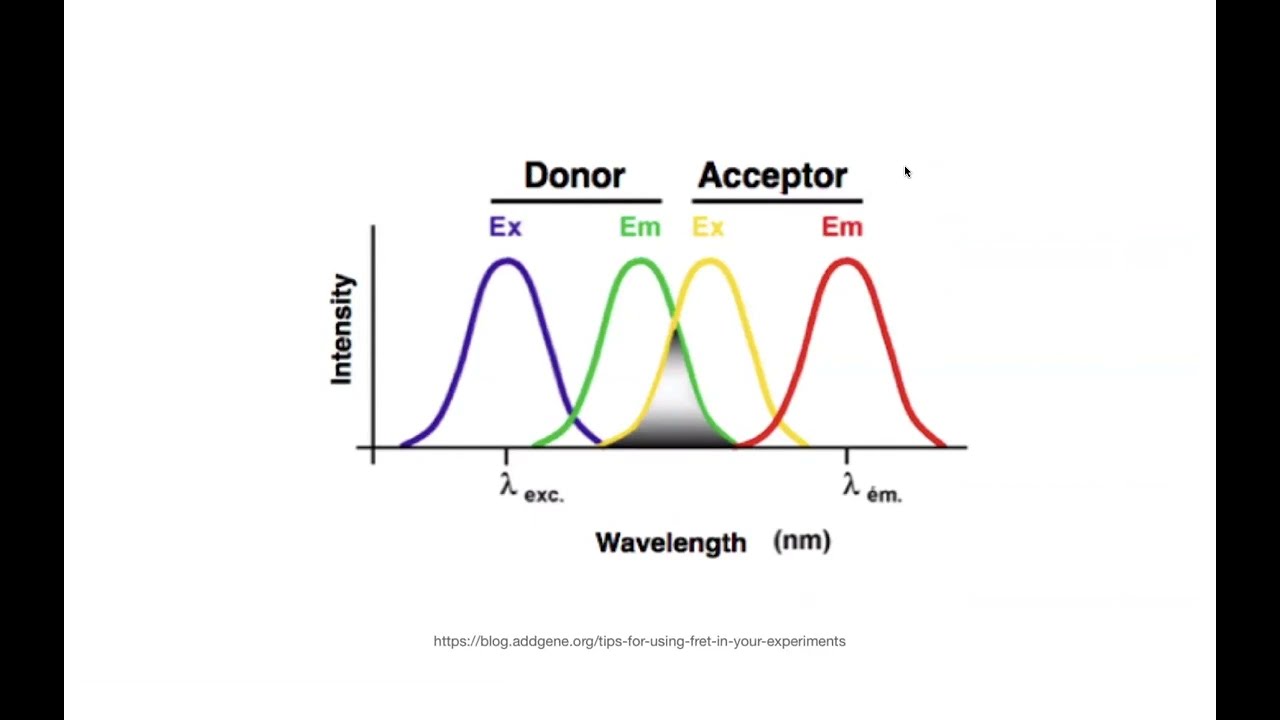
You have 2 fluorophores - one has an emission wavelength (and thus energy) that matches the other’s absorption wavelength (and thus energy). If they’re really close, and you excite the first one, the energy that would have been given off as light by that first one will instead get stolen by the second one and then the second one will give off light.
It is distant dependent, with FRET efficiency (E) falling off depending on distance to the sixth power
You need to be within ~10nm most
The actual distance depends on a value called R0, which is the 50% transfer efficiency (E) (typically 3-7nm)
There’s a mathematical equation that relates distance to FRET efficiency for a given pair
You can use FRET as a “spectroscopic ruler” to measure distances within & between molecules
blog: https://bit.ly/FRET_2&
http://bit.ly/fretandfluorescence
Keep your friends close and your FRET partners closer! The basis of fluorescence is that molecules called fluorophores absorb high-energy light & use some of that energy to excite an electron (like moving it up floors in an electron apartment building where the different floors are different energy states). Then that electron falls back down, releasing lower-energy light that we can detect. In FRET (Förster Resonant Energy Transfer), we couple 2 fluorophores (think 2 side-by-side apartment buildings). Instead of receiving energy from light, the second one receives energy from the first – an electron’s “going down” in apartment building one while an electron’s “going up” in apartment building 2. This can only happen if they’re really close together, so if we see fluorescence from the second fluorophore we can tell that molecules are interacting.
This energy transferring from the 1st to the 2nd isn’t in the form of light (it’s NON-RADIATIVE). It’s transferred through something called Förster Resonance Energy Transfer. There aren’t any particles flowing from one to another (no photons or electrons), just energy “vibes.” If you think of energy as a sort of “money” and photons as “coins,” fluorescence would be like taking in a dime and giving back a nickel (some of the energy gets used for “wiggling” and stuff).
FRET, on the other hand, is more like a sort of wire money transfer, and this sort of transfer can only happen if the molecules are really close. And by close, I mean REALLY close. Visible light has wavelengths of ~380-740 nm (there are 1 billion nm in a m). And FRET can only happen at distances of less than 10nm. For some perspective, an “average” human cell is ~ 20,000 nm (20 μm), bond lengths are ~0.15nm and an “average” protein has an ~4-5nm diameter (check out the bionumbers website for some more cool factoids). Note: sometimes, you see values in Angstroms (Å) - an Angstrom is 0.1 nM.
The ability for FRET to occur decreases rapidly with distance – FRET efficiency (E) varies by the inverse sixth power of the distance between them (r). EFRET = 1/[1 + (r/R0)6]
R0 is the Förster radius and it’s the distance at which E is at 50% of its max. This distance is usually a few nm. When r is less than R0, FRET is very efficient, but once you pass R0 things go downhill fast thanks to that “to the sixth” part, with a useful range ~ 0.5-1.5 x R0
This closeness requirement can be really useful. You might have seen microscopy images where people stain cells with a dye that binds to one thing and another dye that binds to another thing and then they overlay the images? It might look like the molecules are really close – they “co-localize”, but they might not be directly interacting. But with FRET, you know they really are.
There are lots of different “versions” of FRET.
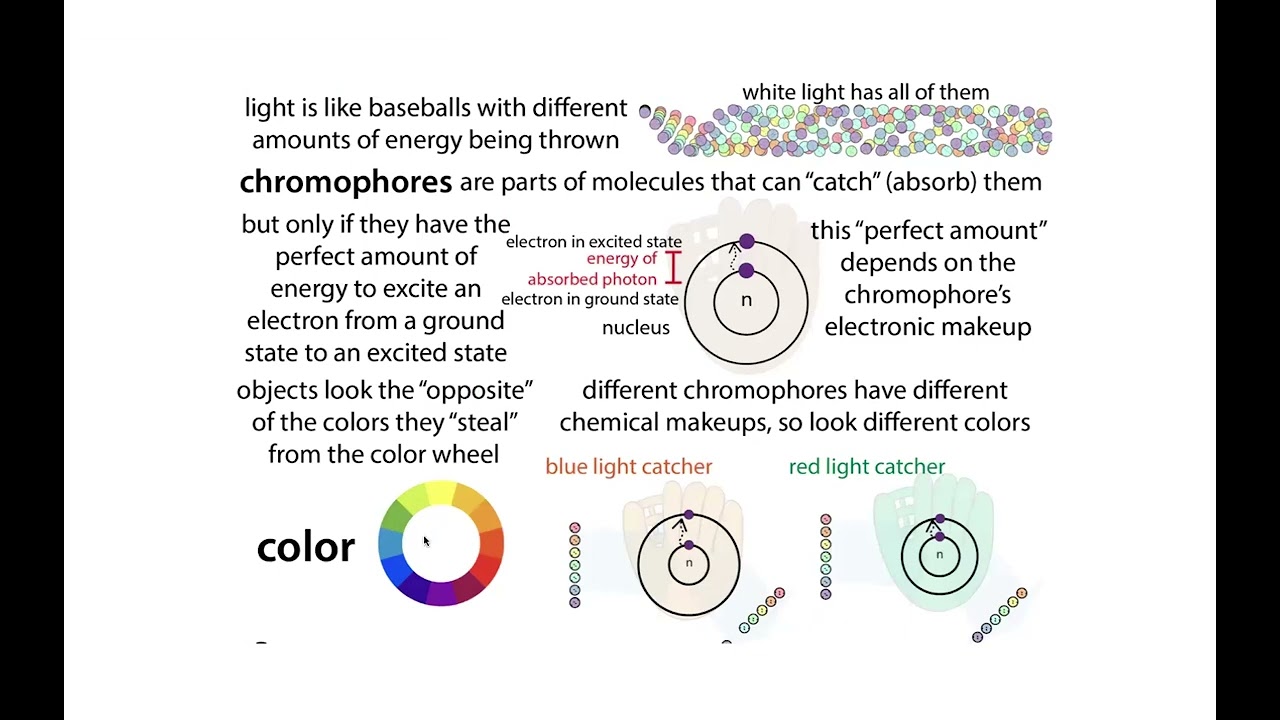
Quick note about chromophore and fluorophores. Chromophores are molecules that absorb light. If they give back light, we call them fluorophores. They only absorb and emit light of certain wavelengths, based on their molecular makeup, so each one has a different absorption (excitation) and emission spectrum. More here: http://bit.ly/fretandfluorescence
Finished in comments
Повторяем попытку...
Доступные форматы для скачивания:
Скачать видео
-
Информация по загрузке: