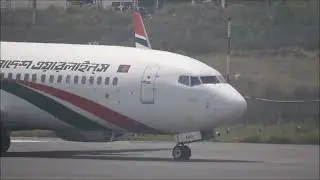
Nepal Airport | Nepal International Airport History with Eng Subtitle
Автор: GP Bhandari
Загружено: 2024-02-17
Просмотров: 176
Описание:
In today's video, we explore how the grassy field, once used for farming, transformed into an airport. We delve into the history of Nepal's aviation sector, discussing the number of individuals who have obtained pilot licenses so far.
We also look into the statistics of companies providing airplane and helicopter services. From 2017 to 2023, how many people received approvals for aviation studies, and the total number of approved aviation companies, will be covered.
We'll share interesting facts, such as the number of air service companies currently operating and the information obtained from our research. After watching the video, please feel free to leave your valuable suggestions in the comments.
Before discussing the country's first airport, Tribhuvan International Airport, we pay our respects to the Wright Brothers, the pioneers of the aviation industry and fathers of the aviation field.
Two brothers' relentless exploration and research have not only led to advancements on Earth but also in outer space. While Hindu scriptures like the Ramayana mention the Pushpak Vimana, the actual breakthrough occurred on December 17, 1903, when the Wright Brothers made everyone's dream a reality.
Thanks to the principles of aerodynamics, airplanes, ultimately serving for travel, became one of the safest means of transportation globally. Wright Brothers' first commercial flight in 27 minutes marked the beginning of a revolution in the aviation industry, signaling the start of a new era.
Approximately 45 years later, in 1948, aviation services commenced in Nepal. H. Odlar, a British citizen, successfully landed the first aircraft at Gaucharan Airport, and the aircraft was named between two mountains.
In 1951, the first commercial flight took off, connecting Kathmandu to Patna, India. After the Rana regime, rapid development took place, officially establishing the Royal Nepal Airlines Corporation in 1958.
Due to the perceived weakness in the systematic management of Nepal's aviation sector, the Shah Dynasty initiated the establishment of the Civil Aviation Authority of Nepal in 1958. The Authority commenced domestic flights in July of the same year.
The first flights operated to Bhairahawa, Viratnagar, Pokhara, and Simara. In 1960, as Nepal became a member of the International Civil Aviation Organization, foreign aircraft started flying into the country.
In 1961, Queen Elizabeth II visited Nepal in a British Royal aircraft. Shortly after, King Mahendra renamed the airport from Gaucharan to Tribhuvan International Airport in 1964.
King Mahendra's vision for development led to rapid expansion in 1967, transforming the airport from 1,100 meters to 2 kilometers. Following this, the corporation acquired larger aircraft in 1968.
In 1989, the construction of the international terminal was completed. Now, the question arises: How did the airport overcome the challenges during the Rana regime?
The story unfolds in 1950 when Rana rulers faced political unrest, leading King Tribhuvan and his family to seek refuge in India. Two Indian planes were sent, carrying not only the King but also all members of the Shah family except for Crown Prince Gyanendra.
Later, under the pressure of the then King, the Ranas forced the Shahs to take refuge in India, leaving behind their only son, Crown Prince Gyanendra, who was subjected to technical restrictions.
#nepalairport
#nepalinternationalairport
#tribhuvaninternationalairport
Повторяем попытку...

Доступные форматы для скачивания:
Скачать видео
-
Информация по загрузке: