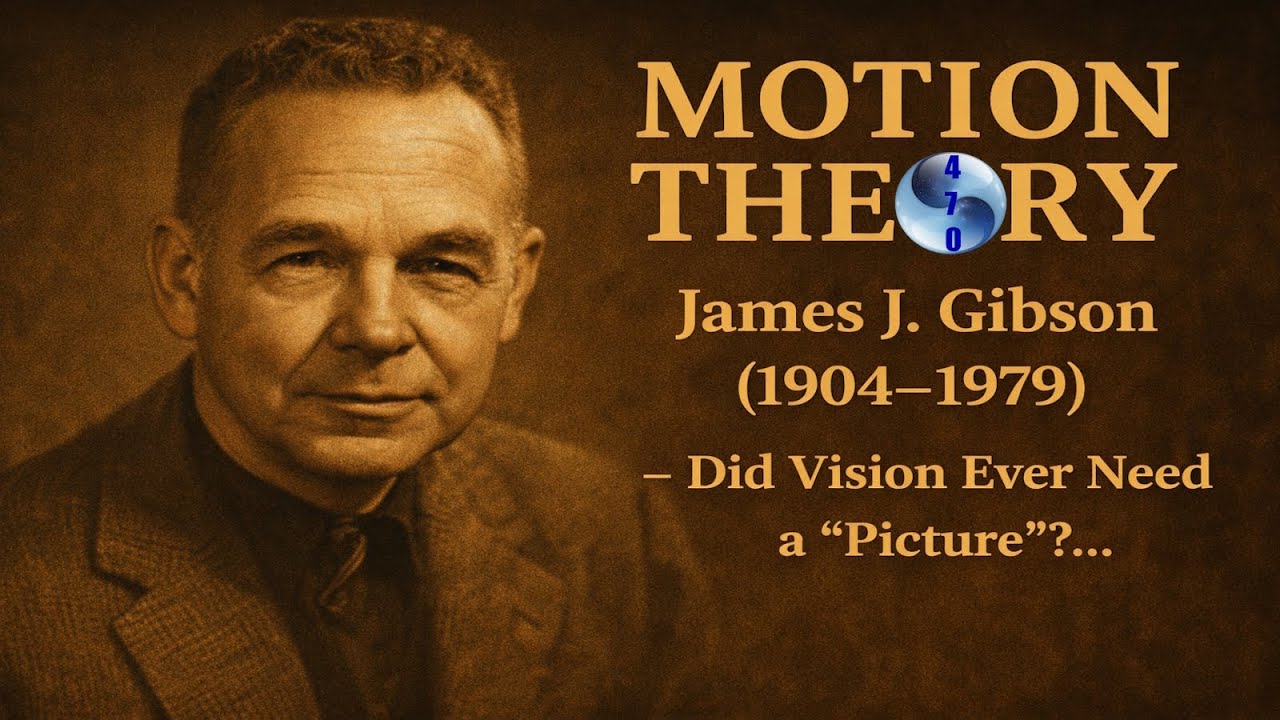
James J. Gibson (1904–1979) — Did Vision Ever Need a “Picture”?
Автор: Motion Theory
Загружено: 2026-01-24
Просмотров: 145
Описание:
/ @themotiontheory
1) Keywords (≈1500 characters, comma-separated)
motion theory, motion theory deep dive, james j gibson, james jerome gibson perception, ecological psychology, optic flow, optic flow theory, direct perception, affordances theory, perception and action, visual perception explained, philosophy of perception, neuroscience perception, embodied cognition, enactive perception, ecological optics, vision without representation, anti homunculus theory, perception as coupling, motion as reality, structured motion, invariants in perception, visual invariants, perception without pictures, brain and environment coupling, organism environment system, sensory flow, focus of expansion, optic array, visual field motion, survival perception, action oriented perception, affordances explained, meaning as action, perception is contact, perception is motion, space as motion medium, time as motion measurement, mass as resistance to motion, fields as motion gradients, motion seers, motion based ontology, reality as flow, perception philosophy, psychology theory breakdown, cognitive science alternatives, non representational perception, direct realism psychology, affordance landscape, constraint based perception, motion synchronization, embodied vision, ecological approach to vision, perception without models, vision and movement, perception is not a picture, world as information, environmental information, motion gradients, structured light, perception and survival, motion compatibility, action possibilities, living systems and motion, motion reading organisms, visual flow navigation, catching a ball perception, perception without computation, perception without reconstruction, anti representationalism, perception theory explained, james gibson optic flow explanation, motion theory philosophy, attology motion theory, perception as rhythm, shared rhythm perception, reality as dynamic system, motion based meaning, perception deep dive
2) Description (≈2500 characters)
Did vision ever really need a “picture”?
In this Motion Theory Deep Dive, we explore the radical ideas of James J. Gibson (1904–1979) and why his work quietly dismantles one of the most common myths in perception: that the brain builds an inner image which a little observer inside your head then looks at.
Gibson rejected the cartoon model of perception entirely. Instead of treating vision like photography followed by interpretation, he reframed perception as direct contact — a continuous coupling between a living, moving organism and the structured motion of its environment. No inner movie. No homunculus. No infinite chain of observers watching observers.
At the center of Gibson’s work is optic flow: the lawful, structured way the visual world changes as you move through it. Forward motion creates expansion from a focus point. Turning produces shear. Approaching surfaces causes texture gradients to scale. These patterns are not noise — they are information. The environment writes geometry, timing, and danger directly into motion.
From a Motion Theory perspective, Gibson was detecting invariants: stable structures that persist across change. Edges remain edges, surfaces remain navigable, objects remain coherent patterns even as the retinal image distorts. Perception, then, is not construction — it is synchronization. A biological motion system tuning itself to reliable structure in a dynamic signal.
This leads to Gibson’s most influential concept: affordances. Meaning is not an abstract label pasted onto objects. Meaning is what the environment offers an organism in terms of possible action. Chairs afford sitting. Ledges afford stepping. Slopes afford caution or disaster. Affordances are relational, action-ready, and immediately available in perception.
Direct perception does not mean the brain is passive. It means the primary task of perception is not guessing reality from fragments, but staying locked into the structured flow well enough that action becomes obvious. If you’ve ever caught a ball without calculating trajectories, your nervous system already understands this logic.
Through the Motion Theory lens, Gibson emerges as a Motion Seer: someone who understood that perception is not about receiving objects, but stabilizing a shared rhythm between inner motion (nervous system) and outer motion (environment). Reality is not a static inventory. It is a living stream — and perception is how flows learn to read flows.
The world isn’t a picture.
It’s a flow.
And you are a flow that learned how to move with it.
Повторяем попытку...
Доступные форматы для скачивания:
Скачать видео
-
Информация по загрузке:


