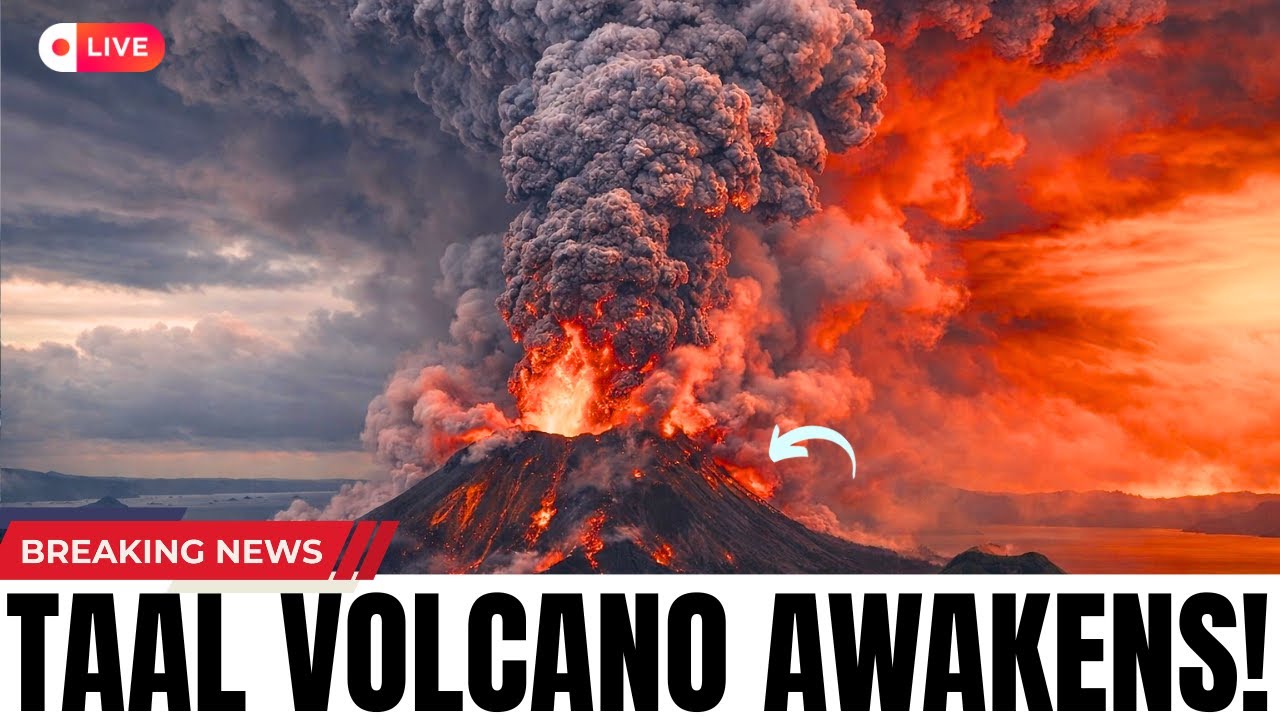
BREAKING: Philippine's Volcano VIOLENTLY Awakens - What Comes Next?
Автор: GeoSphere
Загружено: 2026-01-13
Просмотров: 25253
Описание:
On January 6, 2026, Taal Volcano in Batangas, Philippines remained under close watch as volcanic activity continued to unfold inside one of the most complex and dangerous volcanic systems on Earth. Unlike a classic mountain-shaped stratovolcano, Taal is a flooded caldera system—meaning much of the volcano’s structure sits beneath Taal Lake, with the active crater located on Volcano Island. That geography is exactly what makes Taal uniquely hazardous: when magma rises and interacts with groundwater or lake water, the result can be sudden steam-driven explosions, ash plumes, ballistic rocks, and rapidly changing conditions that can escalate with little warning. Even when eruptions are short, ash and volcanic gases can spread far beyond the crater depending on wind direction, and fine ash can disrupt travel, reduce visibility, and affect air quality in nearby towns and cities.
What many people don’t realize is that Taal’s most dramatic danger isn’t just lava—it’s the speed. Events like phreatomagmatic eruptions can happen quickly because the system has both magma and water in close contact. That mixing can create ash-heavy eruptive columns and unstable, turbulent clouds of hot gas and particles. Even smaller eruptions can cause localized hazards around the crater such as falling ash, volcanic tremor, and toxic gas buildup, especially sulfur dioxide. This is why authorities maintain strict guidance around restricted areas and constantly track multiple signals at once: earthquake swarms, crater glow, tremor, inflation or deflation of the ground, and plume behavior. Taal’s history proves that “minor” does not always mean “safe,” because in complex caldera systems, small bursts can occur as part of a larger evolving episode.
In this video, we break down what January 6, 2026 activity means in real-world terms—what signs scientists look for, why the Danger Zone matters so much at Taal, and how an eruption in a lake environment changes the game compared with typical volcanoes. We’ll also explain how ash plumes form, what can cause sudden short-lived explosions, and why communities surrounding Taal have to treat updates seriously even when the volcano appears calm between events. This is a volcano known for rapid shifts—quiet periods can change fast—and the monitoring behind these alerts is exactly what helps prevent tragedy by giving the public time to act before the next escalation.
#volcanoeruption #geologyexplained
Повторяем попытку...
Доступные форматы для скачивания:
Скачать видео
-
Информация по загрузке: