BrindaMukthi's
Автор: BrindaMukthi
Загружено: 2026-01-01
Просмотров: 305
Описание:
BrindaMukthi proudly presents the Margazhi Javali Festival celebrating the song form of Javalis and paying homage to the Veena Dhanammal Family and its role in preserving them and bringing them to the proscenium stage today.
This exclusive Margazhi series celebrates the poetic and musical beauty of Javalis, presented through rare recordings from the Dhanammal school. Each day at 10 AM IST, a new Javali premieres meticulously chosen from the repertoire documented by Smt T Brinda for The Music Academy, Madras in 1960, the most authentic written record of the artform.
Javalis occupy a uniquely elegant space within Carnatic music poised delicately between classical structure and expressive lyricism. Emerging prominently in the late 18th and 19th centuries, they belong to the family of compositions such as Padams, but possess a distinctly quicker gait, more conversational poetry, and a vibrant emotional immediacy. While Padams dwell in introspection, slow unfolding, and inward sringāra, Javalis give voice to the more playful, outward-facing shades of love, longing, teasing, impatience, persuasion, and emotional vulnerability.
Historically, Javalis were deeply interwoven with the Sadir dance tradition forming a part of the repertoire of hereditary dancers and musicians. Their vivid sahitya and subtle rhythmic lilt made them ideal for both expressive dance and intimate musical presentation.
Even as Carnatic music evolved across sabhas and concert halls, the core essence of the Javali remained rooted in delicate sringāra, personal storytelling, and deeply human emotion.
In true Javali aesthetics: Every phrase is conversational. Every word carries emotional weight and Every repetition deepens the rasa, not the volume.
In the Veena Dhanammal tradition, Javalis were treated with profound respect and meticulous care, much like padams. Artistes such as Smt T Brinda, Smt T Muktha, Smt T Jayammal, Smt. Balasaraswati, Sri T Viswanathan, Smt Vegavahini Vijayaraghavan placed absolute emphasis on correct pronunciation, natural word flow, and emotional truth. Their renditions are unhurried, savourable, and ripe with internalised feeling. Many Javalis in circulation today survive in their most authentic form only because the Dhanammal family preserved them orally across generations.
Thanks to archival efforts, recordings, and curations like this, Javalis are slowly reclaiming their place as one of the most emotionally honest and aesthetically sophisticated forms in our musical heritage.
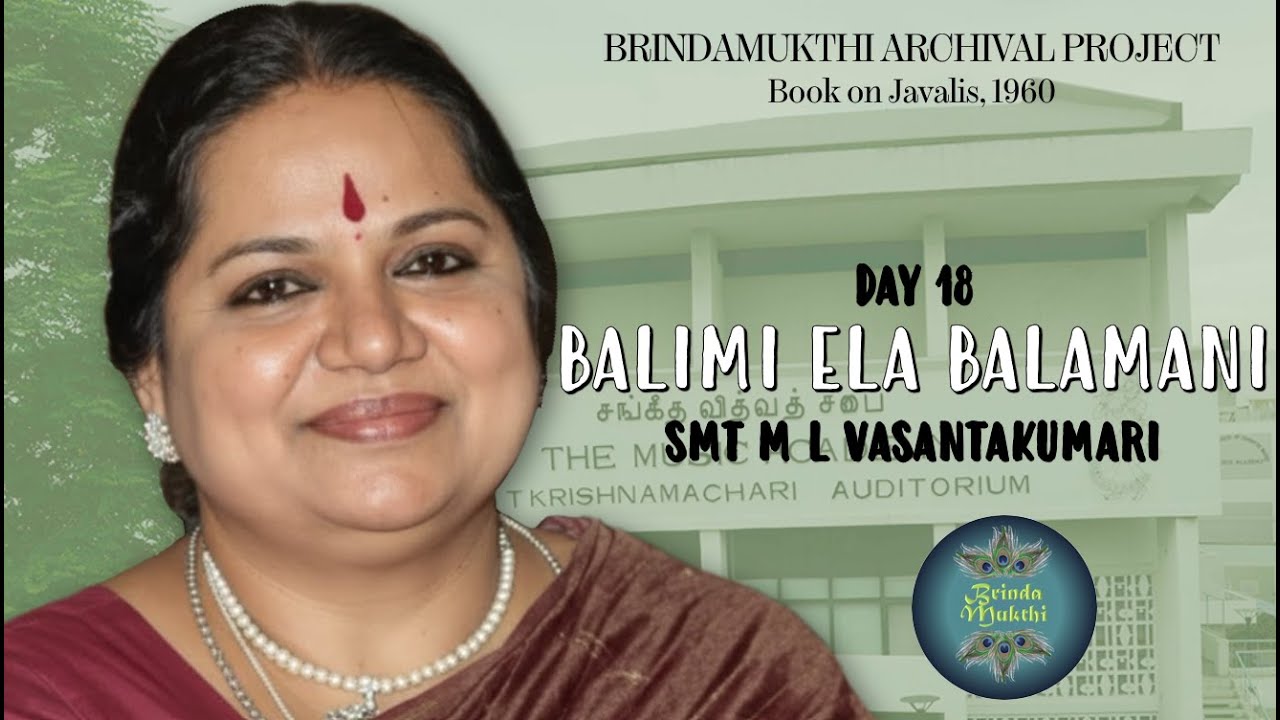
Day 18 I Balimi Ela Balamani I Raga Thodi I Adi I Pattabhiramayya
Balimi Ēlā is a deeply poignant jāvali by Pattabhiramayya, revealing his extraordinary sensitivity to emotional nuance and psychological realism. In this composition, the nāyikā addresses her beloved with a quiet but piercing question — “Balimi ēlā?” — “Why this stubbornness?” The question is not confrontational; rather, it emerges from emotional fatigue, wounded affection, and an earnest desire for reconciliation.
Choosing Tōḍi for this jāvali is both daring and profound. Often associated with weight, gravity, and deep pathos, Tōḍi here is not expansive or monumental. Instead, it is turned inward, serving as a vessel for dignified sorrow and quiet endurance. The rāga’s characteristic kampitas, its tension-laden phrases, and its capacity for emotional depth are shown here beautifully in context to the jāvali.
Since , we do not have a recording of this javali being performed in this Bani , we have used a recording of Smt ML Vasanthakumari who came in the shishya parampara of Sri Tiruppanandal Pattabhiramayya making it an authentic source.
Smt M L Vasanthakumari - Vocal
Sri A Kanyakumari - Violin
Sri Karaikudi Krishnamurthy - Mridangam
00:00 - Opening Credits
00:06 - The Margazhi Festival
00:24 - The Manuscript of the 1960 Javali Book by Smt T Brinda
00:32 - Portrait of Smt Veena Dhanammal
00:40 - Pallavi
balimi Ela bAlAmaNi alavAnitO palumAru nIku
01:39 - Charana 1
vAni pilici balkeTi hInata lellanu alivENu lerugina mana mAnamulu pOnE
02:40 - Charana 3
tALavana lOluni E vELa talacucu vayya kulapaDanEla palu vAlAyamu gA
03:38 - Closing Credits
We , from the family thank the Music Academy Madras for bringing out such a unique archival volume on this artform carefully preserved in this tradition and acknowledge the contributions of Dr V Raghavan , the then secretary of the institution and also appreciate their approval now for use of its excerpts in our archival project.Note: This recording has been taken from Family archives. It does not claim ownership of the content whatsoever.
Headphones are recommended for optimum sound quality.
Curated by BrindaMukthi
BrindaMukthi's Blog : https://brindamukthi.blogspot.com/
BrindaMukthi's Instagram : https://www.instagram.com/brindamukth...
BrindaMukthi's YouTube Channel : / @brindamukthi
BrindaMukthi's Facebook Page :
/ brindamukthi
Повторяем попытку...
Доступные форматы для скачивания:
Скачать видео
-
Информация по загрузке: