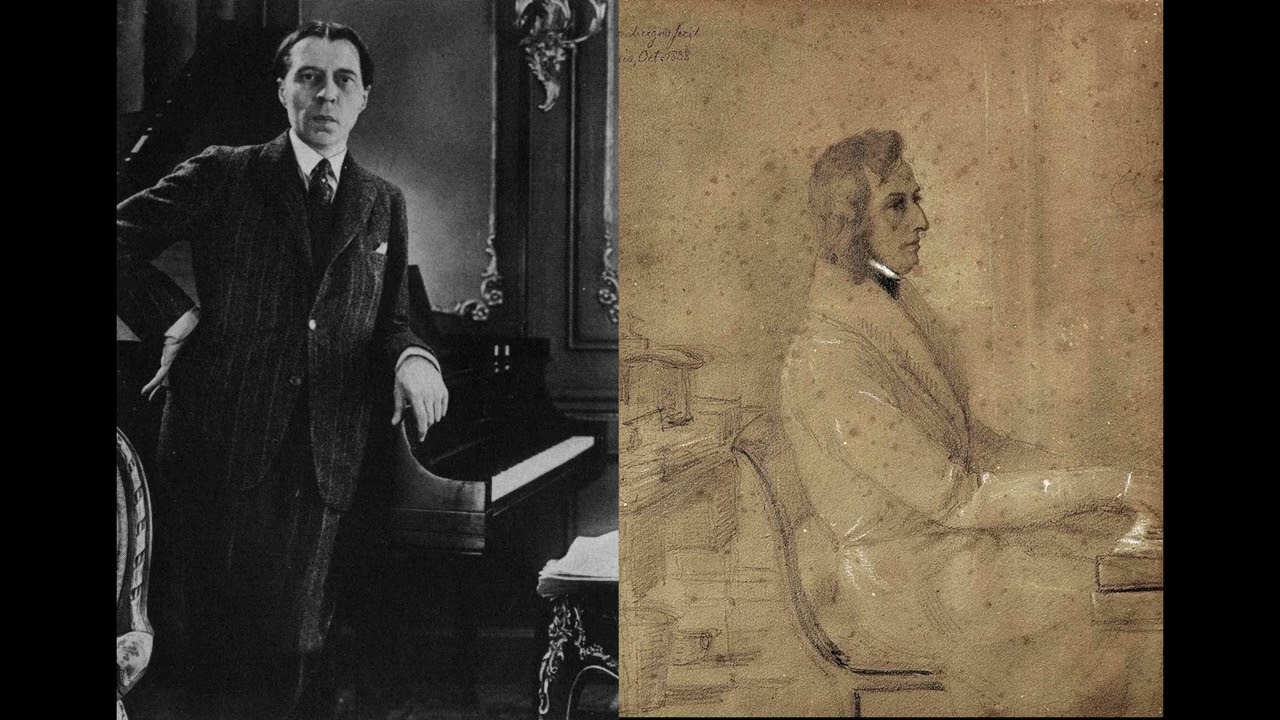
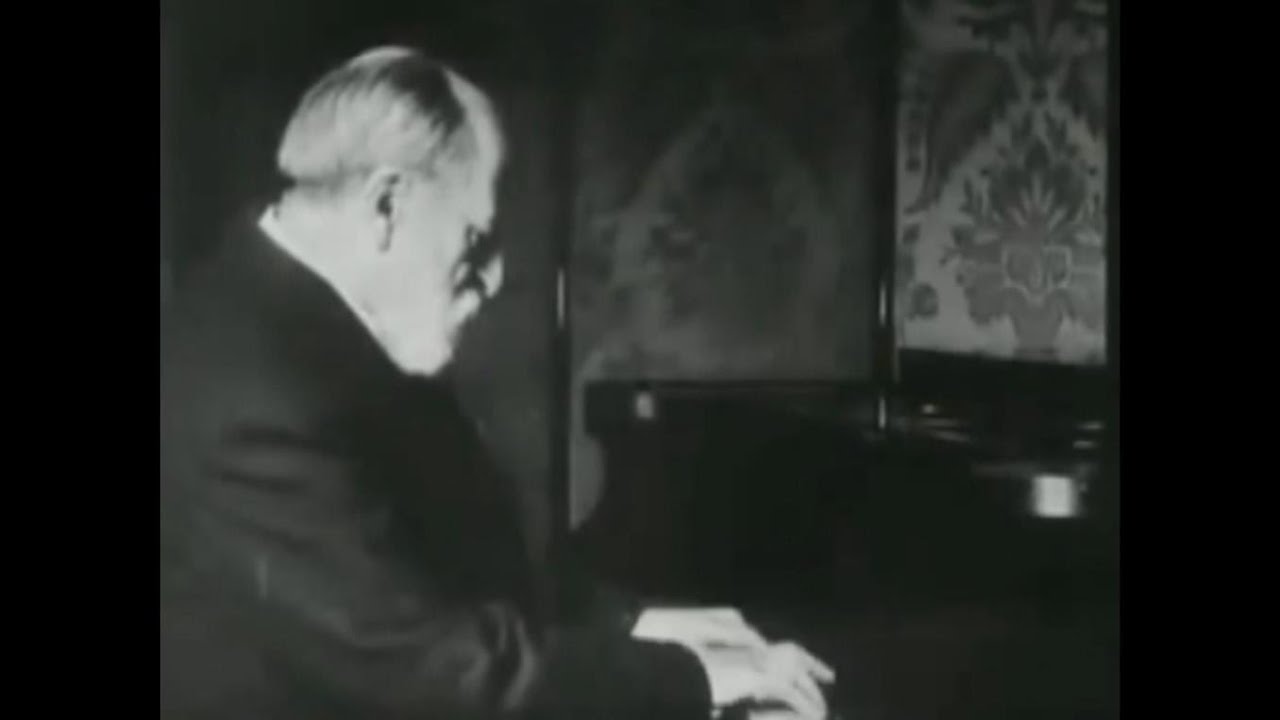
Saint-Saëns plays Chopin: An in-depth analysis.
Автор: Piano (again, with feeling)
Загружено: 2020-10-16
Просмотров: 2388
Описание:
This is an illustrated analysis of a portion of Saint-Saëns’s 1905 Welte piano roll recording of Chopin’s Nocturne, Op.15 No.2. From this we may be able to glimpse elements of Chopin’s playing style, since Saint-Saëns claimed to have learned it from Pauline Viardot, a singer who had not only sung with Chopin but also played duets alongside him at the piano. Unfortunately, a piano roll does not reproduce the exact sound of a pianist’s playing, so don’t expect to love it, but do consider what kind of playing it suggests. It shows several deviations from Chopin’s text but also many additional details that it would perhaps be hard for Chopin to notate.
It is thought that piano rolls contain largely accurate timing data but that dynamics and pedalling may be problematic (an over-simplification for the purpose of this summary). Bars 1-24 were produced using a sample-based piano on the computer which was calibrated for best musical effect by myself. I did very little editing to the piano roll and made no timing changes whatsoever. I am grateful to Peter Phillips for providing the piano roll files, which he transfers from the original rolls with great care https://www.petersmidi.com
A second recording features my own playing which seeks to imitate the piano roll as much as possible, followed by a third recording which slows down the playback of the roll by 25%, making the score a little easier to follow, since the tempo of the original is surprisingly fast (but initially very close to Chopin’s metronome mark).
There exist wonderful acoustic recordings of Saint-Saëns (in his eighties), showing surprisingly nimble finger-work. These are best heard in high-quality restorations by Marston https://www.marstonrecords.com . They suggest to me that the magic of his playing is not fully captured on this piano roll, yet enough detail emerges here to observe that:
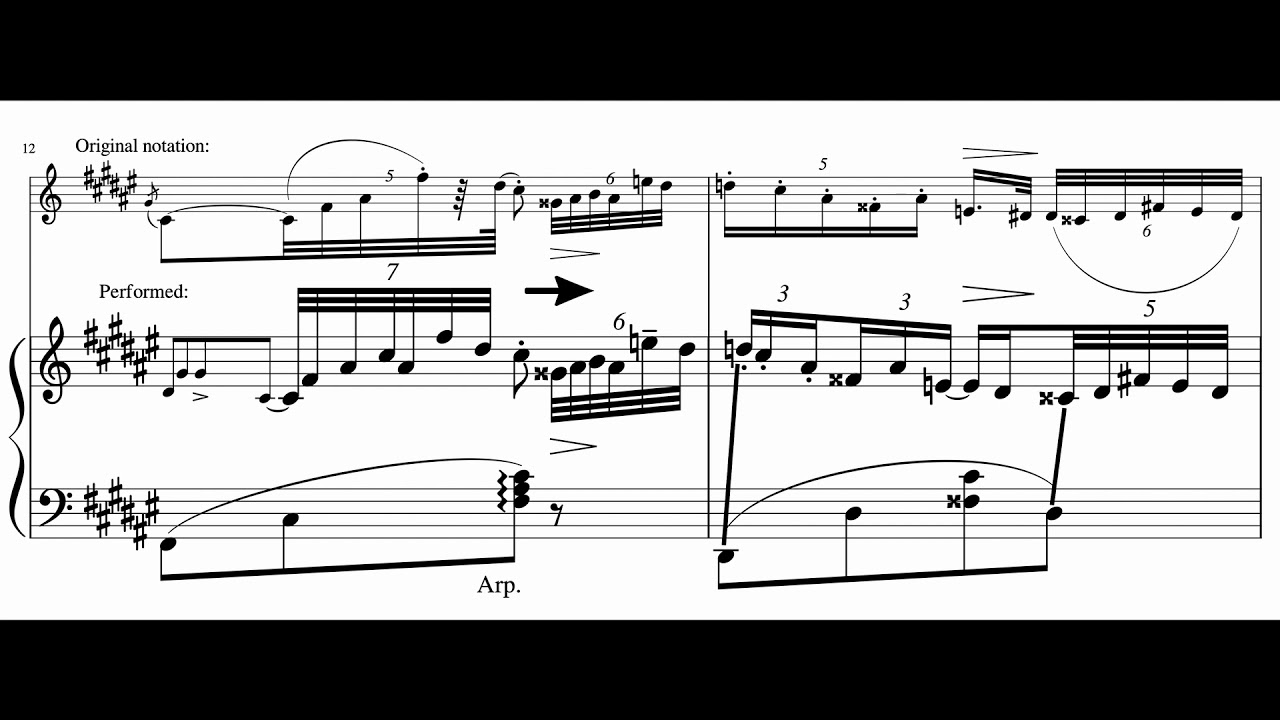
1) He arpeggiates many of the left-hand chords and octaves, as many pianists did who were born in the 19th century (and recorded this piece);
2) He appears to alter many small rhythmic details;
3) He places the right hand slightly after the left, a detail which I have researched extensively in relation to Chopin recordings (shown with diagonal lines). This is significant because he does this much more rarely in his other recordings. Note that he avoids predictability with regard to this delaying effect, varying it or omitting it freely. Most of the delays are very small indeed (thin lines), some above 100 milliseconds (thick lines) whilst two exceed 200 ms (very thick lines). Other pianists of the 19th century who commonly utilise a very short time-lag between the hands are Emil von Sauer (a student of Anton Rubinstein and later, of Liszt - for example, in Chopin’s E flat Nocturne • Emil von Sauer (1862-1942): Chopin - Noctu... ) as well as Carl Friedberg, who can be heard doing so in the opening Chopin’s A flat Nocturne • Carl Friedberg plays Chopin Nocturne in A ... . Friedberg is far more sparing with this delayed approach when playing other repertoire. It may be significant that he was advised by Clara Schumann, who had heard Chopin play. (According to her husband, she played his music better than Chopin himself!). Many other pianists recorded the piece with delay between the hands as a standard feature. Michalowski’s version is a personal favourite: • Chopin Nocturne F# Op 15 No 2 Michalowski ...
4) Perhaps the most astonishing aspect of the interpretation occurs at bars 22-24 1:10 / 2:31 . Saint-Saëns achieves a breathless stretto effect here by pushing the tempo with the left hand whilst the melodic right hand lingers. I have notated this to show where the bass is early but the perceived effect is of the right hand falling behind. This recalls the independent execution of the hands that was mentioned several times with regard to Chopin’s style (Mathias, Chopin’s student, said ‘you can be early, you can be late. The two hands are not in phase; then you make a compensation which re-establishes the ensemble’). Several other pianists can be heard shifting the placement of the hands here in analogous ways, if not quite so dramatically: all pianists with a connection to Chopin’s disciple, Mikuli, do so (Koczalski, Michalowski and Horszowski), as do Edouard Risler, Myra Hess, Busoni (1922), and Alicia de Larocha.
5) A further detail of great interest in relation to this ‘Chopin rubato’ is the longer (but still slight) delay between left hand chord and right hand melody note in bars 6 and 14 (highlighted by a thick black line 0:25 ). This was sanctioned by Mathias’s student, Raoul Pugno: ‘You can even isolate it a little by playing it (this exceptionally) after the chord of the left hand’. Many other pianists make the melody note late by spreading the left hand chord up to it. Reinterpreting this tradition, Busoni reversed the timing of these two events in his recording of 1922, placing the right hand before the left, with a strong dynamic accent (see this recording at 55 seconds: • Nocturne No. 5 in F-Sharp Major, Op. 15, N... )
Повторяем попытку...
Доступные форматы для скачивания:
Скачать видео
-
Информация по загрузке:




![Chopin - Nocturne op. 15 no. 2 in F# major (Audio+Sheet) [Cziffra]](https://imager.clipsaver.ru/rvQo7WSnJyk/max.jpg)