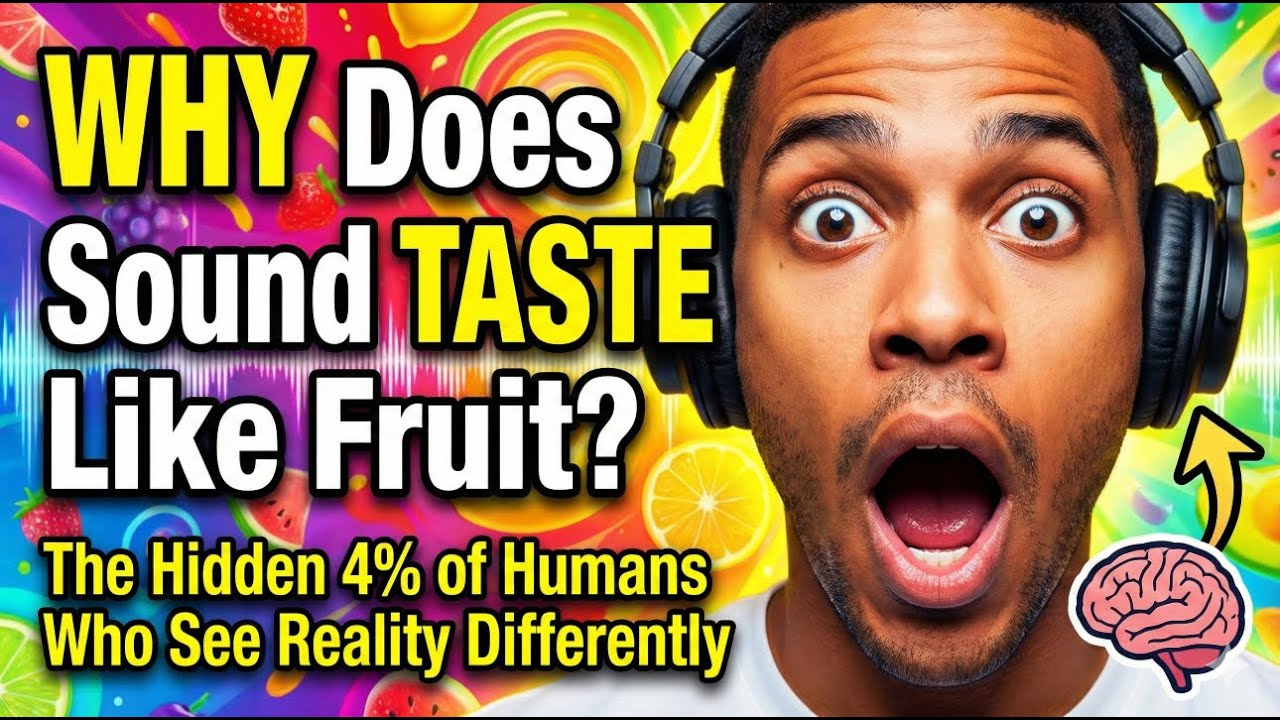
Why Does Sound Taste Like Fruit?
Автор: The Polymath Project
Загружено: 2025-12-03
Просмотров: 6
Описание:
Hello, truth seekers and sensory explorers!
Welcome back to the channel where we unravel the most astonishing secrets of the human mind.
We all believe our senses operate in isolation, right? Your eyes see, your ears hear, and your tongue tastes. But what if I told you that for millions of people, the wiring is deliberately, fundamentally 'leaky'?
This episode dives deep into Synesthesia, a truly mind-bending phenomenon where one sensory input automatically triggers a second, unrelated sensory experience. If only 4% of the population experiences this radical blend—where letters have distinct colors (grapheme-color synesthesia) or where words evoke specific tastes (lexical-gustatory synesthesia)—then are the rest of us actually perceiving reality in deficit?
The Neural Blueprint: Is Your Brain Just Too Tidy?
What causes this spectacular sensory crossover? Our research points to hyperconnected sensory cortices in the brain. Specifically, connections like those between V4 (the visual color area) and S1 (the somatosensory area) might explain why synesthetes see certain colors when reading text.
This leads us to a crucial question posed by neuroscientists: Is synesthesia evidence of reduced pruning during childhood brain development?
According to Ramachandran's 2001 cross-activation theory, perhaps in synesthetes, the natural neural pathways that are usually trimmed away remain active, creating this 'woven senses' experience. If this is the case, is synesthesia the original default setting, and is our segregated perception the result of necessary, yet potentially limiting, evolutionary refinement?
The Evolution, Creativity, and the Future of Perception
Synesthesia is not merely a curious quirk; it carries significant advantages. Individuals with synesthesia often exhibit superior memory (such as linking information to specific colors or tastes) and enhanced creativity. We know that famed artists, like Wassily Kandinsky, were synesthetes. Does this blending of perception naturally optimize the brain for innovative thought, making these individuals the true pioneers of sensory creativity?
This raises profound questions about potential acquisition: If synesthesia arises from certain neural structures, could it be intentionally activated? We know it has been acquired post-stroke or temporarily induced by substances like LSD. Therefore, could methods like intensive meditation, advanced virtual reality (VR), or focused training unlock this hidden symphony for the majority of people, fundamentally expanding human perception?
Furthermore, if AI researchers are now simulating synesthesia, does creating "richer" machine consciousness require intentionally blending simulated sensory inputs? And looking back in time: Did the evolutionary edge of enhanced pattern recognition offered by synesthesia historically aid ancient shamans or creative leaders, or is this merely a neutral variation in the human genome?
Your Call to Action & Verification
We encourage every viewer to become your own neuroscientist! Your brain subtly blends senses all the time. We challenge you to research fMRI studies on synesthesia and test your own perception. Do you notice music having a 'color' or a 'texture'? Try out the exercises suggested by Dr. Cytowic to see if you can unlock your own latent crossover. What hidden symphony awaits discovery in your mind?
For those interested in verifying our research and diving deeper into the science, the information presented in this video is based on the following foundational works:
• "The Man Who Mistook His Wife for a Hat" by Oliver Sacks (offers compelling case studies).
• "Wednesday Is Indigo Blue" by Richard Cytowic (detailed neuroscience analysis).
• "Synesthesia: A Union of the Senses" by Richard Cytowic (explores the origins of the phenomenon).
Повторяем попытку...
Доступные форматы для скачивания:
Скачать видео
-
Информация по загрузке: