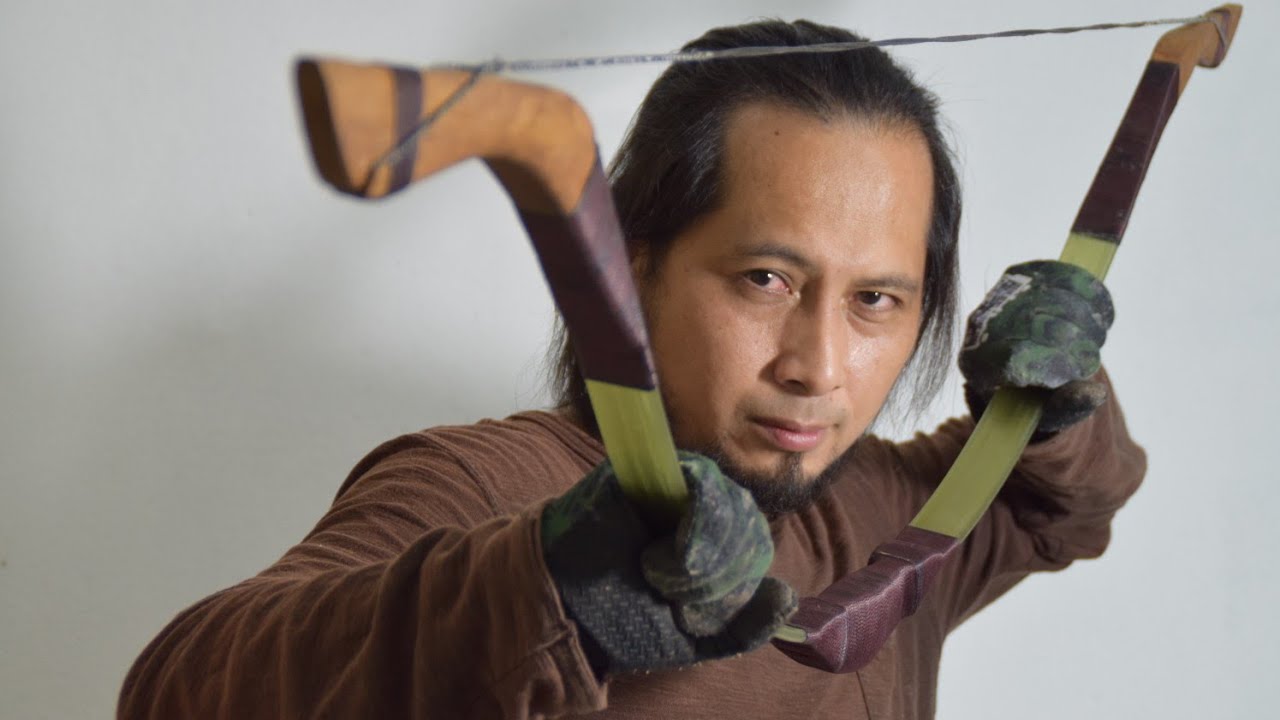
making turkish horse bow epoxy fiberglass 55 lbs at 28 inch
Автор: North Borneo Archer
Загружено: 2021-10-24
Просмотров: 52511
Описание:
making turkish horse bow from epoxy fiberglass as limb + wood for siyah and handle.
epoxy fiberglass strip https://shopee.com.my/ilhammalaysia?s...
draw weight: 55 lbs at 28 inch draw length
brace height: 9.5 inch
efg limb.
length: 110cm one piece
wide: 31mm
thickness: 5mm
handle.
ordinary timber+5mm efg as handle support.
8inch length.
https://en.m.wikipedia.org/wiki/Turki...
The Turkish bow is a recurved composite bow used in the Ottoman Empire. The construction is similar to that of other classic Asiatic composite bows, with a wooden core (maple was most desirable), animal horn on the belly (the side facing the archer), and sinew on the front, with the layers secured together with animal glue. However, several features of the Turkish bow are distinct. The curvature tends to be more extreme when the bow is unstrung, with the limbs curling forward into the shape of the letter "C". With some bows, the rigid tips of the limbs ("kasan") even touch. The grip area is not recessed like other Asianic bows and is fairly flat on the belly, while the front of the grip bulges outwards.
The dramatic curvature of the bows makes stringing them very different from straighter bows found in Europe. There is an old saying in Turkey that there are "120 ways to string a bow," though the most common methods involve sitting on ground with one's feet pressed against the grip. Heavier bows usually require the use of a long, looped strap to pull the limbs back and hold them while the string is seated.
In the modern world, the Turkish bow is now predominantly used for sporting purposes. Authentic horn and sinew bows are still made but are both extremely costly and difficult to store outside certain environments and climates. For this reason, the majority of historically-styled bows of this type are made with some combination of fiberglass, hardwood (for the kasan) and resin, and with some being entirely resin.
https://archeryhistorian.com/turkish-...
The Turks crafted the most sophisticated and powerful bows of the ancient world. They constructed their weapon from materials typical of Asiatic recurve bows – a wooden core, horn on the belly, and sinew on the back. However, the Turkish bow had the most extreme curvature because, when unstrung, the outer limbs would curve forward in a “C” shape and would often touch or overlap. Turkish archers used a thumb draw to operate their bows and frequently wore a thumb ring, or “zihgir,” to protect the digit and assist with the draw.
A traditional Turkish bow is a relatively short bow measuring between 41 and 44 inches from tip to tip when strung. The extreme reflex of the bow limbs, as well as the materials, results in extremely efficient bows. Flight archery (distance shooting) was widely practiced throughout the Ottoman Empire. Distances of 800 meters or more are recorded in Ottoman sources! The Ottomans developed specialized archery equipment to ensure the arrows would travel as far as possible.
https://archeryhistorian.com/horse-bo...
A horse bow is a composite recurve bow used on horseback. The horse bow originated in the Central Asian Steppe and was an essential tool for survival amongst the early pastoralists in this region. The domestication of the horse in Central Asia around 3500 B.C.E. allowed groups of nomadic hunter-gatherers to effectively control large herds and large areas of land. With the additional advent of a sufficient long-range weapon, ancient nomads would dominate the Steppe and cause much trouble for their “civilized” neighbors throughout history.
The early history of these nomads and their composite horse bow is not well recorded, as the people who developed it did not have a written tradition. These early herders and hunter-gathers of the vast grasslands of Eurasia would have come into contact with the early settled civilizations of the Bronze Age (3000 BC – 1200 BC), such as the Egyptians and Chinese. The composite bow was incorporated into the arsenal of these early sedentary people. The Pharaohs of Egypt and Emperors of Ancient Assyria are usually depicted riding into battle with their composite horse bows at full draw. Indeed the earliest depictions of horse archers are from Neo-Assyrian reliefs dated to the 9th century BCE.
At first, the Assyrians used the composite bow in chariots or on foot. A typical Assyrian battle chariot, much like the Egyptian one, was light and would typically hold the driver and an archer. Eventually, individual riders would wield their bows on horseback. Early Assyrian reliefs depict two riders side by side, one with his bow at full draw, while the other rider beside him holds the reigns and controls the archer’s horse. This is reminiscent of the partnership between driver and archer from past chariot based warfare. The co-driver would eventually be abandoned and individual horse archers would ride without assistance.
Повторяем попытку...
Доступные форматы для скачивания:
Скачать видео
-
Информация по загрузке:







![[4K] 1년 동안 만드는 전통 활 '각궁' 제작 과정 'Gakgung' production process](https://image.4k-video.ru/id-video/WjgtsGKdhMs)

