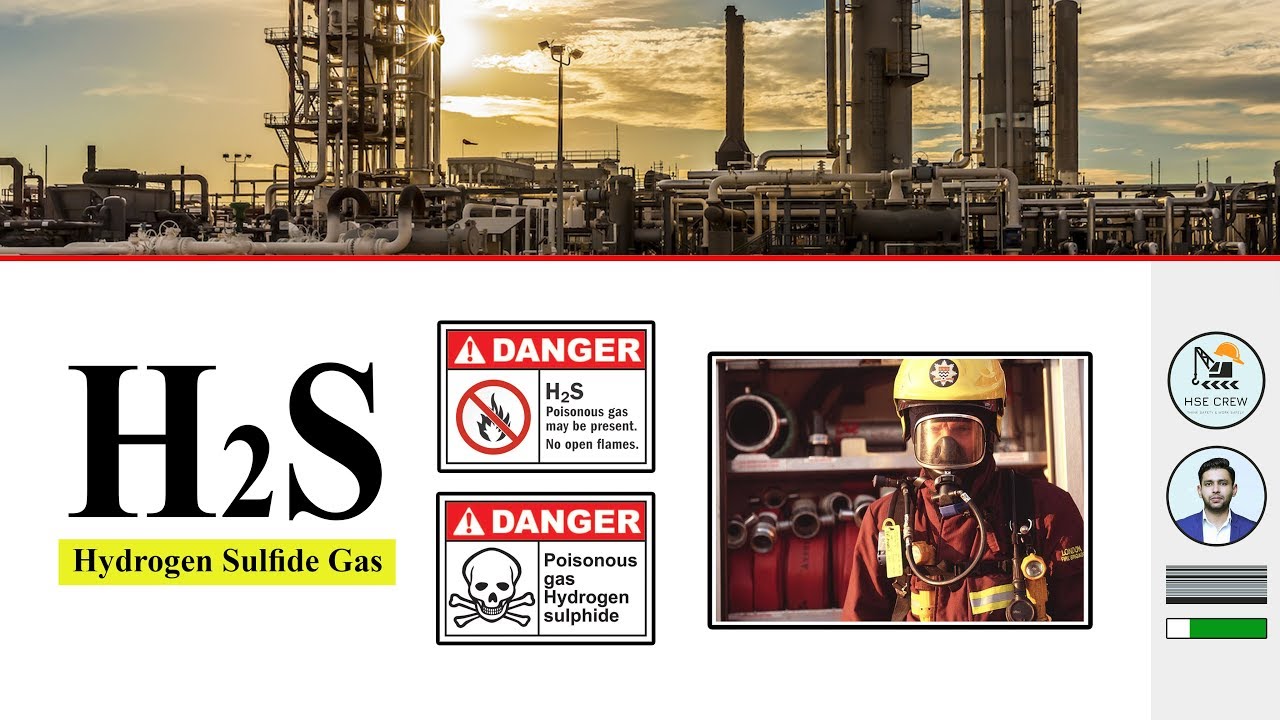
Hydrogen Sulfide (H2S) Gas Complete Description
Автор: HSE Crew
Загружено: 2018-12-21
Просмотров: 22536
Описание:
Hydrogen Sulfide (H2S) Gas:
Hydrogen sulfide is a gas present along with natural gas.
It is a very toxic gas, which in concentrations of more than 700 ppm can cause immediate respiratory paralysis and unconsciousness and death within a few minutes
It is a colorless gas, so we need detectors to detect it. There are three types of detectors, First is fixed detectors in working areas (5-10 ppm alarm level), second is portable gas detectors used for gas testing (10 ppm alarm level), third is personal detectors for personal use (10 ppm alarm level)
It has a rotten egg like odor which is easily detectable even in low concentrations of 0.13 ppm because of olfactory nerve, but at higher concentrations (more than 100 ppm ), H2S causes loss of sense of smell, and hence the nose is not are liable detector for H2S.
H2S (vapor density = 1.1895) is heavier than air (vapor density = 1) and will settle in low lying areas.
It is highly corrosive in certain materials.
It forms an explosive mixture with air / oxygen (LEL=4.3% and UEL=46%) (1% H2S = 10,000 ppm)
Auto ignition temperature for H2S is 518 ℉ (260 oC)
It burns with a bluish flame to produce Sulphur Di-oxide (SO2).
H2S dissolves in to any liquids especially water, producing a mild acid
H2S is also known as sour gas and sulfated hydrogen is highly toxic.
H2S affects human metabolism in two significant ways. It causes cessation of respiratory functions and reduces the ability of blood to carry oxygen to body organs.
Corrosive nature of H2S can lead to equipment failure hazards.
Attack metals, forming phosphoric iron sulfide scale.
Below 1 ppm it gives rotten egg like odor, around 10 ppm eye irritation begins, 300 ppm loss of balance, unconsciousness, at 700 ppm death within 1 to 3 minutes, at 1000 to 2000 ppm coma or death in single breath.
H2S exposures:
Maintenance operations
Pipeline and pump repair
Confined space entry
Unclogging drains
Gas leak investigations
Tank gauging
Sources of H2S:
Oil exploration, extraction and refining.
Natural gas exploration, extraction and processing.
Contaminant in crude oil and natural gas
Synthetic petroleum operation.
Also occurs in Landfills, Sewage, waste water treatment, Laboratories, dye and pigment manufacture.
Maximum Exposure Limit:
MEL is the maximum allowable amount that a worker can be exposed to over 8 hrs working day without any adverse effect.
Types of exposure controls:
First one is Exposure avoidance, second is engineering controls and third is PPEs.
Engineering controls:
Ventilation, monitors, warning system, fixed monitoring system linked to control room in the central control building (CCB), portable multi gas monitoring and personal single gas monitor. LTEL & STEL of different chemicals are as under.
Lower Explosive Limit (LEL):
The minimum amount of flammable vapors or gas in the mixture of air that can ignite in the presence of ignition source is called Lower Explosive Limit (LEL). In case of H2S it is 4.3 % by volume. (1 % by volume is 10,000 ppm)
Upper Explosive Limit (UEL):
The maximum amount of flammable vapors or gas in the mixture of air that can ignite in the presence of ignition source is called Upper Explosive Limit (UEL). In case of H2S it is 46 % by volume. (1 % by volume is 10,000 ppm)
Повторяем попытку...
Доступные форматы для скачивания:
Скачать видео
-
Информация по загрузке: