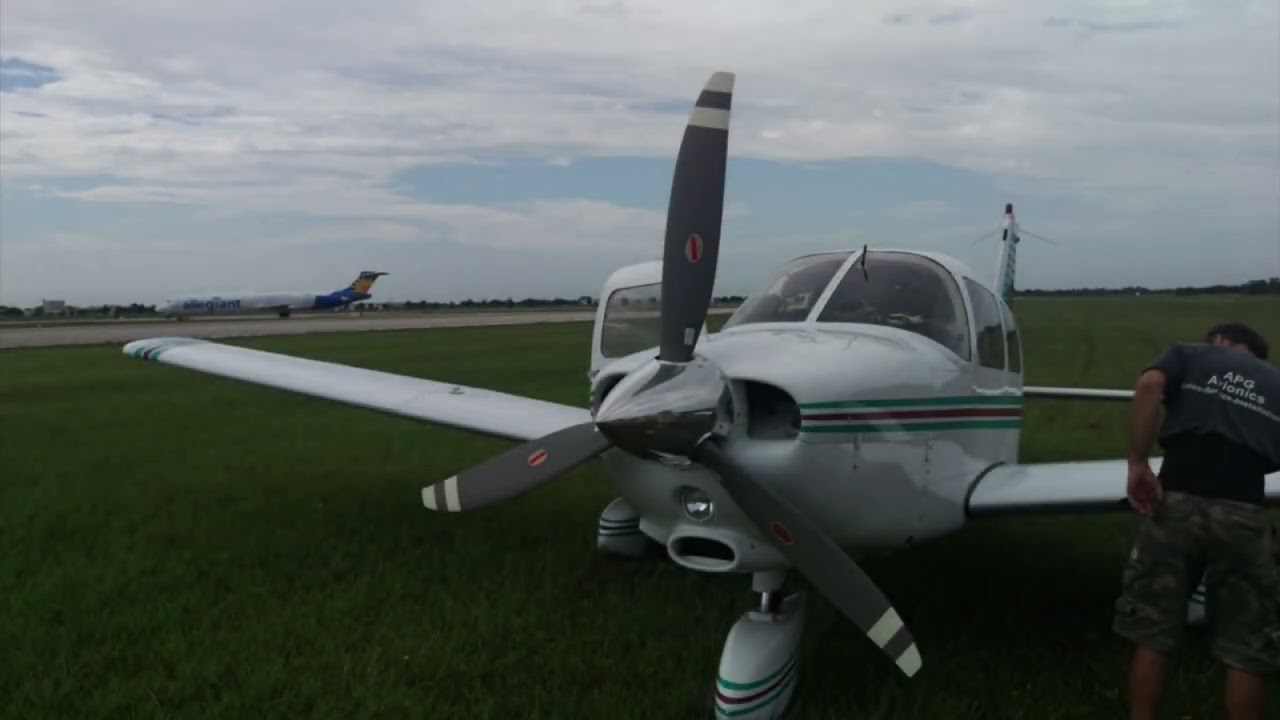
Piper Dakota Blown Off By MD-83 Jet Blast at Punta Gorda Airport, Florida (June 17, 2016)
Автор: Aviation Accidents / NTSB Case Reviews
Загружено: 2024-10-03
Просмотров: 7933
Описание:
Original Publish Date: September 10, 2018
On June 17, 2016, about 1709 eastern daylight time, a Piper PA-28-236, N8161X, sustained substantial damage during landing roll out at the Punta Gorda Airport (PGD), Punta Gorda, Florida. The private pilot and the two passengers were not injured. The airplane was registered to a private company and operated by the pilot. A visual flight rules flight plan was filed for the personal flight that departed Peter O. Knight Airport (TPF), Tampa, Florida, about 1630 and was destined for PGD. Visual meteorological conditions prevailed for the personal flight conducted under the provisions of 14 Code of Federal Regulations Part 91.
The private pilot stated that, during the landing roll, the airplane suddenly departed the left side of the 150-ft-wide runway into the grass, resulting in substantial damage to the left wing. The pilot initially thought a tire had blown, but when he exited the airplane, he noticed a McDonnell-Douglas MD-83 parked on the movement area of the adjacent taxiway performing a maintenance test run of its engines and realized he had been blown off the runway.
Before the accident, the tower controller had cleared the MD-83 to position itself in the movement area adjacent to the landing runway; the positioning resulted in the engine and resultant exhaust being directed toward the landing area of the runway. The controllers did not warn the accident pilot about the MD-83 and its purpose on the taxiway, as required per FAA policy. Additionally, the local procedures for positioning transport category airplanes to do engine test runs was not formally documented, and the informal procedure in use at the time of the accident did not adequately protect aircraft operating on the airport from jet blast. The estimated idle jet engine exhaust velocity of the MD-83 was 35 knots. Combined with the prevailing wind, the estimated sudden right quartering headwind acting on the accident airplane would have been about 39 knots. As a result of this investigation, the air traffic control tower and airport authority developed and disseminated procedures for conducting high-power engine test runs in the movement area of the airport.
Probable Cause: The tower controller’s failure to identify and mitigate jet blast from an airplane conducting an engine test run, and the effect of the jet blast on landing traffic, which resulted in a runway excursion when a landing airplane encountered the blast. Contributing to the accident was the lack of procedures for positioning high-powered airplanes conducting engine test runs in the airport movement area.
Report:
https://data.ntsb.gov/carol-repgen/ap...
Docket:
https://data.ntsb.gov/Docket?ProjectI...
Повторяем попытку...
Доступные форматы для скачивания:
Скачать видео
-
Информация по загрузке: