Understanding Time-of-Day (TOD) Charges in Your Electricity Bill
Автор: Flirting with Technology
Загружено: 2024-05-07
Просмотров: 2873
Описание:
Understanding Time-of-Day (TOD) Charges in Your Electricity Bill
Ever wondered why your electricity bill fluctuates throughout the year? It could be due to a billing system called Time-of-Day (TOD) pricing.
This system is becoming increasingly common in some areas, and it can help you save money if you understand how it works.
What is TOD Pricing?
TOD pricing is a billing system that charges different rates for electricity based on the time of day. Typically, there are three time periods:
Peak hours: These are the hours when electricity demand is highest, such as weekdays from afternoon to evening.
Off-peak hours: These are the hours when electricity demand is low, such as late night and early morning.
Shoulder hours: These are the hours in between peak and off-peak hours.
The cost per unit of electricity will be highest during peak hours and lowest during off-peak hours. Shoulder hours may have a rate in between the two.
Benefits of TOD Pricing
Save money: By shifting your electricity usage to off-peak hours, you can potentially save money on your electricity bill. For example, consider running laundry or using dishwashers at night instead of during peak hours.
Reduced strain on the power grid: By encouraging consumers to use less electricity during peak hours, TOD pricing can help to reduce the strain on the power grid. This can lead to fewer blackouts and more reliable electricity service.
How to Calculate TOD Charges
If you have TOD pricing, your electricity bill will show the amount of electricity you used during each time period, as well as the rate per unit for each time period.
To calculate your total TOD charges, you simply multiply the number of units you used in each time period by the corresponding rate per unit and then add those numbers together.
Example:
Let's consider a scenario with the following rates:
Normal hours: ₹7/unit
Off-peak hours: ₹3.5/unit
Peak hours: ₹10.5/unit
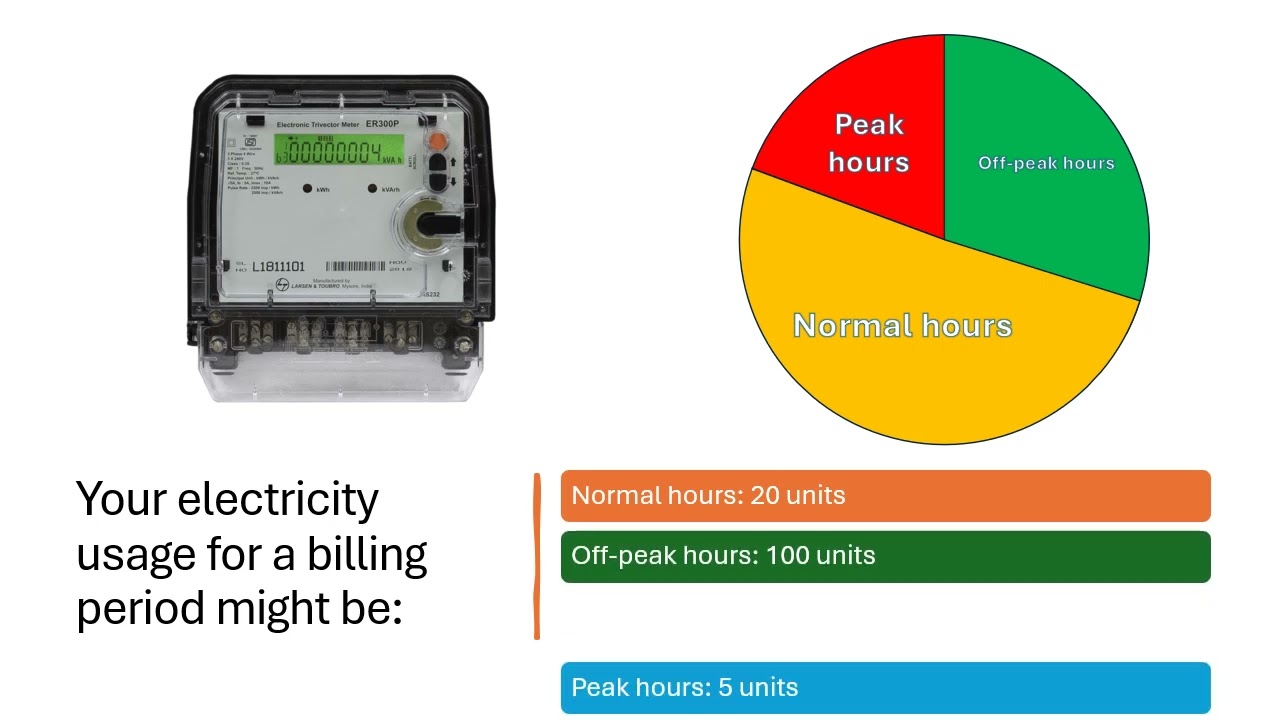
Your electricity usage for a billing period might be:
Normal hours: 20 units
Off-peak hours: 100 units
Peak hours: 5 units
Here's how to calculate the TOD charges:
TOD charges = (Normal hours * Rate) + (Off-peak hours * Rate) + (Peak hours * Rate)
= (20 units * ₹7/unit) + (100 units * ₹3.5/unit) + (5 units * ₹10.5/unit)
= ₹140 + ₹350 + ₹52.50
Total TOD charges = ₹542.50
Normal Bill Charges
If you had not been on a TOD pricing plan and instead paid a flat rate of ₹7/unit for all your electricity usage, your bill would have been ₹7/unit * 125 units = ₹875. By shifting some of your electricity usage to off-peak hours, you saved ₹875 - ₹542.50 = ₹332.50 on your electricity bill.
Finding Out If You Have TOD Pricing
The best way to find out if you have TOD pricing is to check your electricity bill. Your bill should explain the different time periods and the rates for each period. You can also contact your electricity provider for more information.
Conclusion
TOD pricing can be a great way to save money on your electricity bill and help to reduce the strain on the power grid. By understanding how TOD pricing works and making some adjustments to your electricity usage habits, you can take advantage of this billing system.
Повторяем попытку...
Доступные форматы для скачивания:
Скачать видео
-
Информация по загрузке: