Why Free Markets Always Need the State
Автор: Financial Historian
Загружено: 2026-06-15
Просмотров: 2482
Описание:
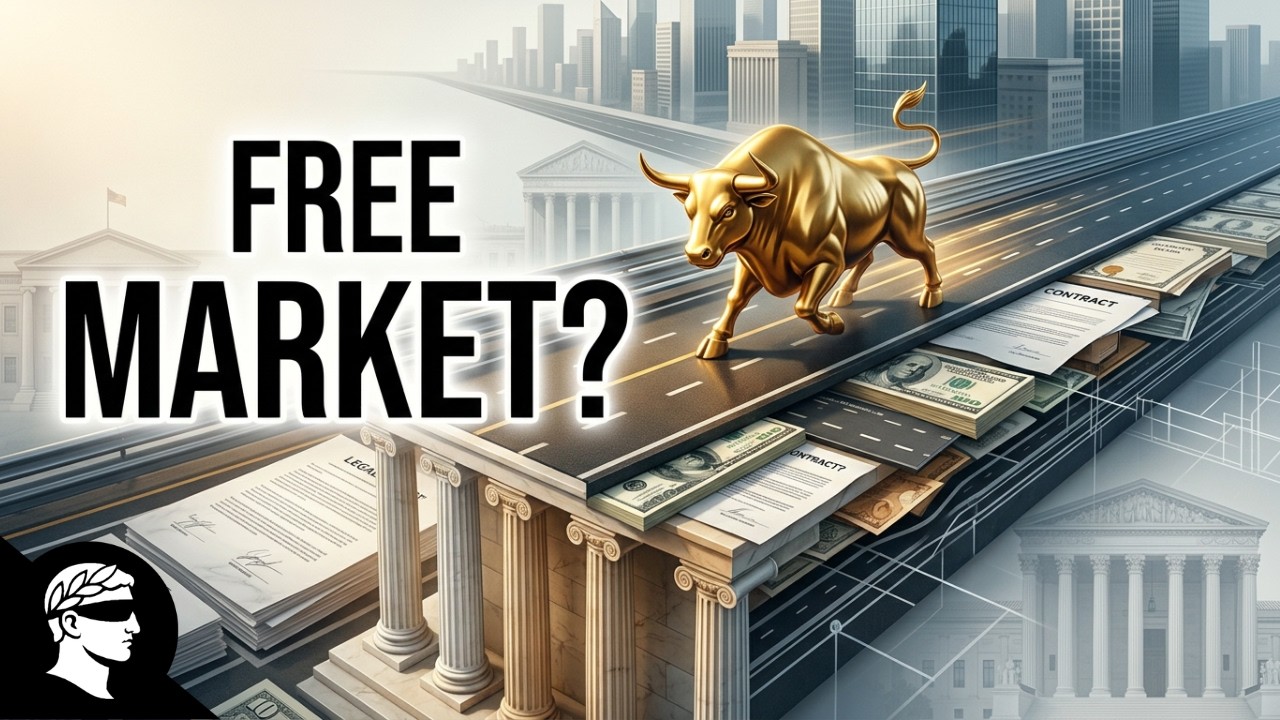
In this episode of The Financial Historian, we break down one of the biggest myths in modern economic history: the idea that free markets exist without the state. From property rights and courts to central banks, public infrastructure, banking systems, bailouts, contracts, currency, and crisis rescue, this video shows why capitalism has always depended on political power. Markets are real. Competition is real. Private enterprise is real. But none of it works without the legal, financial, and institutional architecture built by the state. The real question is not whether government is involved in the economy — it already is. The real question is who the state protects, who pays for the system, and who profits from calling it “free.”
Key Facts & Insights
• Free markets depend on state-built foundations: property rights, contract enforcement, courts, currency, banking rules, infrastructure, and legal recognition of corporations.
• Property is not just possession — it is a legal claim backed by state power, courts, police, title systems, and enforceable contracts.
• Modern banking relies on public trust through central banks, deposit insurance, legal tender, regulated payment systems, and emergency crisis support.
• Historically, markets expanded inside political orders — from Roman roads and coinage to medieval charters, imperial trading companies, railroads, patents, and industrial infrastructure.
• During financial crises, the language of “free market discipline” often disappears and is replaced by liquidity, bailouts, systemic risk, central bank intervention, and public rescue.
• The 2008 financial crisis and COVID-era interventions showed how deeply private markets depend on public support when collapse threatens the wider financial system.
• The debate is rarely “state versus market.” The real debate is which state, for whom, and at whose expense.
• Financial freedom begins with understanding that the financial system is not natural or neutral — it is designed, protected, rescued, and shaped by money and power.
Further Reading
• The Great Transformation by Karl Polanyi — a foundational work on how markets are embedded in law, society, state power, and political institutions.
• The Entrepreneurial State by Mariana Mazzucato — a sharp look at how public investment, research, and state-backed risk-taking helped create major private-sector innovation.
• The Rise of the Regulatory State of the South by Navroz K. Dubash and Bronwen Morgan — a useful lens on how regulation, institutions, and state capacity shape modern markets beyond the usual Western framework.
#FinancialHistory #FinanceExplained #HowMoneyWorks #EconomicHistory #MoneyAndPower #FinancialEducation #FreeMarkets #CapitalismExplained #FinancialSystem #CentralBanks #Bailouts #PropertyRights #BankingSystem #EconomicPolicy #MarketEconomy #WealthInequality #CorporatePower #StatePower #FinancialFreedom #TheFinancialHistorian
If this gave you a new perspective, hit subscribe. History has the answers—and I’ll show you where to look.
Повторяем попытку...
Доступные форматы для скачивания:
Скачать видео
-
Информация по загрузке: