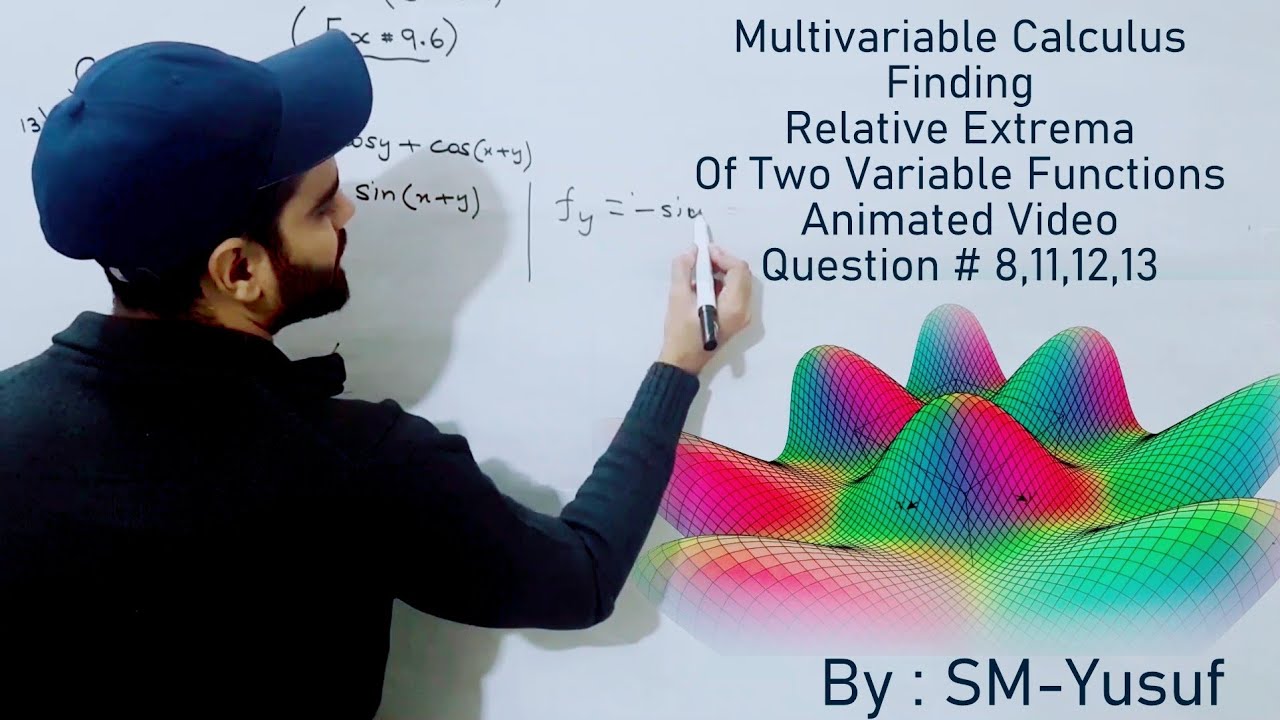
Calc-II || Finding Relative Extrema || Ex 9.6 ||Question # 8 ,11 ,12 ,13 By : Muhammad Anas Amjad
Автор: Study Circle Academy
Загружено: 2021-01-30
Просмотров: 1145
Описание:
You remember how to find local extrema (maxima or minima) of a single variable function f(x). Let's assume f(x) is differentiable. Then the first step is to find the critical points x=a, where f′(a)=0. Just because f′(a)=0, it does not mean that f(x) has a local maximum or minimum at x=a. But, at all extrema, the derivative will be zero, so we know that the extrema must occur at critical points.
For example, in the graph below, f(x) is plotted by a green line. The three critical points are marked by colored circles. The red circle marks a local maximum and the blue circle marks a local minimum. The yellow circle marks a critical point that is neither a maximum or a minimum. Even though f′(x)=0 at the yellow circle, the yellow circle does not mark a local extremum.
If f(x) is a function of multiple variables, categorizing local extrema proceeds in an analogous way. So that we can visualize f(x), we look only at the case of two variables, x=(x,y), where we can graph f(x,y) as a surface. Assuming f(x,y) is differentiable, local extrema can occur only at critical points (x,y)=(a,b), where the derivative of f(x,y) is zero, i.e., those points (a,b) where Df(a,b)=[0 0].
If Df(a,b)=[0 0], then the linear approximation (i.e, tangent plane) of f(x,y) at (a,b) is a horizontal plane. As in the one-variable case, we can determine if f has a local extremum at (a,b) by looking at the secord-order Taylor polynomial. If we let (a,b)=a (remember that (x,y)=x), then the second-order Taylor polynomial is
f(x)≈f(a)+12(x−a)THf(a)(x−a).
All this equation says is that, around x=a, the graph of z=f(x,y) looks like a quadric surface (unless Hf(a,b) is zero). In fact, f(x,y) will look like a paraboloid.
Depending on the second derivative matrix Hf(a,b), the graph of f(x,y) might look like an elliptic paraboloid pointing upward, centered at the point (a,b) (shown by the blue dot, below). In this case, we say that Hf(a,b) is positive definite, and f has a local minimum at (a,b).
There is a third possibility that couldn't happen in the one-variable case. The graph of f(x,y) might look like a hyperbolic paraboloid centered at the point (a,b) (shown by the green dot, below). In this case, the graph looks like a local maximum if you move in one direction (the direction where one's legs would go if one sat on the saddle) and the graph looks like a local minimum if you move in another direction (the direction corresponding to the front and back if one sat on the saddle). In this case, we say that Hf(a,b) is indefinite, and f has neither a local maximum nor a local minimum at the critical point. Such a critical point is called a saddle point.
Повторяем попытку...
Доступные форматы для скачивания:
Скачать видео
-
Информация по загрузке: