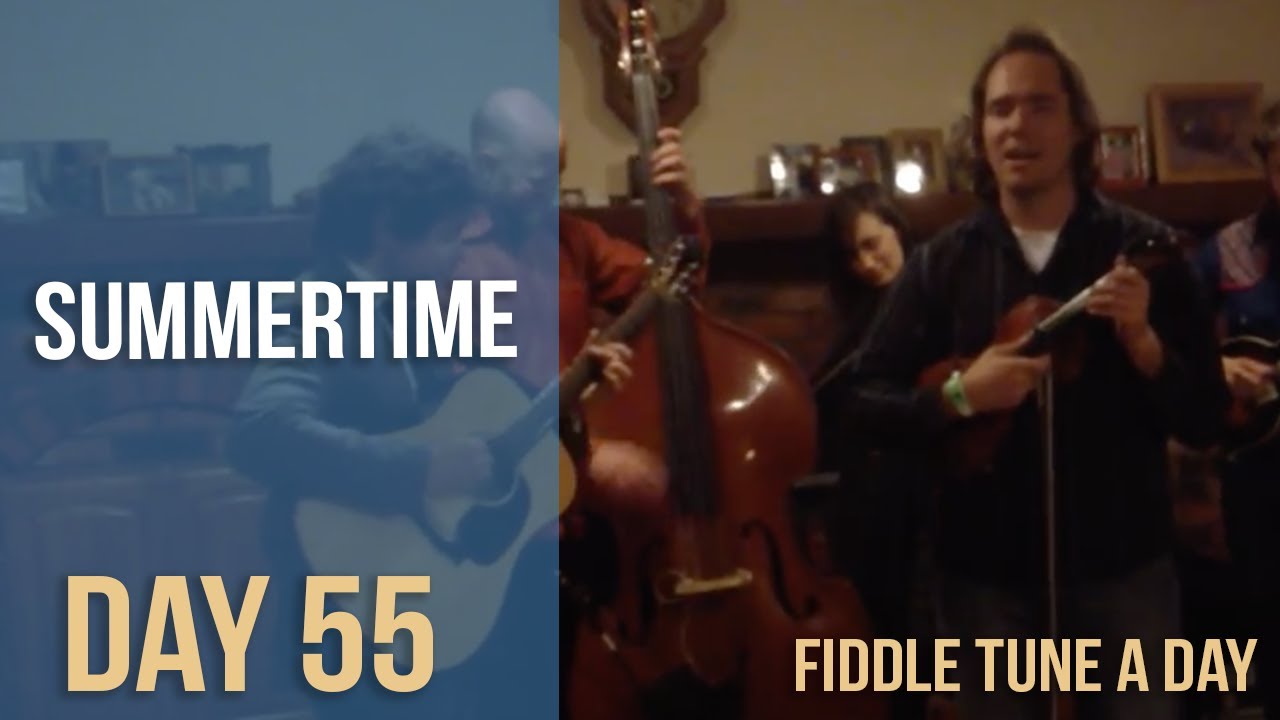
Summertime - Fiddle Tune a Day - Day 55
Автор: Vi "The Fiddler" Wickam
Загружено: 2012-02-25
Просмотров: 2770
Описание:
Signup for Vi Wickam's Fiddle Tune a Day: http://www.vithefiddler.com
Buy Summertime on my album, Long Time Comin': https://www.vithefiddler.com/product/...
Summertime is one of my all-time favorites. I remember the first time I heard it; I was listening to the Four World Champion Fiddlers album that featured Benny Thommasson, Terry Morris, Jim "Texas Shorty" Chancellor, and Mark O'Connor. I wore that record out. I hope that Mark O'Connor decides to reissue it. I will definitely buy a copy if he does. Shorty's rendering of Summertime was so cool, it was smooth and full of soul. Soon after, I heard Janis Joplin sing it, and I was hooked for good. The emotion in her voice was so authentic and heart-felt that it moved me.
Grant Gordy is a beast of a guitar player, and the members of his quartet all stand on their own as tremendous musicians. I had a great time recording Summertime with them after listening to them play an awesome house concert.
More about the Grant Gordy Quartet:
http://www.grantgordy.com
More about Vi Wickam
Website: http://www.vithefiddler.com
Facebook: / vithefiddler
Twitter: / vithefiddler
Summertime according to Wikipedia
"Summertime" is an aria composed by George Gershwin for the 1935 opera Porgy and Bess. The lyrics are by DuBose Heyward, the author of the novel Porgy on which the opera was based, although the song is also co-credited to Ira Gershwin by ASCAP.[1]
The song soon became a popular and much recorded jazz standard, described as "without doubt... one of the finest songs the composer ever wrote....Gershwin's highly evocative writing brilliantly mixes elements of jazz and the song styles of African-Americans in the southeast United States from the early twentieth century."[2] Composer and lyricist Stephen Sondheim has characterised Heyward's lyrics for "Summertime" and "My Man's Gone Now" as "the best lyrics in the musical theater".[3] The song is recognized as one of the most covered songs in the history of recorded music, with more than 25,000 covers by groups and solo performers.[4]
Gershwin began composing the song in December 1933, attempting to create his own spiritual in the style of the African American folk music of the period.[5][6] Gershwin had completed setting DuBose Heyward's poem to music by February 1934, and spent the next 20 months completing and orchestrating the score of the opera.[7]
The song is sung multiple times throughout Porgy and Bess, first by Clara in Act I as a lullaby and soon after as counterpoint to the craps game scene, in Act II in a reprise by Clara, and in Act III by Bess, singing to Clara's baby.
It was recorded for the first time by Abbie Mitchell on 19 July 1935, with George Gershwin playing the piano and conducting the orchestra (on: George Gershwin Conducts Excerpts from Porgy & Bess, Mark 56 667).
Musical analysis
Musicologist K. J. McElrath wrote of the song:[7]
"Gershwin was remarkably successful in his intent to have this sound like a folk song. This is reinforced by his extensive use of the pentatonic scale (C-D-E-G-A) in the context of the A minor tonality and a slow-moving harmonic progression that suggests a "blues." Because of these factors, this tune has been a favorite of jazz performers for decades and can be done in a variety of tempos and styles."
Heyward's inspiration for the lyrics was the southern folk spiritual-lullaby All My Trials, of which he had Clara sing a snippet in his play Porgy.[8][9] While in his own description, Gershwin did not use any previously composed spirituals in his opera, Summertime is often considered an adaptation of the Afro-American spiritual Sometimes I Feel Like a Motherless Child, which ended the play version of Porgy.[9][10][11] Alternatively, the song has been proposed as an amalgamation of that spiritual and the South-Russian Yiddish lullaby Pipi-pipipee.[12] The Ukrainian-Canadian composer and singer Alexis Kochan has suggested that some part of Gershwin's inspiration may have come from having heard the Ukrainian lullaby, Oi Khodyt Son Kolo Vikon (A Dream Passes By The Windows) at a New York City performance by Oleksander Koshetz's Ukrainian National Chorus in 1929 (or 1926).[13]
Повторяем попытку...
Доступные форматы для скачивания:
Скачать видео
-
Информация по загрузке: