Secondary Strikes: Blendhau
Автор: Björn Rüther
Загружено: 2016-05-14
Просмотров: 14226
Описание:
Transkription/Translation:
Blendthauw (14recto)
Bindt dem Mann von deiner Rechten an sein Schwerdt / windt im Bandt mit dem gehültz oder Hefft unden durch gegen seiner Lincken seiten /wann nun dein widerpart dem winden wilt nachwischen / so schnell geschwindt von deiner Rechten gegen seiner Lincken mit geschrenckten Henden / die schweche zu seinem Kopff / das ist der vorder ort / windt behend wider durch / oder reiß auff deiner Lincken seiten mit halber schneiden auß / so hastu den Blendthauw volbracht / dieser Blendthauw wirdt auff vil wege gemacht. Darvon in Stucken weiter.
Blendthauw (61recto)
Den Blendthauw soltu lassen bröllen /
Umbwirff die Zwirch /
fleiß dich des schnellen.
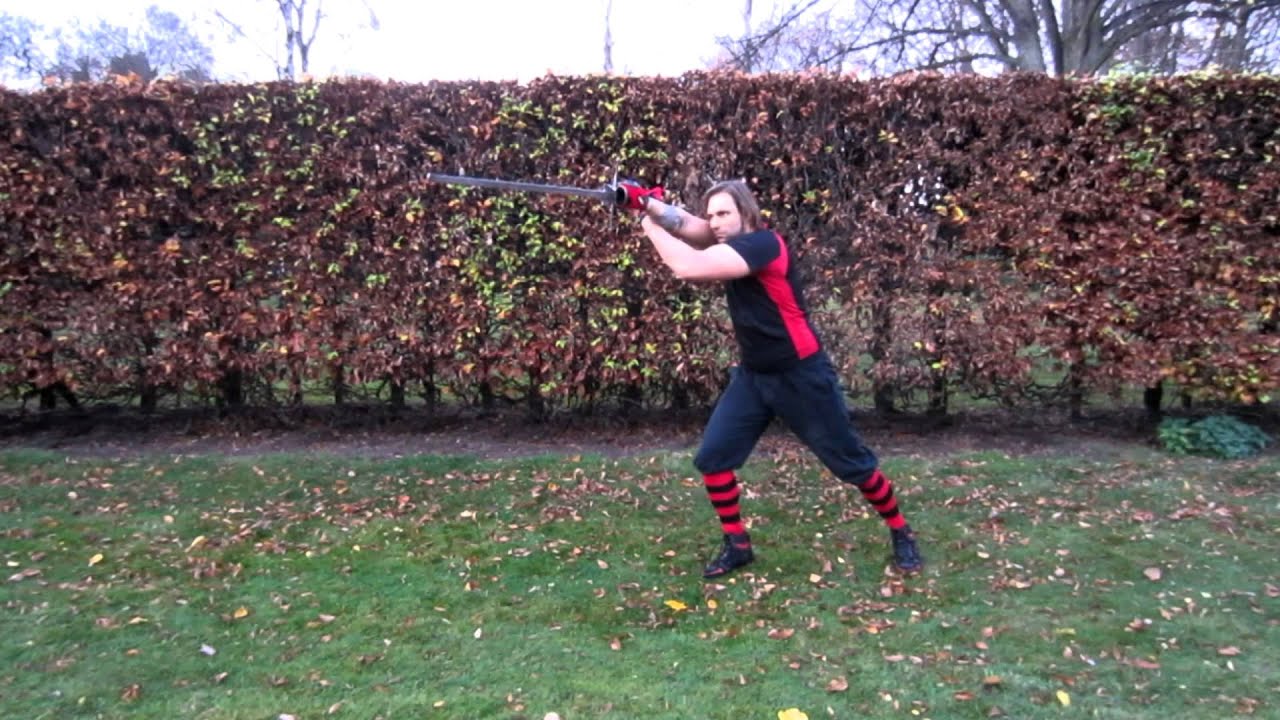
Streich den Langen ort in sein gesicht / trit und zucke dein Schwerdt umb den Kopff / und schlag mit inwendiger flech von deiner Rechten / zu seinem Lincken ohr /durch die mittel Lini / nimm den Kopff wol mit / und windt behendt an seinem Schwerdt wider umb die außwendigef flech / auch zu seinem Lincken.
---
Blind strike (14recto)
Bind your opponent from your right on his sword, in the bind, wind through below with your hilt or haft toward his left side. When your opponent tries to slip after the winding, then nimbly flick the weak, that is the point, at his head from your right at his left with crossed hands. Quickly wind back through, or wrench to your left side with the short edge, thus you have executed the Blind strike. This Blinde strike is done in many ways, there will be more about it in the section on plays.
Blind strike (61recto)
You shall let the Blind strike bellow /
cast the Thwart around /
be diligent about the flicking.
Slash the Longpoint in his face, step and pull your sword around your head, and strike with the inside flat from your right at his left ear through the Middle Line, take your head well out of the way with this, and wind the outside flat quickly back in on his sword also to his left.
---
BTW: What is the difference between Doplieren and Blendhau?
As a lot of swordwork these two techniques are very similiar. In our opinion the difference is the intent behind the strike. While the Doplieren doubles a strike from long to short edge, the Blendhau results in just a flicking to the face with the flat. Doplieren can harm the opponent very badly. After all, the Blendhau is a bit more gentle. The Blendhau mostly causes lacerations, but this will not kill our opponent.
Meyer presents us many options to sort out a problem, including ones that are not lethal – a necessity in Fechtschulen and for self-defense in „modern“, law-regulated cities of the 16th century.
Learn Sword Fighting - Martial Arts of the 16. century
with Meyer Class Hammaborg
Повторяем попытку...

Доступные форматы для скачивания:
Скачать видео
-
Информация по загрузке: