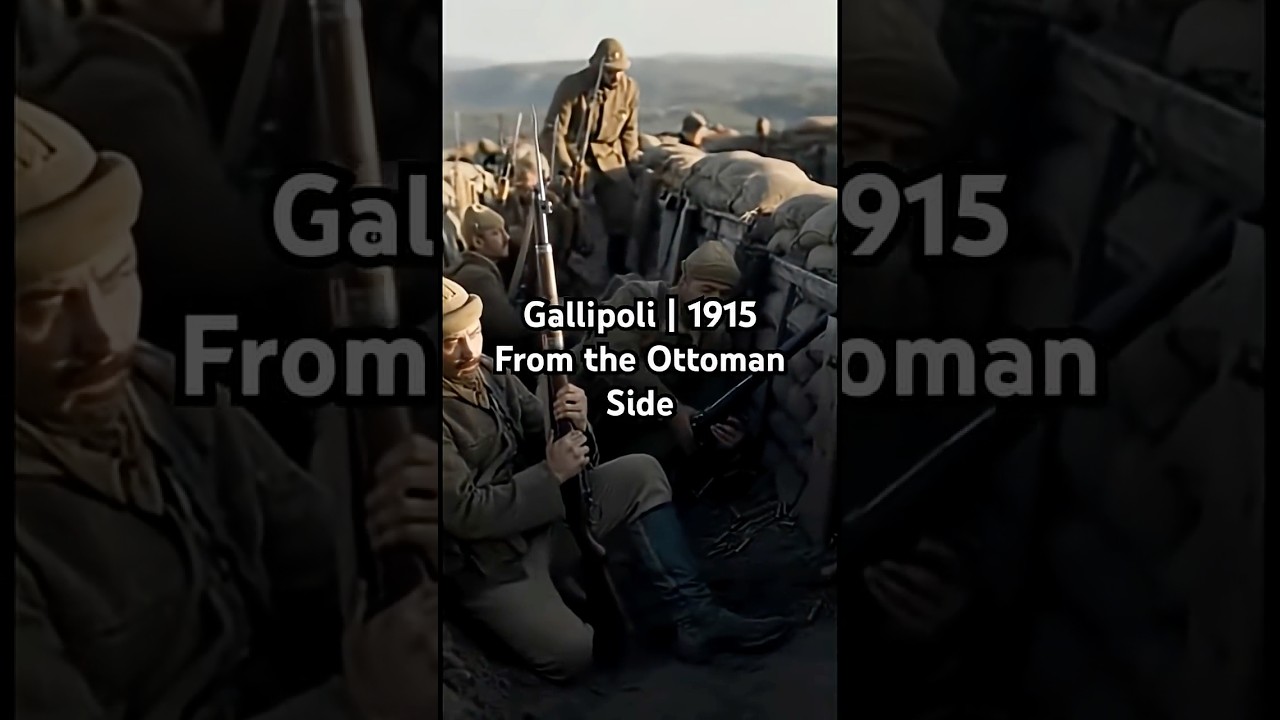
🪖Gallipoli 1915 | Ottoman (Turkish) Perspective
Автор: @itsaihistory
Загружено: 2025-10-24
Просмотров: 115818
Описание:
Why was the Ottoman Empire involved in World War I?
The Ottoman Empire entered World War I alongside the Central Powers — Germany, Austria-Hungary, and Bulgaria. Several motivations drove this decision: the empire sought survival, territorial integrity, and a chance to reverse decades of decline after losing much of its territory in the 19th century. German influence played a decisive role. A secret alliance was signed with Germany in August 1914, strengthened by years of German military training, industrial loans, and construction of the Berlin–Baghdad railway. On 29 October 1914, Ottoman warships with German crews attacked Russian ports in the Black Sea — an act that prompted Russia, Britain, and France to declare war on the Ottomans.
Why the Ottomans sided with Germany:
By 1914, the empire’s leadership viewed Germany as its best chance to modernize and survive. Germany provided military advisors, equipment, and infrastructure that the Ottomans desperately needed. The alliance offered protection against Russian expansion in the Caucasus and British naval dominance. After the German cruisers Goeben and Breslau joined the Ottoman fleet and flew Ottoman flags, the partnership became irreversible — pulling the empire into the war on Germany’s side.
Where was the Battle of Gallipoli fought?
The Gallipoli (or Dardanelles) Campaign took place on the Gallipoli Peninsula in north-western Anatolia — in modern-day Turkey, along the narrow strait of the Dardanelles (Çanakkale Strait) separating Europe and Asia. The Allies — primarily Britain, France, and ANZAC forces (Australia and New Zealand) — sought to force the strait, capture Constantinople (Istanbul), and open a sea route to Russia through the Black Sea.
Why the Ottomans were in the trenches:
After the Allied landings in April 1915, the Gallipoli front quickly settled into trench warfare, similar to the Western Front in France. The Ottoman 5th Army, commanded by Liman von Sanders and including divisions under Mustafa Kemal, built long defensive trench networks along the ridges and hills overlooking the beaches. From these positions, Turkish soldiers endured constant artillery fire, sniping, disease, and heat — for months at a time. Their orders were to hold every ridge and repel any landing, forcing attackers to fight uphill under devastating conditions. Artillery shelling from Allied ships and howitzers pounded the trenches daily, causing steady casualties. Snipers and shrapnel frequently wounded soldiers even during quiet periods. Field medics treated injuries on the spot, often rewrapping wounds or bandaging men before renewed fighting.
Why the Ottoman defenders won the battle:
Defensive terrain: Ottoman forces held the high ground and constructed strong, interconnected trench systems above the Allied landing beaches. Allied delays and underestimation: The Allies paused after their failed naval assault, giving the Ottomans time to reinforce and fortify. Leadership and morale: Commanders such as Mustafa Kemal (Atatürk) rallied local troops, showing tactical skill and determination to defend their homeland. Allied logistical strain: Difficult terrain, heat, disease, and supply problems crippled the invading forces. The result was a stalemate that turned into an Allied withdrawal by January 1916 — a major victory for the Ottoman Empire.
Implications of the Battle
For Turkey / the Ottoman Empire: The Gallipoli victory became a defining moment in Turkish national memory, symbolizing resilience and unity. It boosted morale during a brutal war and is often seen as the event that forged the spirit of the future Turkish Republic.
For the Allies: The failure at Gallipoli caused massive casualties and political fallout, particularly in Britain. Winston Churchill, then First Lord of the Admiralty, had championed the plan — and its failure temporarily ended his political career.
Geopolitical effects: The campaign prolonged the war in the region and delayed Allied plans to divide Ottoman territories. After the war, those divisions shaped the modern Middle East (including the borders of Iraq, Syria, and Turkey).
What the Battle Means to the Turkish People Today:
Gallipoli — known in Turkey as Çanakkale Zaferi (“the Victory of Çanakkale”) — is remembered as a symbol of national courage, sacrifice, and unity. Each year, March 18 is observed as Çanakkale Victory and Martyrs’ Day, honoring the soldiers who defended their homeland against a vastly larger invading force.
For modern Turks, Gallipoli represents:
The birth of a modern national consciousness, later embodied by Mustafa Kemal Atatürk, who fought there and became the founder of the Republic.
A moment of shared sacrifice, where men from every province of the Ottoman Empire stood together.
#turkey #militaryhistory #history #itsaihistory #england #britain #ottomanempire #centralpowers #shorts
Повторяем попытку...
Доступные форматы для скачивания:
Скачать видео
-
Информация по загрузке: