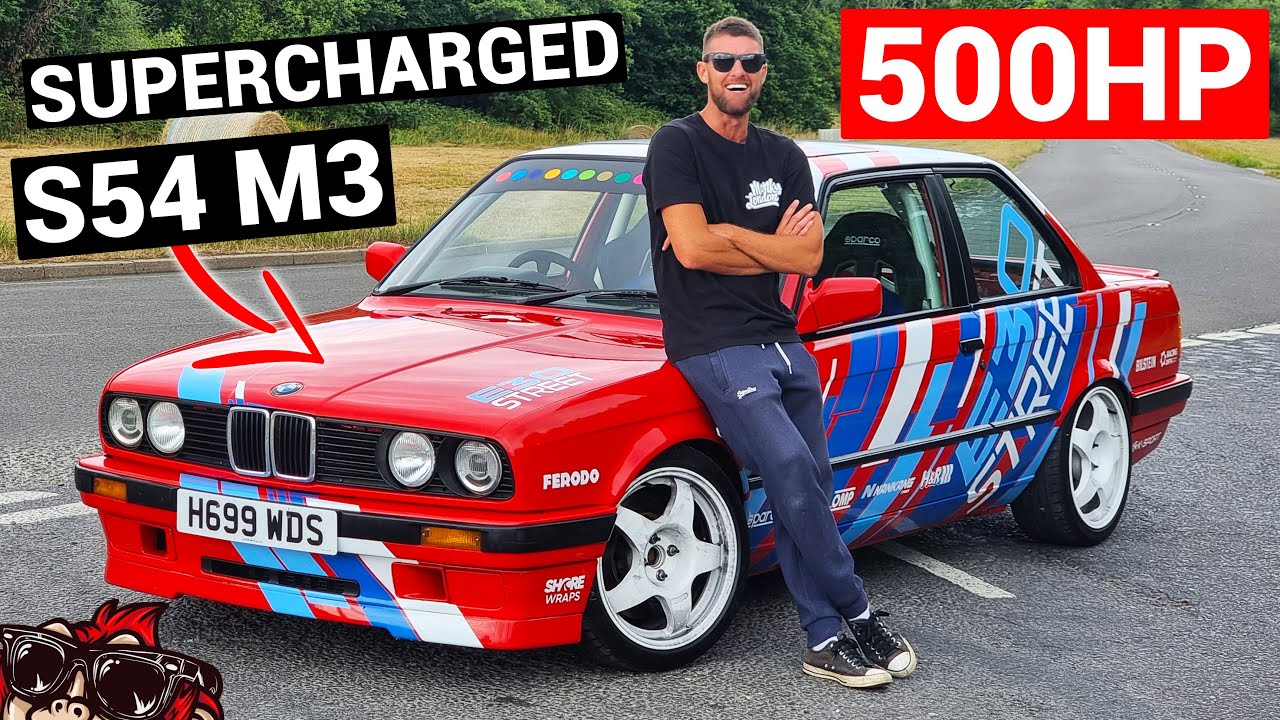
🐒 INSANE 500HP SUPERCHARGED BMW E30 REVIEW! S54 E46 M3 SWAP
Автор: MONKY LONDON
Загружено: 2022-08-08
Просмотров: 53142
Описание:
Full review of Scott's absolutely mental BMW E30 running a supercharged S54 from a E46 BMW M3! 500hp, well sorted RWD chassis, immense brakes, lightweight and all the way from bonny Scotland! Strap up as John takes you on a mental ride! Enjoy the review homies and homettas, ML 💪
---
🐒 Official ML merch! ! - http://monkylondon.com
🐒 Join the family! - / monkylondon
🐒 Follow me on Twitch! - / monkylondontv
Keep up to speed! -
► Instagram: / monkylondon
► Facebook: / monkylondon
► Twitter: / monkylondon
► Patreon: / monkylondon
► Merchandise: http://monkylondon.com
Send us cool stuff with the possibility of getting it featured on the channel! :)
Monky London, Carson Performance, Unit 10, Home Farm, Rad Lane, Dorking, Surrey. RH5 6RA. England
Don't miss out out on the latest ML madness, do a subscribe! - / monkylondon
Want to have your car featured on the channel and have something sick to show the grandkids? See here yo:
https://www.monkylondon.com/pages/fea...
---
#500HP #RWD #SENDIT
🐒 THE GETAWAY DRIVER - S54 SUPERCHARGED BMW E30 REVIEW
The BMW E30 is the second generation of BMW 3 Series, which was produced from 1982 to 1994 and replaced the E21 3 Series. The model range included 2-door coupe and convertible body styles,[4][5] as well as being the first 3 Series to be produced in 4-door sedan and wagon/estate body styles. It was powered by four-cylinder petrol, six-cylinder petrol and six-cylinder diesel engines, the latter a first for the 3 Series. The E30 325iX model was the first BMW to have all-wheel drive.
The first BMW M3 model was built on the E30 platform and was powered by the high-revving BMW S14 four-cylinder petrol engine, which produced 175 kW (235 bhp) in its final iteration.[6] The BMW Z1 roadster was also based on the E30 platform. Following the launch of the E36 3 Series in 1990, the E30 began to be phased out.
Interior of a 316i model
Development of the E30 3 Series began in July 1976, with styling being developed under chief designer Claus Luthe[7] with exterior styling led by Boyke Boyer.[8] In 1978, the final design was approved, with design freeze (cubing process) being completed in 1979. BMW's launch film for the E30 shows the design process including Computer-aided design (CAD), crash testing and wind-tunnel testing.[9] The car was released at the end of November 1982.[10][11][12][13]
Externally, the E30's appearance is very similar to twin headlight versions of its E21 predecessor, however there are various detail changes in styling to the E30. Major differences to the E21 include the interior and a revised suspension, the latter to reduce the oversteer for which the E21 was criticised.[14]
1985-1987 BMW 318i
In 1985 the exterior and interior trim were updated. The 323i model was replaced with the 325i at this time and the diesel-engined 324d was introduced.[15] A factory convertible entered the model range. However, the Baur remained on sale, alongside the factory convertible. The M3 convertible was only offered for the European market.
1987 update
At the Frankfurt Motor Show in September 1987, BMW introduced a major update to the E30 (often called Series 2).[15][16] The changes to the lineup were the addition of the Touring (station wagon) variant and removal of the 325e model. The 1987 update models remained largely unchanged until the end of production, with the addition of the 318is model in 1989.
External styling changes included redesigned rear lights, front bumper and a reduction in the amount of chrome trim.[16] The four-cylinder engine was upgraded from the BMW M10 to the BMW M40 and various other mechanical changes were made. Rust protection was improved with the update.
In addition to the two-door sedan and Baur convertible body styles of its E21 predecessors, the E30 later also became available as a four-door sedan and five-door station wagon (marketed as "Touring").[17]
The Touring body style began life as a prototype built by BMW engineer Max Reisböck in his friend's garage in 1984 and began production in 1987.[18][19] The factory convertible version began production in 1985, with the Baur convertible conversions remaining available alongside it.[20] nitially, the E30 used carryover four-cylinder (M10) and six-cylinder (M20) petrol engines from its E21 predecessor.[21] Over the production run, new families of four-cylinder petrol engines were introduced and the six-cylinder engine received various upgrades. A six-cylinder diesel engine was introduced, in both naturally aspirated and turbocharged forms.
Повторяем попытку...
Доступные форматы для скачивания:
Скачать видео
-
Информация по загрузке:


![James Pumphrey's S54 Swapped BMW E30 - Mo Powa Baby! [4K]](https://image.4k-video.ru/id-video/BJokUPjEIC8)


![LOUD & Rowdy SUPERCHARGED V8 Swapped BMW E30 [4K]](https://image.4k-video.ru/id-video/qenEBQAbLg0)


