Average Velocity and Instantaneous Velocity for: Motion in 2 Dimensions (Class 11 Physics)
Автор: The Science Cube
Загружено: 2023-06-27
Просмотров: 1196
Описание:
In this lesson, we focus on _motion in 2 dimension, including position vectors, displacement vectors and velocity components_. These topics are fundamental concepts of kinematics for Class 11 physics students. We will also explore average velocity and instantaneous velocity of a particle undergoing motion in two and three dimensions. By understanding these concepts, you will gain a solid foundation in mechanics.
Average Velocity and Displacement Vector
For a particle moving in a straight line, the average velocity is defined as the displacement (Δx) divided by the time.
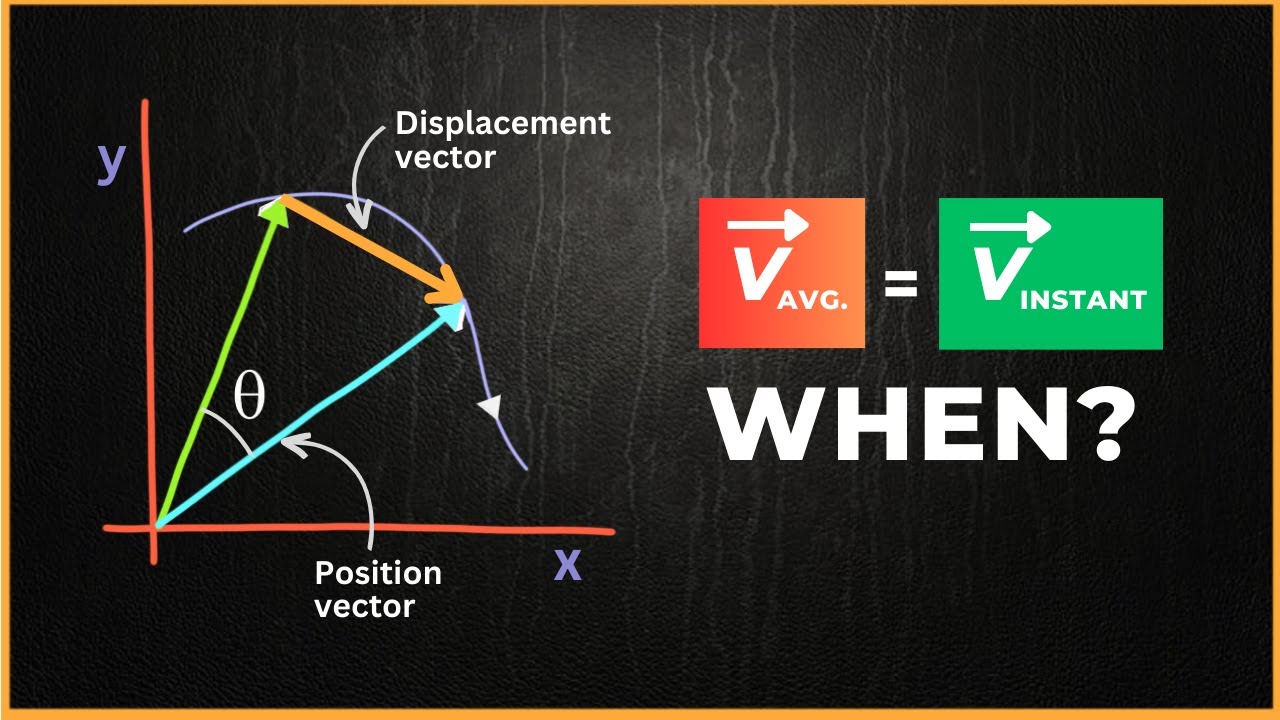
When dealing with motion in two or three dimensions, we modify the formula by using the displacement vector (Δr) or Vavg = Δr/Δt
The direction of the average velocity vector aligns with the displacement vector (Δr) because dividing a vector by a scalar only changes its magnitude, not its direction.
Example of Average Velocity Calculation
Consider a particle with a displacement vector of Δr = (10m)i + (4m)j in 2s.
The average velocity during this displacement can be calculated as Vavg. = [(10m)i + (4m)j] / 2s = 5i + 2j or more precisely, (5m/s)i + (2m/s)j
The average velocity vector has components of five meters per second along the x-axis and two meters per second along the y-axis.
Instantaneous Velocity in 2 dimension
Instantaneous velocity (v) represents the velocity of a particle at a specific instant of time.
It can be expressed using calculus as v = dr/dt, where r is the position vector of the particle at any time (t).
Relationship between Position Vector and Direction of Motion:
When observing the path of a particle in the XY plane, we note that the position vector (r) of the particle moves along with it.
The displacement (Δr) occurs within a time interval (Δt) as the position vector changes from r1 to r2.
Shrinking the time interval (Δt) towards zero, the direction of the average velocity vector (Δr/Δt) approaches the tangent to the curve at a given instant t1
As Δt approaches zero, the average velocity becomes the instantaneous velocity at time t1, and its direction aligns with the tangent to the curve.
Key Points to Remember
1. Instantaneous velocity at any point is given by dr/dt, where r is the position vector.
2. Instantaneous velocity (V) is composed of three components: V = vxi + vyj + vzk.
3. The direction of instantaneous velocity vector matches the direction of the tangent to the curve at that point.
Understanding Velocity Components and Particle Motion:
Velocity vectors play a crucial role in determining the path or curve a particle takes in two or three dimensions.
A particle’s velocity vector at a specific time (t) is a tangent to its path, consisting of components Vy and Vx.
The particles ability to traverse a curved path is attributed to these two vector components.
Removing either Vx or Vy will cause the particle to move solely in the remaining direction (X or Y), resulting in linear motion.
Physics Numerical: Finding Resultant Velocity of a particle on a wall with changing x and y coordinates over time.
To determine the particle’s velocity at t = 15 seconds, we find the X component (Vx) and the Y component (Vy) separately.
Differentiating X with respect to time gives us Vx = -2.1 m/s at t = 15s.
Differentiating Y with respect to time gives us Vy = -2.5 m/s at t = 15s.
Combining the two vectors, we calculate the resultant velocity as V = (-2.1m/s)i + (-2.5m/s)j
Key moments:
00:00 Average velocity in 2 dimension
02:21 Instantaneous velocity for motion in one dimension
02:45 Instantaneous velocity for motion in 2 dimension
03:05 Position vector of a particle
04:15 Vector equation for motion in 2 dimension
06:05 Instantaneous velocity vector is a tangent to the motion curve
06:15 The vector components of velocity define motion
07:15 Physics numerical example
Instantaneous velocity for Motion in One dimension: • Instantaneous Velocity: DERIVATION from Av...
Join TELELGRAM Channel for PDF File 📁Summaries and Numerical Videos: https://t.me/TheScienceCube_Community
Повторяем попытку...
Доступные форматы для скачивания:
Скачать видео
-
Информация по загрузке: