Arrhenius base increases OH⁻ concentration in water
Автор: DrY♥Lab
Загружено: 2023-06-17
Просмотров: 379
Описание:
TRANSCRIPT
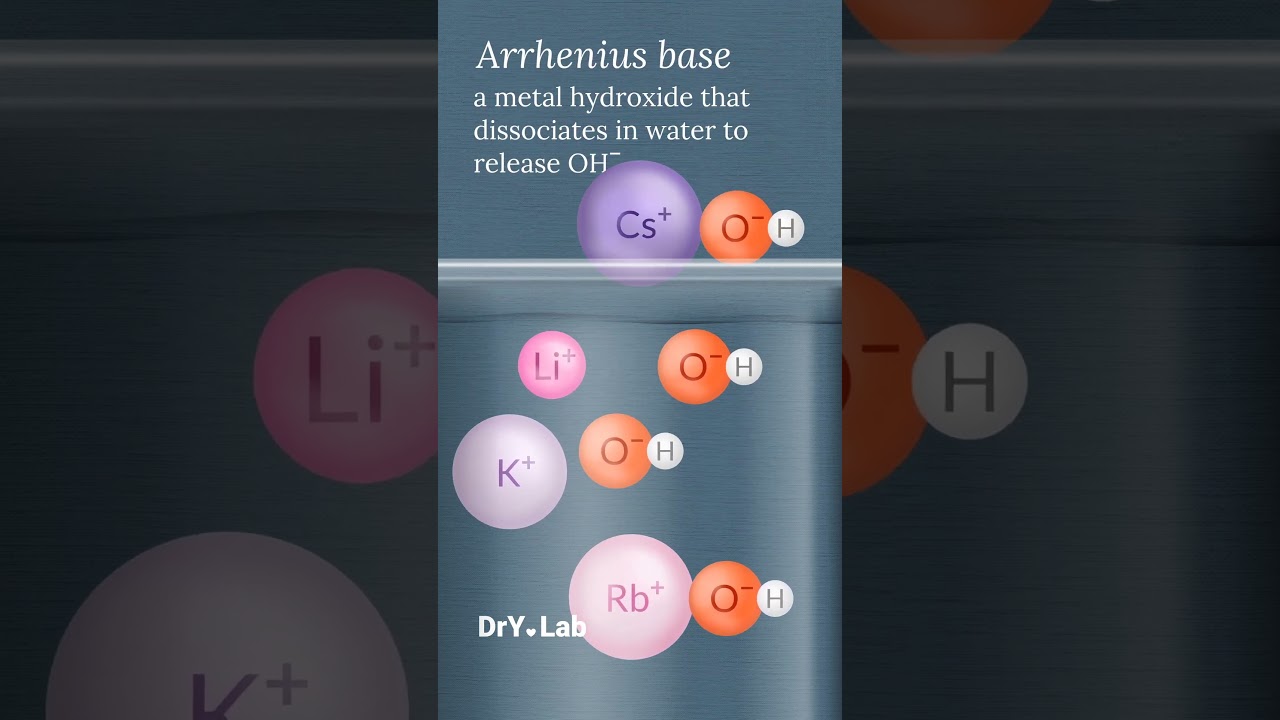
An Arrhenius base is a substance that increases hydroxide ion (OH⁻) concentration in aqueous solution. What this often means in general chemistry is a metal hydroxide that dissociates in water to release hydroxide ion.
In contrast to Arrhenius acids, which start out as molecules and then ionize in water, Arrhenius bases are already ionic compounds having the hydroxide ion. Arrhenius bases just need to dissociate, meaning split apart, to release hydroxide ion.
Sodium hydroxide dissociates in water into sodium ion and hydroxide ion. Other examples are the Group 1 hydroxides of lithium, potassium, rubidium, and cesium. Group 2 hydroxides of magnesium, calcium, strontium, and barium are also Arrhenius bases. All of these Arrhenius bases are ionic compounds that dissociate into hydroxide ion and the metal cation.
MORE INFORMATION
The number of hydroxide ion in each unit of the metal hydroxide depends on the charge of the metal cation. The total electrical charge of the metal cation (positively charged ion) and the hydroxide ion (−1 charge) necessarily adds to zero. Group 1 metal ions have +1 charge, and thus, each Group 1 ion is balanced by one hydroxide ion: LiOH, NaOH, KOH, RbOH, and CsOH. Group 2 metal ions have +2 charge, and thus, each Group 2 ion affords two hydroxide ions Mg(OH)₂, Ca(OH)₂, Sr(OH)₂, and Ba(OH)₂.
Original content © 2023 Jung-Lynn Jonathan Yang
♥
ATTRIBUTIONS
Sound effects modified from freesound.org
“Electricity00.wav” by jeremysykes
“Splash, Small, A.wav” by InspectorJ
Background image modified from Unsplash
“MS9Tnh3if1o.jpg” by kiwihug
Повторяем попытку...
Доступные форматы для скачивания:
Скачать видео
-
Информация по загрузке: