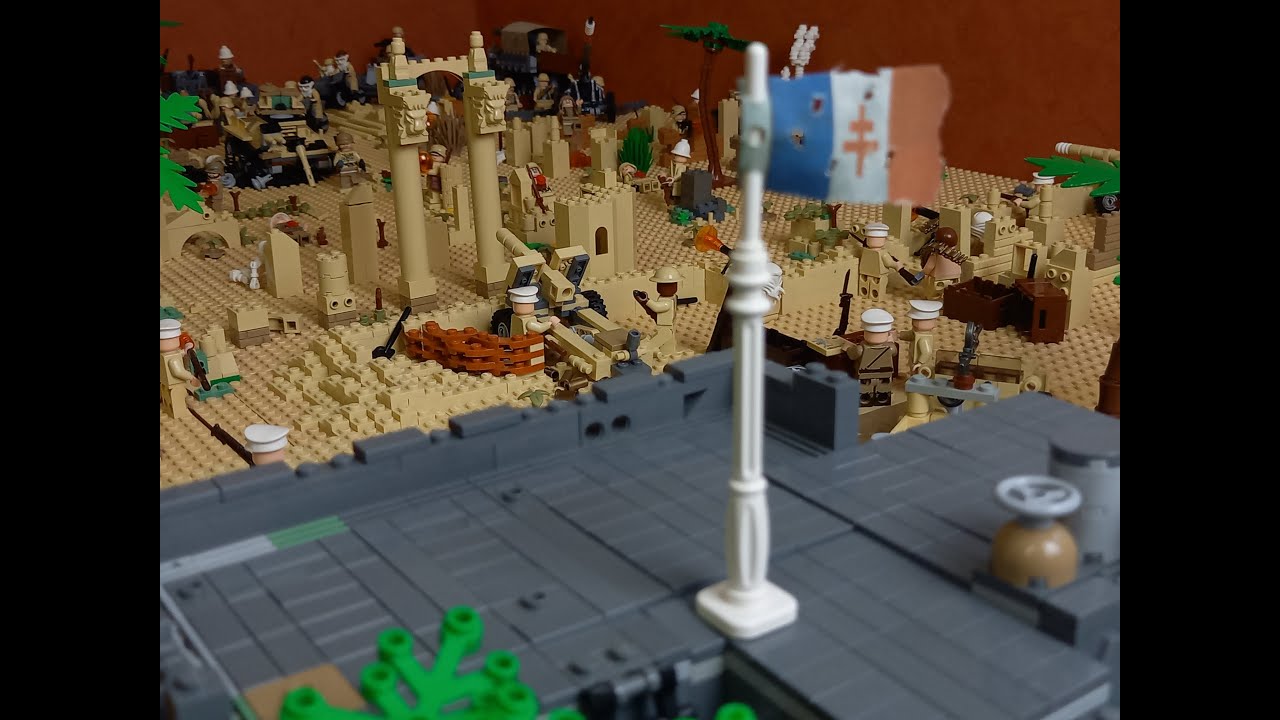
Battle of Bir Hakeim - part 3 - the battle scene - Lego display
Автор: History in Bricks
Загружено: 2022-09-27
Просмотров: 930
Описание:
Hi Guys,
Today, after many delays, I can finally present you part 3 of my Battle of Bir Hakeim Moc. I hope you will enjoy! 😊
_ _ _ _ _ _
Historical description :
1. Review of the last episode:
Bir Hakeim (Libyan Desert)
Deutsches Afrikakorps🌴 ⚔ 1st Free French Brigade☨
│
Italian armoured divisions │
Forces: +30,000 men ± 3700 men
Mission: delay the advance of German and Italian troops
-Duration (of the battle): 2 weeks & 2 days (from 26/27 May to 11 June 1942)
2. The Battle in a more detailed manner:
On 26 May 1942, German General Erwin Rommel ordered the Italian troops under command to attack the “Gazala Line” (the Allied defence line from Gazala to Bir Hakeim) head-on. This was only a diversionary manoeuvre. While the Italians were presenting themselves for battle, Major Rommel led two German armoured divisions (the 15th and 21st) and an Italian armoured division (the Ariete) into the southern desert, beating British armoured units. Arriving at Bir Hakeim on 27 May, General Rommel decided to divide his troops. Assuming that the Free French Forces would be easy to defeat, the “Desert Fox” commissioned the Italians to confront the defensive position at Bir Hakeim, while he and his divisions continued to break through the “Gazala line”. This decision proved costly in terms of human lives.
Although the Italian forces managed to penetrate the front in some spots, Brigadier General Koenig and his men disabled 32 Italian tanks and managed to drive out the attackers. Meanwhile, the military units led by Erwin Rommel continued to advance northwards, destroying several British outposts on the way. With this offensive, the German divisions completed the encirclement of the outpost of Bir Hakeim. The attackers were victorious in small unit actions, but nevertheless failed to disrupt the entire defence line.
General Rommel, angered by the grim resistance of Koenig's men, suggested to the Free French to surrender, a proposal that was rejected by the French commander. Following this refusal, the Axis forces reacted with bombardments from both artillery and German military aircrafts. In addition, the “Desert Fox” also withdrew his German soldiers from their forward position, sending them to Bir Hakeim. In short, Italian infantry and tanks, supported by German troops, were ordered to attack Bir Hakeim day and night.
The Free French, despite an increasing shortage of ammunition and a lack of drinking water, resisted enemy attacks. After a week of fighting, Brigadier General Marie-Pierre Koenig asked his superior for permission to break through the encirclement to withdraw. His request was refused, as the British were preparing fallback positions at El Alamein (Egypt), to avoid the total collapse of the “Gazala line”. After that, commander Koenig returned to his men, and together they, despite their precarious situation - water shortage, constant bombardment, lack of ammunition and high heat - pushed back attacks one after another.
Knowing that the fall of Bir Hacheim was imminent, Koenig ordered an escape under cover of darkness. So, on the night of 10 to 11 June, the Free French attempted to break through the enemy’s lines to join the British. At first, the French tried to withdraw in formation, but when the Germans discovered the movement, the retreating garrison split into groups of a few individuals. The majority of the fighters, 2500 men, arrived safely in British positions.
3. The Outcome of the battle:
On the French side, there were 140 killed, 130 wounded and around 760 missing (including 600 prisoners). On the side of the Axis powers, the casualties were much higher: the losses are estimated at several hundred or even thousands of soldiers (wounded and killed) and several hundred prisoners.
This courageous and relentless defence of the free French allowed the British, struggling on the «Gazala line», to retreat and reposition themselves elsewhere. In other words, this heroic resistance by the Free French Forces delayed Erwin Rommel’s offensive to Egypt, which gave the Allies valuable time to prepare their defensive positions in El Alamein, where they, a few months later, won 2 important battles, which would change the course of the war in Afrika in favour of the Allies.
The German General Rommel said the following about the battle of Bir Hakeim: « Seldom in Africa was I given such a hard fought struggle »
Sources:
Idem (Video: part 2)
https://www.cheminsdememoire.gouv.fr/... (consulted on 25/09/2022).
_ _ _ _ _ _
As compensation for the long delay, I have a little surprise for you: 2 small videos for end of September
Thanks for watching !! 😊 If you enjoyed the video, please leave a like, comment and subscribe!! 😉
History in Bricks ⚔
Повторяем попытку...
Доступные форматы для скачивания:
Скачать видео
-
Информация по загрузке: