Frugal Innovation: From Financial Constraints to Universities with Impact
Автор: dl.Suswardany
Загружено: 2025-09-01
Просмотров: 69
Описание:
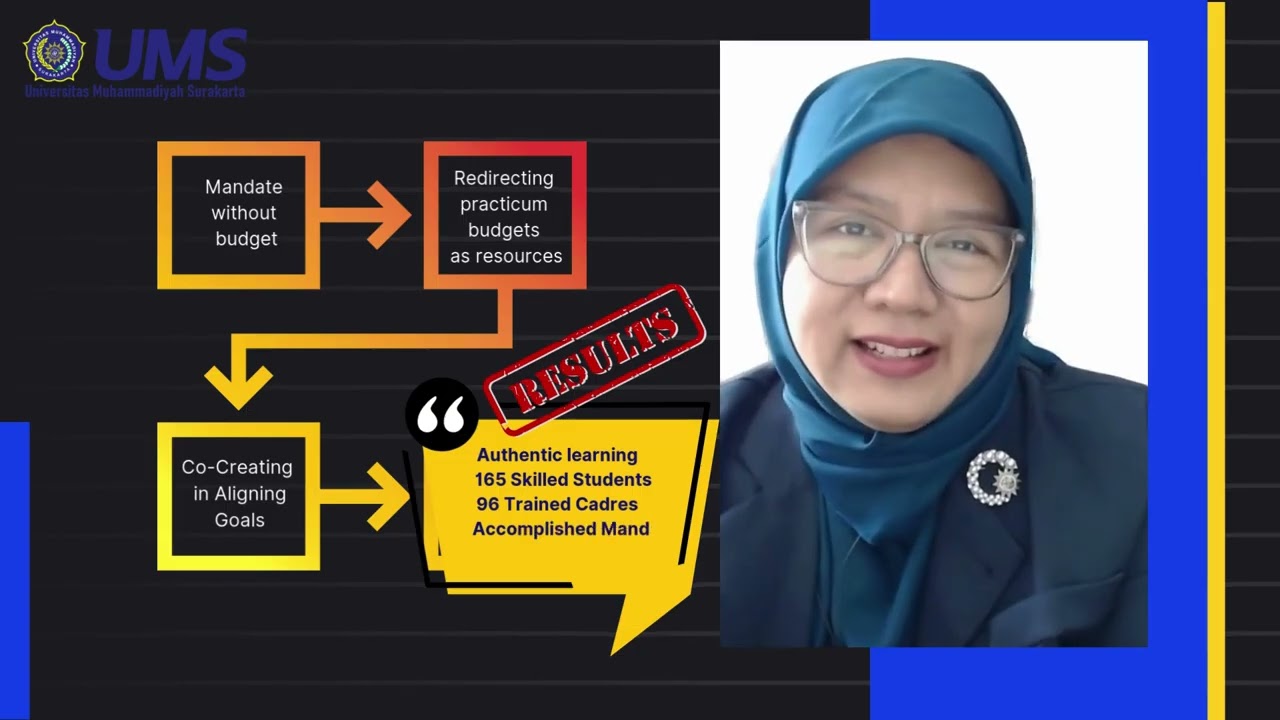
Background: In the Asia-Pacific, universities are expected to contribute directly to societal challenges, yet many operate under persistent financial constraints. Universitas Muhammadiyah Surakarta (UMS) faced this paradox when the Surakarta City Health Office mandated the university, through a formal MoU, to co-develop a TB-Care Village in Panularan. The policy goal—reducing tuberculosis incidence—had no dedicated funding, while competitive grants could not ensure continuity.
Actions: To address this gap, UMS reimagined the student field practicum as a form of frugal innovation. Practicum budgets, once spent as administrative fees with little accountability, were redirected into community action. In one semester, 165 public health students, guided by faculty and the Community healthcare TB programmer, co-designed and delivered three training sessions for 96 TB cadres, focusing on persuasive and empathetic communication skills. Training integrated lectures, simulations, and role-play, informed by systematic reviews showing persuasive communication improves TB adherence and trust.
Results: The outcomes were tangible. Students achieved authentic learning outcomes in planning, facilitation, and evaluation (Planning of Action), gaining transferable employability skills. Cadres reported improved knowledge, attitudes, and confidence in communication, shifting from coercive practices to empathetic persuasion. The Surakarta City Health Office recognized Panularan as an active TB-Care Village, demonstrating the alignment of academic outcomes with local health priorities.
Policy Lessons: This case illustrates how policy–curriculum alignment and knowledge co-production can transform resource-constrained environments into platforms for systemic impact. By integrating public health mandates into the practicum, UMS showed universities can act as governance partners, not only knowledge providers.
Framework Contribution: The model advances the discourse on frugal innovation in higher education, showing how universities convert routine budgets into community resilience, embed ESG, and contribute to health goals while strengthening academic quality. This model aligns with six SDGs (3, 4, 9, 10, 11, 17), showing how universities can turn constraints into systemic impact.
Повторяем попытку...
Доступные форматы для скачивания:
Скачать видео
-
Информация по загрузке: