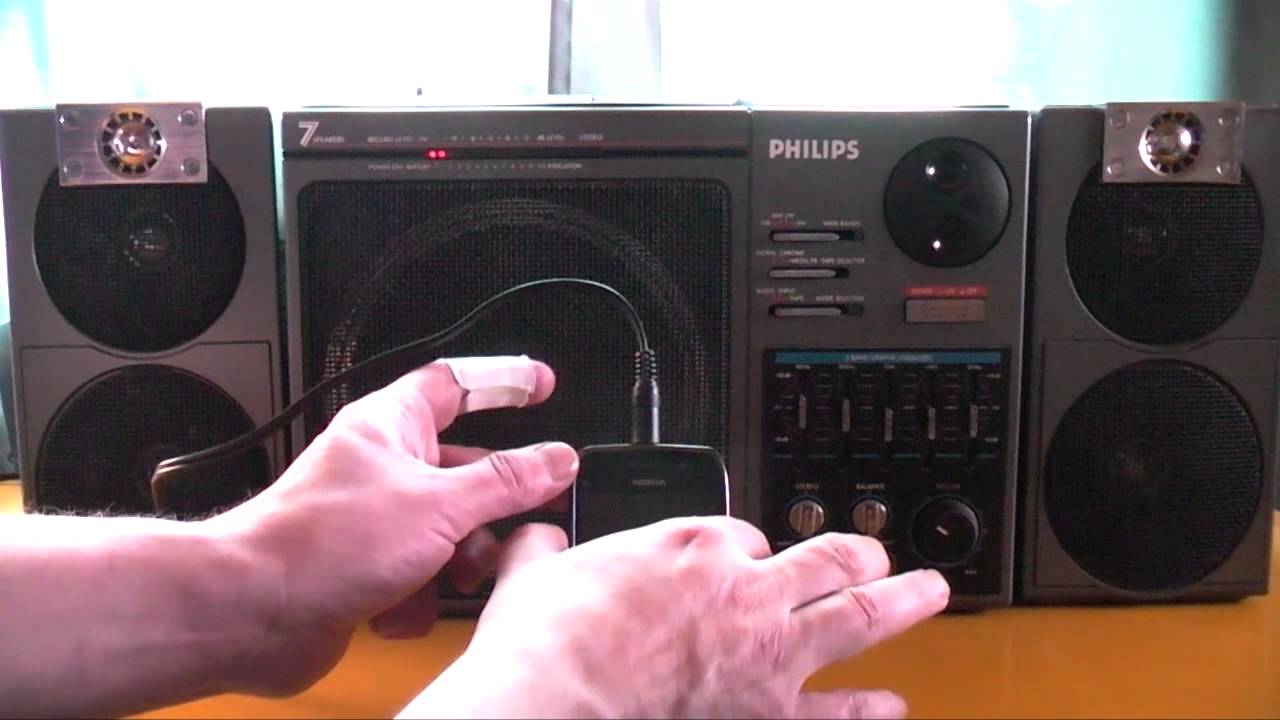
Let's make things better - Vintage Philips D8554 & CD620
Автор: nokivasaracom
Загружено: 2013-04-01
Просмотров: 5178
Описание:
This Youtube-video has been produced in the spirit of "old stuff". In this video, I savour the vintage music players of the 1980's manufacured by Philips, because there are merely meager traces of these quality players in the Internet. I shan't dwell into the wonders of the chipsets found in these devices, but merely to enjoy the sound of these quality devices.
Philips D8554 Soundmachine was one of the flagship portable (draggable?) players of the early 1980's, priced as whopping 1200 Finnish marks (~200 euros) in 1984. A hefty sum of money for a young man, if I may say. D8554 featured a single cassette deck capable of recording on normal (IEC 1) and chrome (IEC 2) tapes. TDK D and TDK SA-X are showed as examples. The deck was also able to reproduce metal (IEC 4) metal tapes. TDK MA-X is showed as an example (absurd 6 euros in 1988). Wow and flutter 0.16% (very good). Five band equalizer, soft touch buttons, Dolby B noise reduction, one RCA output, one shared RCA input (any RCA-compatible device) and Phono-input with Phono ground, mic-input and a connector for an external FM-antenna. My Nokia E6 is used as a player in the first part.
Philips CD620 (600-series, 900-series was the "high end" product line) was the basic model of Philips CD-players in 1988. 1200 Finnish marks (about 200 euros) Analogue out, digital out & RC5 in/out. Flat frequency reproduction and error correction that excelled among any player during that era, if not among current CD-players. This combination was able to reproduce sound that could compete with many current stereo system as sold today. Well, it was able to disturbe my neighbours in the early 1990's (Depeche Mode / Enjoy the Silence, you know...)
As a courtesy to the worldwide audience of Youtube, I shall present a quiz. Please degoogle before You answer.
1) Most commercial cassettes were recorded on IEC 1 type tapes.They suffered from fading of high frequencies. How did record companies resolve this issue?
2) Philips products in the 1980's had so called "sister models". What companies manufactured portable and standalone players that resembled Philips players?
3) The motto of Philips in 1980's was "Let's make things better". A notable artist was showed in the vintage advertisements of Philips. Who was this artist?
Philips vintage players by Nokivasara.com 01.04.2013, produced and shared under creative commons copyright. Produced in the republic of Finland (city of Tampere), the European Union.
----
Answers:
1) Record companies chose to use chrome tape (IEC II/80 µs) and the sound was recorded using IEC I equalisation (120 µs). Chrome tapes did not suffer from fading high frequencies, and all players could reproduce the sound because IEC I equalisation.
2) Magnavox, Dux and Lux. Certain Philips models were also sold under Marantz brand.
3) Mark Knopfler.
Повторяем попытку...
Доступные форматы для скачивания:
Скачать видео
-
Информация по загрузке:


![Jean-Michel Jarre - Equinoxe (Part I - IV) [1978 Original Pressing] - Black Vinyl LP](https://image.4k-video.ru/id-video/a98fX8iHLRM)