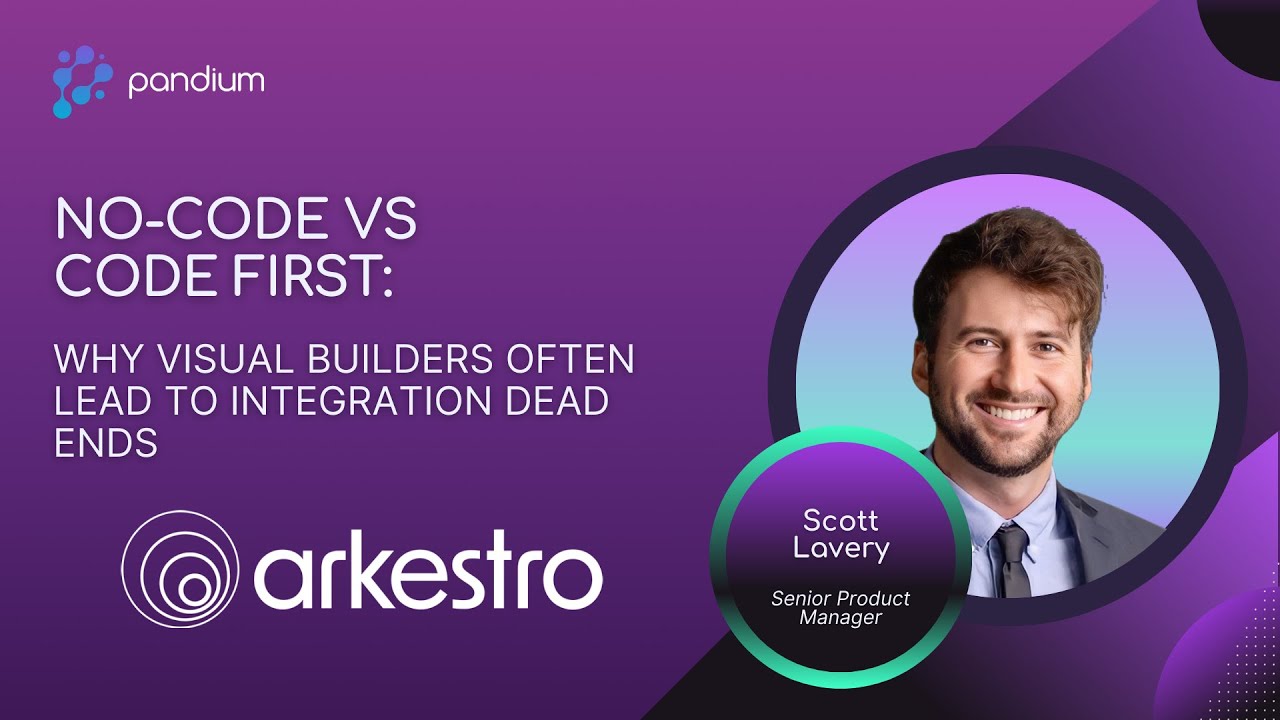
No-Code vs Code First: Why Visual Builders Often Lead to Integration Dead Ends
Автор: Pandium
Загружено: 2026-01-28
Просмотров: 19
Описание:
Integrations look deceptively simple until they become the backbone of your business. In this episode of Between Product and Partnerships, Pandium CEO Cristina Flaschen sits down with Scott Lavery, Senior Product Manager at Arkestro. They unpack what really happens when integrations shift from a "nice to have" feature to something the company can't function without.
Scott shares hard-earned lessons from a decade in B2B SaaS, covering sectors from martech to procurement. He discusses the headache of inheriting messy stacks and why iPaaS tools often hide long-term costs. The conversation also explores how integration work fundamentally changes what it means to be a product manager. Together, they dig into common failure modes and the tough tradeoffs junior PMs face when they’re "volun-told" to own integrations.
Who we sat down with
Scott Lavery is a Senior Product Manager at Arkestro. With over ten years of experience in B2B SaaS, he has repeatedly found himself responsible for integrations, often without ever intending to specialize in them.
Scott is known for:
Unwinding complex iPaaS-driven environments.
Designing integrations built to be "set and forget."
Managing third-party dependencies alongside specific scale constraints.
Advocating for pragmatic, cost-aware strategies.
Key Topics
1. Why integration PM work is fundamentally different
Integration success is defined by invisibility. Unlike standard features, value is found in reliability and trust rather than how often a user clicks a button.
2. The hidden costs of low-code and iPaaS tools
Teams often end up writing code blocks inside "no-code" tools. We discuss how pricing models can distort architectural decisions and where velocity eventually hits a wall.
3. What to do when you inherit a messy integration stack
Practical advice for PMs walking into undocumented systems filled with inherited workflows and vendor dependencies they can’t control.
Episode Highlights
01:48 - How most PMs “fall into” owning integrations
03:58 - Why integration metrics flip traditional product thinking on its head
06:31 - Contextual success metrics: Why volume is not the same as value
08:21 - Navigating ecosystems without becoming a domain admin
11:18 - Why API docs lie and customers ignore your design intent
15:37 - Warning signs of an unhealthy iPaaS environment
19:05 - Silent failures and the pain of hearing about outages from customers
23:45 - The code-block paradox in low-code platforms
31:52 - Scott’s playbook for PMs inheriting integrations
Key Takeaways
1. Great integrations are designed to disappear
Successful integrations are rarely touched after the initial setup. In this space, reliability is a far more important metric than user engagement.
2. Metrics are contextual, not universal
A monthly sync can be just as vital as one that runs every five minutes. Frequency alone does not signal success.
3. You can’t abstract away real-world usage
API contracts rarely reflect reality. No tool removes the need to understand how customers actually use systems like NetSuite or Salesforce.
4. Low-code tools often trade speed for long-term pain
Teams save time early but spend years optimizing around pricing models and managing fragile logic.
5. Inherited workflows is a scalability risk
If only one person understands the system, it is already brittle. This is a massive liability once customers are live.
6. Silent failures erode trust fastest
Learning about outages from customers is a major failure. Proactive monitoring and clear communication are basic requirements at scale.
7. Think in dollars, not just features
When evaluating an iPaaS, long-term maintenance costs and cost curves matter more than short-term convenience.
Follow Scott Lavery (Guest)
LinkedIn: / scott-j-lavery
Follow Cristina Flaschen (Host)
LinkedIn: / cristina-flaschen
Повторяем попытку...
Доступные форматы для скачивания:
Скачать видео
-
Информация по загрузке: