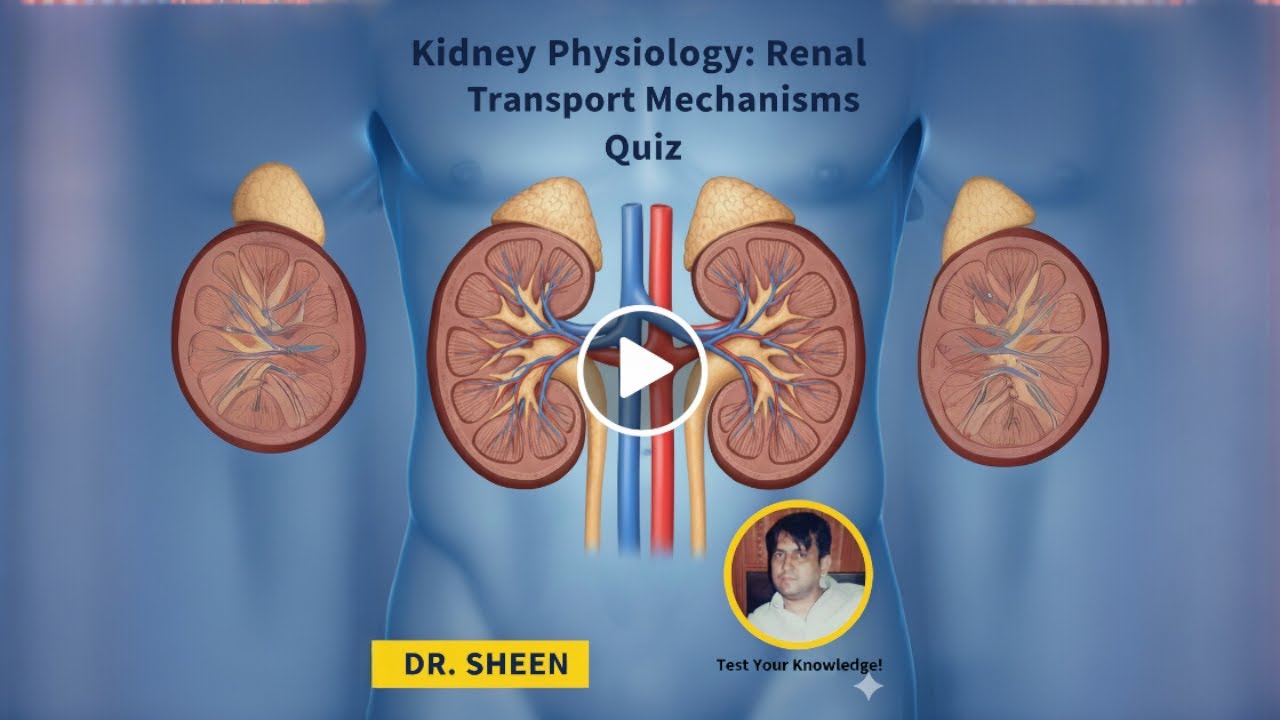
Kidney Physiology Renal Transport Mechanisms Quiz-3
Автор: Dr Sheen Medical lectures
Загружено: 2025-12-18
Просмотров: 3
Описание:
Kidney Water and Solute Reabsorption
When solutes like sodium are actively transported out of kidney tubules, their concentration drops in the tubule and rises in surrounding tissue (interstitium). This creates an osmotic gradient, pulling water passively from tubule to interstitium via osmosis. In proximal tubules, water moves quickly through aquaporin-1 (AQP-1) channels in cell membranes and leaky tight junctions, keeping solute concentrations balanced.
Proximal tubules are highly water-permeable, allowing rapid reabsorption. Water flow also drags solutes (solvent drag). Since water, ions, and organics couple to sodium reabsorption, changes in sodium uptake affect everything else.
In distal nephron (loop of Henle onward), tight junctions are less leaky. Water permeability varies: always high in proximal and descending loop (AQP-1); low in ascending loop (no water reabsorbed despite gradient); adjustable in distal/collecting tubules via antidiuretic hormone (ADH), which inserts AQP-2 channels.
Passive Solute Reabsorption
Chloride: Follows sodium due to electrical attraction (positive sodium leaves negative charge in tubule) and concentration gradient from water osmosis. Also via secondary co-transport with sodium/potassium in thick ascending loop.
Urea: Partially reabsorbed (about 50%) via concentration gradient from water loss; facilitated by transporters in inner collecting duct. Helps excrete nitrogen waste.
Creatinine: Barely reabsorbed; large molecule, impermeant to membranes, mostly excreted.
Nephron Segments
Proximal Tubule: Reabsorbs ~65% filtered sodium, water, chloride. High metabolic cells with brush border (20x surface area) and mitochondria for active transport. Early: Sodium co-transports with glucose/amino acids. Late: With chloride (higher chloride concentration after early preferences for bicarbonate/glucose). Osmolarity constant; glucose/amino acids drop to zero; creatinine rises.
Secretes organic acids/bases (e.g., bile salts, urate, drugs like penicillin) for rapid clearance. Para-aminohippuric acid (PAH) secreted efficiently, used to measure renal plasma flow.
Other Segments: Discussed briefly; focus on selective reabsorption/secretion for body balance.
Kidneys filter vastly but reabsorb selectively: nutrients fully, wastes partially. Equation: Urine = Filtration - Reabsorption + Secretion. Precise control maintains fluids/electrolytes
Повторяем попытку...
Доступные форматы для скачивания:
Скачать видео
-
Информация по загрузке:


