1st ELECTRIC RECORDING (1925) Mask And Wig Club on Victor 19626 ORTHOPHONIC 78 rpm Joan of Arkansas
Автор: Tim Gracyk
Загружено: 2020-07-09
Просмотров: 1574
Описание:
The transition from acoustic to electric recording around February to April 1925 is complex.
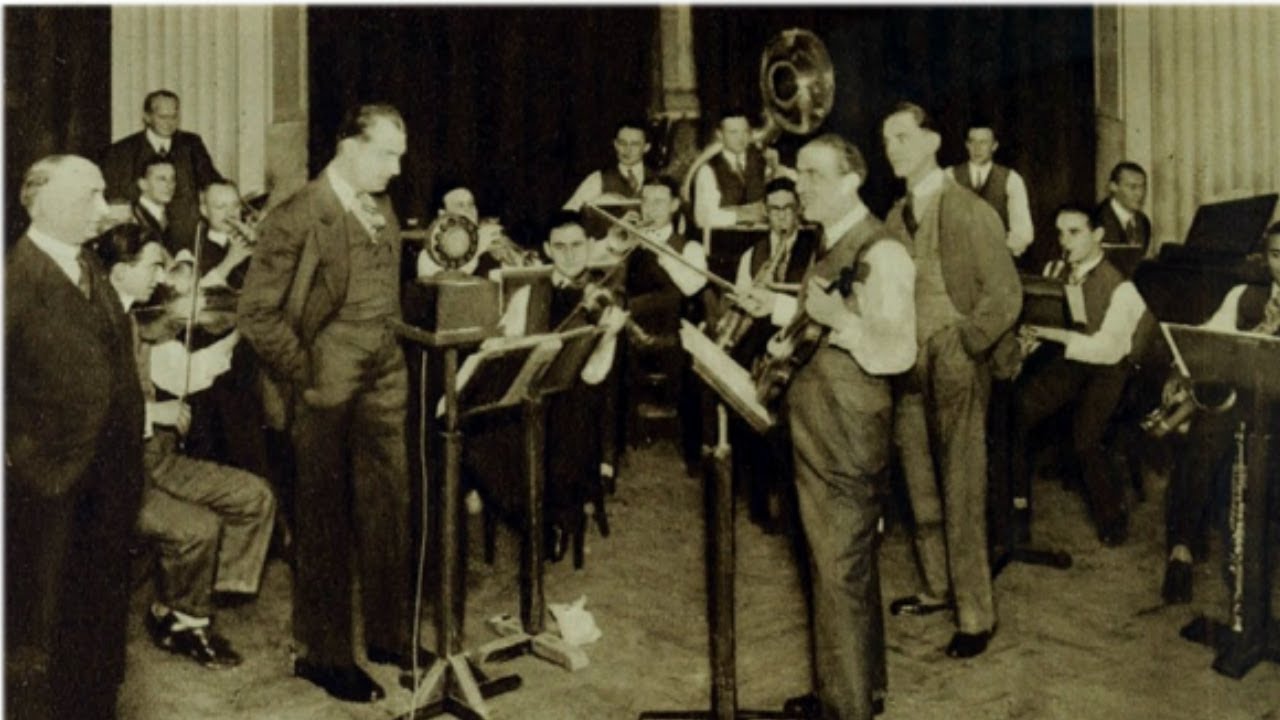
The A side (a medley of "Joan of Arkansas" tunes) on Victor 19626 was recorded on March 16, 1925. It is among the first performances to be recorded ELECTRICALLY by the Victor Talking Machine Company.
More impressively for historians, the A and B sides of this disc were first to be RELEASED.
The A side was recorded four days earlier than the B side, so I focus on that A side.
Victor experimented by early 1925 after licensing to use a Western Electric system. Columbia experimented with microphones and the Western Electric process, too. A race was on!
On March 11, 1925, pianist Olga Stokowski recorded numbers--not issued.
Five days later--on March 16--this Mask and Wig Club performance was captured with a microphone. It reached some homes weeks later. Early buyers were unaware of any new process and lacked proper equipment for playing "electric" recordings.
Early buyers were kept in the dark. Victor issued this electric disc and others without identifying the discs as being different.
This disc's A-side ensemble--also known as the University of Pennsylvania Mask and Wig Glee Chorus--is a male vocal "double quartet." The Victor Orchestra accompanies eight college students in the studio.
The college is across the river from the Camden studio.
Charles Gilpin (not the actor) is the composer.
The label states, "From the 37th annual production of the Mask and Wig Club (University of Pennsylvania)."
The reverse side is "Buenos Aires," recorded on March 20 and played by the International Novelty Orchestra conducted by Jack Shilkret.
A Western Electric/Victor "demo" disc has Jack Shilkret's orchestra playing "You and I," issued on 19571. It was recorded by the acoustic and "Orthophonic" process in January 1925.
The company, not ready to commit itself, dipped toes in the water of electric recording, issuing a few discs with no publicity.
A campaign promoting electric recordings came later.
This disc was not distributed nationally. It was available in Pennsylvania only--the Mask and Wig Glee singers had local appeal.
A newspaper of the singers' college declared that the disc was available in April 1925.
The disc is rare.
In July of 1925, the public could purchase a disc with "electric" recordings of an earlier date (nothing was said by the company about this at the time)--a 12-inch Victor disc with performances recorded on February 26, 1925, was issued in July 1925. The 12-inch disc has performances captured very early with a microphone, but the company did not rush its release. The 10-inch disc was issued earlier.
The 12-inch disc is Victor 35753--"A Miniature Concert' by the Eight Popular Victor Artists" with Murray, Burr, Wiedoeft, Banta, Silver, Campbell, Croxton, and Meyer. This was recorded weeks earlier than the "Joan of Arkansas" medley but released months later than the "Joan of Arkansas" item.
Earliest may be Jack Shilkret's orchestra playing "You and I" on Victor 19571, recorded as both acoustic and "Orthophonic" in January 1925.
Red Seal artists--McCormack, Casals, Rachmaninoff, Gigli, Lashanska, Crabbe, Johnson, Maztenauer, Cortot--made early electric recordings (not as early as what we hear on Victor 19626).
McCormack's "Moonlight and Roses" was recorded on April 23, 1925.
Columbia made electrical recordings in early 1925 (the Mandoliers on March 2) and issued them.
Sam Lanin & His Roseland Orchestra recorded "Egyptian Echoes" on March 3.
Earlier, on February 25, 1925, Art Gillham recorded five songs using a microphone. Electrical recordings made on February 26 and 27 were released on Columbia 326-D in May, 1925. In June, "You May Be Lonesome" was issued on Columbia 328-D.
In a publicity campaign, Victor designated November 2, 1925 as "Victor Day," finally declaring that the new technology is superb. Electric discs had already been issued (quietly, on the sly), but in November the company was open about the switch, fully committed.
Consumers played early electric discs on their old machines, not knowing that these discs were made with a new process. So consumers were not hearing the full richness of the new discs. Only on new Orthophonic machines would Victor's Orthophonic discs sound as they should. New discs on old machines give a mere hint of the real sound.
Victor dealers could not judge if early electric discs were a success since consumers in 1925 were not playing them on machines made for electric discs. How well were Victor dealers informed in 1925? Many were clueless.
Victor 19621 (the Trinity Choir) is electrically recorded, so 19626 is not Victor's lowest numbered electrical item. Gelatt's book The Fabulous Phonograph wrongly stated that 19626 is earliest, and many collectors repeated this mistake.
The Columbians cut two sides on March 7, 1925, released as 329-D--the lowest numbered "electric" dance band disc. Gillham sides have lower numbers.
Повторяем попытку...

Доступные форматы для скачивания:
Скачать видео
-
Информация по загрузке: