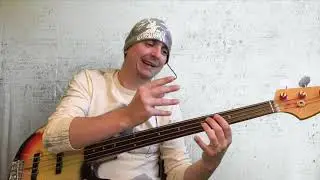
Fretless Bass Intonation - How To Play PERFECTLY In Tune
Автор: Hugh Richardson
Загружено: 2019-01-28
Просмотров: 8220
Описание:
In this short video, I'm going to share two exercises that will get your fretless bass intonation almost perfectly in tune.
Also, here's my ultimate fretless exercise • The Only Fretless Bass Lesson You'll EVER ...
My linktree: https://bit.ly/basslinks
Playing the fretless presents us with two unique problems we don't have on a fretted bass.
The first is that even the smallest movement of the fretting fingers will affect the tuning of the notes we play.
The second is we have to tune as we play in the same way a violin player would. More on this later.
On a fretted bass if we don't catch a note right on the sweet spot then it's no big deal. The note is still in tune.
On a fretless, however, if you're out then you're out. And you'll hear it.
The first exercise will help you find exactly where the notes lie on the neck and you'll avoid this problem.
Plug your fretless into a tuner (or use a clip-on tuner) and then run up through a scale, arpeggio or song you know well but make sure you're keeping your eyes on the tuner the whole time.
If you play a note and the tuner shows you as being anything other than perfectly in tune then pause, adjust your fretting hand to find the tuning you need and then carry on.
This can be a very unforgiving exercise but it will do wonders for your intonation.
Earlier I mentioned that fretless players have to tune like violin players do.
What does this mean?
When a violin player plays music they constantly listen to the other musicians they are playing with and use them as a reference to tune to.
Now, I don't mean that they're constantly adjusting the tuning pegs.
Rather they are making small micro adjustments to their fretting fingers to alter the intonation of each note.
So how can we work this into an exercise?
Simply, by using double stops.
Fret an octave C and if it sounds like you've got a chorus pedal on then it means at least one of your notes is out of tune and you need to adjust.
You can extend this exercise to running through scales in octaves or perhaps more challenging intervals like double-stopped 5ths, 6ths or any other interval you like and each new interval along with moving through a scale will provide a new challenge for your ears.
Using your ears is a huge part of playing fretless bass so make sure you're working on them as much as your hands!
Повторяем попытку...

Доступные форматы для скачивания:
Скачать видео
-
Информация по загрузке:


![Как играть на безладовой бас-гитаре в строю (с Фредди Дрейпером) [БЕСПЛАТНЫЙ PDF]](https://image.4k-video.ru/id-video/quRaOXO7XF8)