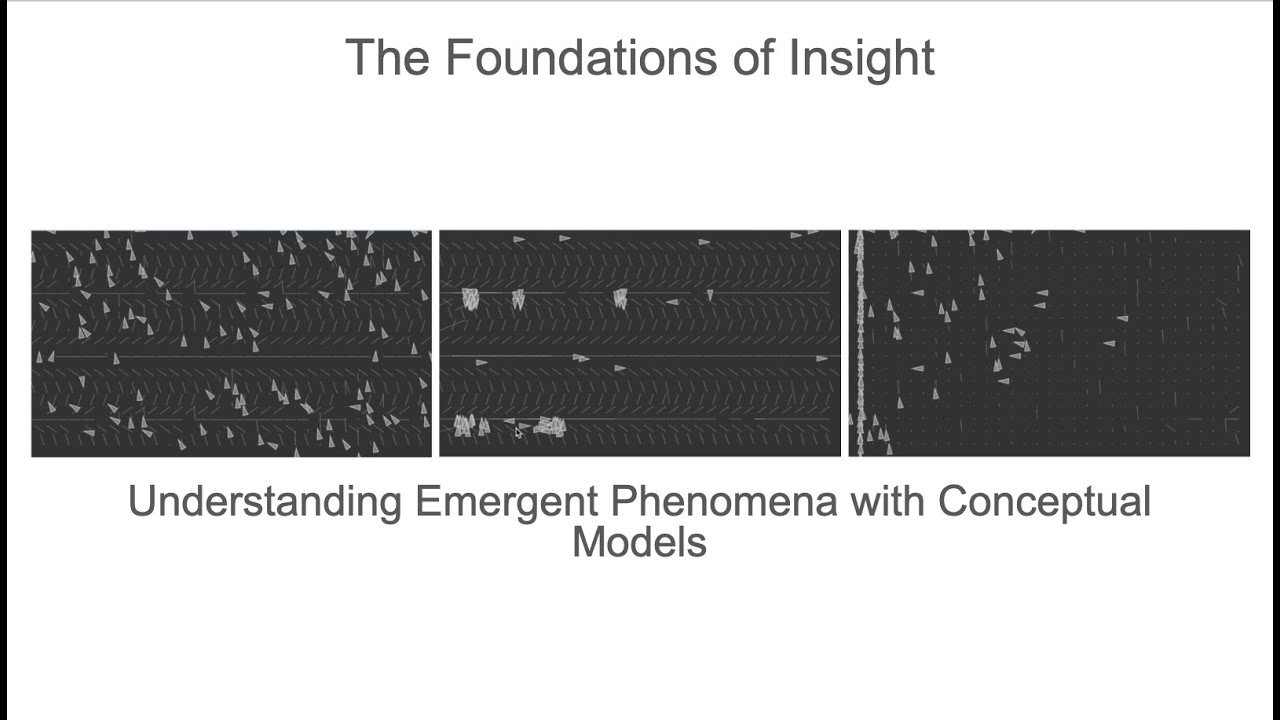
The Foundations of Insight Understanding Emergent Phenomena with Conceptual Models
Автор: David J Hoxie
Загружено: 2025-09-24
Просмотров: 12
Описание:
Lecture 1: The Foundations of Insight
This lecture demonstrates two things simultaneously: core concepts in physics, such as emergent behavior, and a new model for human-AI collaboration in scientific education, as suggested in recent literature [1]. It showcases a process of using an AI partner (Google Gemini) to achieve a deep, intuitive understanding of graduate-level physical concepts.
This dynamic serves as a real-time example of a dialogic, collaborative learning model—in this case, a human-AI partnership—focused on generating insight through shared discovery.
Connect & Support
Website: http://www.djhoxie.net
Google Scholar: https://scholar.google.com/citations?...
Patreon: (Coming Soon!)
arXiv Pre-prints: (Coming Soon!)
AI Collaboration Note:
This video, its title, description, and the concepts explored within were developed in a deep collaboration with Google Gemini. Gemini's role included acting as a Socratic partner, a reviewer, and a tool for structuring and refining the final presentation.
Acknowledgments:
Thank you to Daniel Shiffman (The Coding Train) for providing excellent conceptual starting points for the p5.js demonstrations.
References:
[1] Imran, Muhammad, and Norah Almusharraf. "Google Gemini as a next generation AI educational tool: a review of emerging educational technology." Smart Learning Environments 11, no. 1 (2024): 22.
[2] Schmidgall, S., Su, Y., Wang, Z., Sun, X., Wu, J., Yu, X., ... & Barsoum, E. (2025). Agent laboratory: Using llm agents as research assistants. arXiv preprint arXiv:2501.04227.
[3] Marquardt, F., and Marquardt, F., 2021, "Machine learning and quantum devices," SciPost Physics Lecture Notes, p. 29.
[4] Hinton, G. E., & Zemel, R. (1993). Autoencoders, minimum description length and Helmholtz free energy. Advances in neural information processing systems, 6.
[5] Shannon, C. E., 1948, "A mathematical theory of communication," The Bell system technical journal, 27(3), pp. 379-423.
[6] Hopfield, J. J. (2007). Hopfield network. Scholarpedia, 2(5), 1977.
[7] Wootters, W. K. (1981). Statistical distance and Hilbert space. Physical Review D, 23(2), 357.
[8] Leshno, M., Lin, V. Y., Pinkus, A., and Schocken, S., 1993, "Multilayer feedforward networks with a nonpolynomial activation function can approximate any function," Neural Networks, 6(6), pp. 861-867.
[9] Konen, W. (2011). Self-configuration from a machine-learning perspective. arXiv preprint arXiv:1105.1951.
[10] Por, E., van Kooten, M., and Sarkovic, V., 2019, "Nyquist–Shannon sampling theorem," Leiden University, 1(1).
[11] Shiffman, D. (2024). The nature of code: simulating natural systems with javascript. No Starch Press.
[12] Landauer, Rolf. "Information is physical." Physics Today 44, no. 5 (1991): 23-29.
Повторяем попытку...
Доступные форматы для скачивания:
Скачать видео
-
Информация по загрузке: