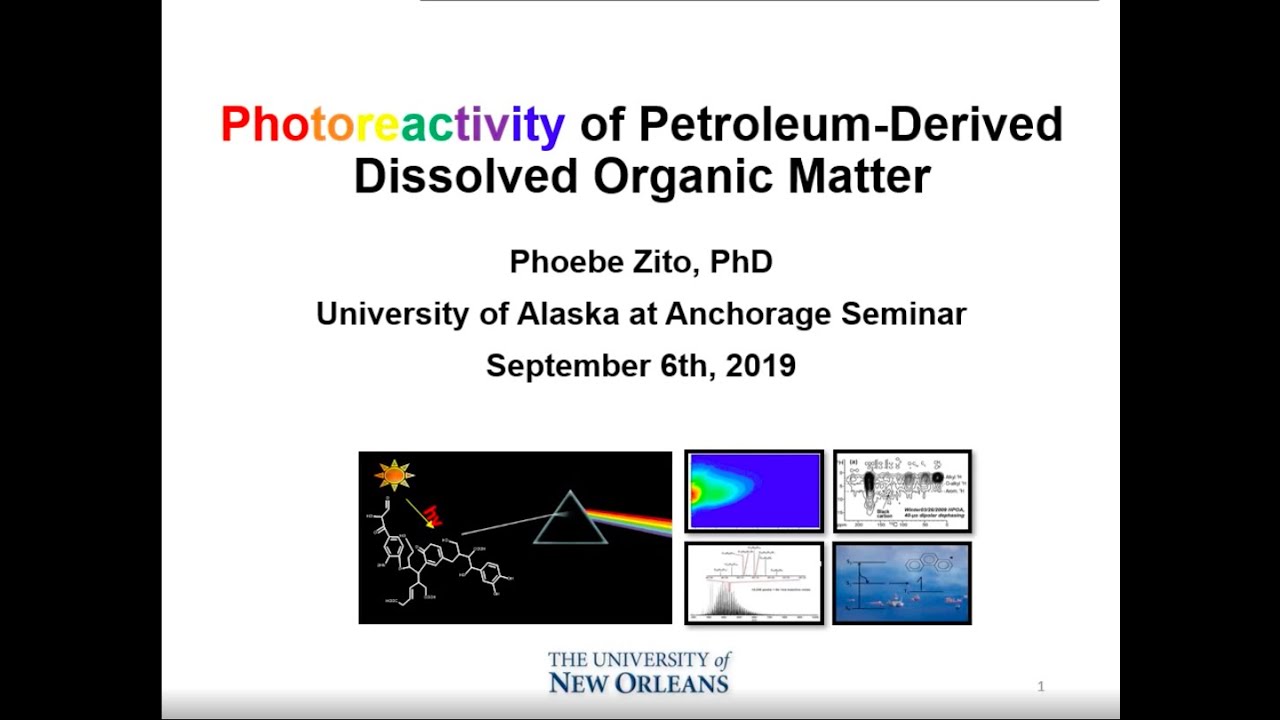
Professional Development Seminar: Photoreactivity of Petrogenic Dissolved Organic Matter
Автор: UAA College of Engineering
Загружено: 2019-09-06
Просмотров: 403
Описание:
The two largest contributors of oil entering the marine environment are from natural oil
seeps (47 %) and anthropogenic sources (53 %). Once petroleum enters the environment, it
can undergo many chemical and physical changes. Due to its dark color, it is optically active
(contains many chromophores) and can undergo photodegradation, which is an important
weathering process in the environment. These photodegradation processes result in the
formation of oxyhydrocarbons, petroleum compounds formed upon weathering. Some
oxyhydrocarbons are polar enough to dissolve into the water, becoming highly mobile and
bioavailable to the ecosystem. Methodologies and techniques for assessing the impact of
this on the environment can also be applied to other bodies of water that are affected by
organic contaminants.
Phoebe Zito is an Assistant Professor in the Chemistry Department at the University of New
Orleans. She specializes in studying the photochemical formation and fate of petroleumderived dissolved organic matter. Phoebe has a B.S. from the University of South Florida
(2007), and worked as an Associate Chemist in the pharmaceutical industry (2007-2011).
She earned her Ph.D. from the University of New Orleans (2014), was a post-doctoral
associate at the National High Magnetic Field Laboratory (2015 – 2017), and has been
working in the environmental analytical field since 2017.
Повторяем попытку...
Доступные форматы для скачивания:
Скачать видео
-
Информация по загрузке:


