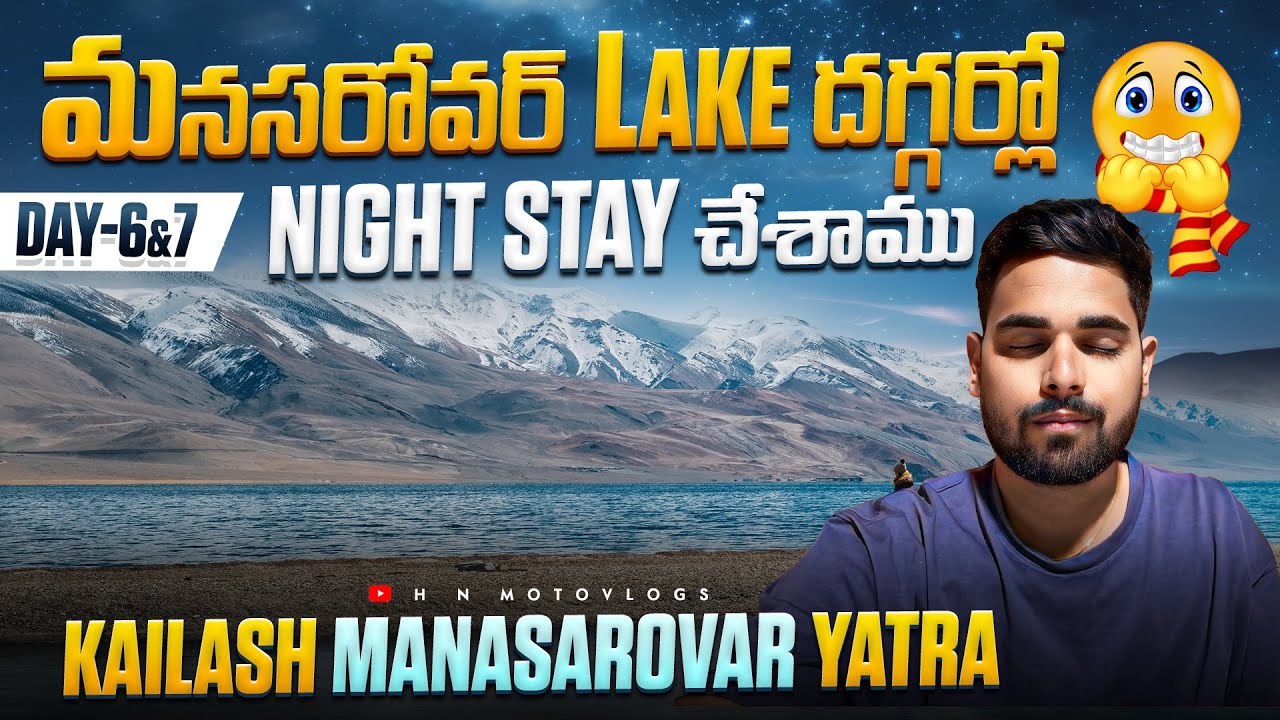
మనసరోవర్ Lake లో Night Stay చేశాం || Purang To Manasarovar Lake || Kailash Manasarovar Yatra Day 6&7
Автор: HN motovlogs
Загружено: 2025-08-09
Просмотров: 270742
Описание:
📿 For Booking Kailash Manasarovar Yatra
Contact: 8510007751
Website: www.triptotemples.com
Plan your spiritual journey with Trip To Temples 🙏
Mansarovar Lake and Rakshastal sit side by side in the remote, high-altitude wilderness of western Tibet, close to the sacred Mount Kailash, separated only by a narrow strip of land known as Tso Langpo. Though they are neighbors in geography, they are worlds apart in spirit, nature, and symbolism.
Mansarovar, at an elevation of around 4,590 meters (15,060 feet), is a perfect round expanse of shimmering blue water. Fed directly by the glaciers of the Kailash range, its waters are crystal clear and sweet to taste. The name comes from Sanskrit — Manas meaning “mind” and Sarovar meaning “lake” — signifying “the lake born from the mind of Brahma.” According to Hindu legend, it was first imagined in Lord Brahma’s mind before taking form on Earth, as a bathing place for Lord Shiva and Goddess Parvati. Pilgrims across Hinduism, Buddhism, and Jainism revere it as one of the holiest lakes on Earth. Hindus believe that bathing in its waters or even sipping a single drop can cleanse the accumulated sins of many lifetimes, helping the soul move closer to moksha — liberation from the cycle of birth and death. Buddhists consider it equally sacred, believing a single circumambulation of the lake can erase negative karma, while in Jain tradition it is said to be the site where the first Tirthankara attained enlightenment.
Just a short distance to the west lies Rakshastal, at about 4,575 meters (15,010 feet). In sharp contrast to Mansarovar’s round shape, Rakshastal forms a striking crescent moon. Its waters are saline, barren, and lifeless — no fish swim in its depths, no aquatic plants thrive on its shores. In Hindu mythology, Rakshastal is associated with Ravana, the demon king of Lanka from the Ramayana. It is believed that Ravana performed severe penance here to win the favor of Lord Shiva and gain great powers. The name Rakshastal — “Lake of the Demon” — reflects its association with ambition, desire, and ego. Tibetan culture views it as a place of negative energy, where the atmosphere feels heavy and silent.
The contrast between the two lakes is so stark that even from space, satellite images show Mansarovar as a brilliant blue circle full of life, while Rakshastal appears dark and foreboding. Tibetan tradition links Mansarovar to the sun, radiating light, purity, and spiritual awakening, while Rakshastal is linked to the moon, symbolizing mystery, power, and the pull of worldly desires.
Standing between them, a pilgrim cannot help but reflect on their deeper meaning — Mansarovar representing the path of light, truth, and liberation, and Rakshastal symbolizing the challenges of temptation, ego, and attachment. Together, they are a living reminder that in the journey towards the divine, the soul must choose its waters wisely.
Follow Me On
---------------------
Facebook Page Link :- / haricharanhn123
Instagram Link :- / haricharanhn
-------------------------------------------------------------------------------------------------------------
For Promotions And Sponsorship's Contact Me On :- [email protected]
Whatsapp :- 9816615747
#kailashmanasarovaryatra
#KailashManasarovarTelugu
#day6
#PurangToManasarovar
#KailashYatra2025
#కైలాసమానసరోవర్
#KailashYatra11DaysTrip
#manasarovarYatraTelugu
#KailasaYatraTelugu
#KailasaManasarovarYatraTelugu
#Hnmotovlogs
Повторяем попытку...
Доступные форматы для скачивания:
Скачать видео
-
Информация по загрузке:


