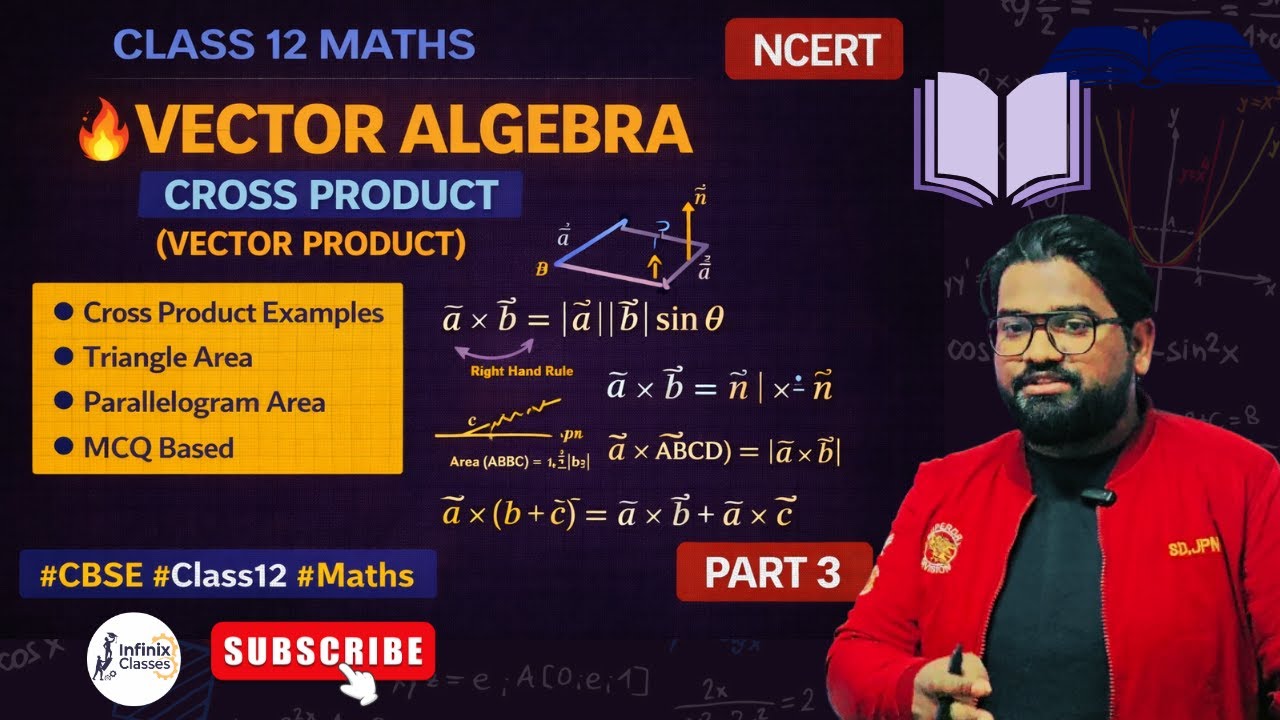
Vector Algebra Cross Product 🔥 | Class 12 Maths Ch 10 NCERT | Vector Product Concepts | Faiz Sir
Автор: Infinix Classes
Загружено: 2026-02-06
Просмотров: 36
Описание:
इस वीडियो में हम Class 12 Maths | Chapter 10 – Vector Algebra (Part 3) को detail में cover करेंगे।
यह NCERT आधारित complete lecture है, जो CBSE Board Exams, School Exams और Competitive Exams के लिए बेहद important है।
📌 इस Part में क्या-क्या पढ़ाया गया है?
👉 Vector (Cross) Product की definition और concept
👉 Right Hand Rule और Direction of Cross Product
👉 Properties & Observations of Vector Product
👉 Area of Triangle & Parallelogram using Cross Product
👉 Important Derivations & Proofs
👉 NCERT के Solved Examples
👉 Board Exam level Important Questions with full solutions
📐 Important Topics Covered:
✔ Cross Product of two vectors
✔ When a × b = 0
✔ î × ĵ, ĵ × k̂, k̂ × î and their negatives
✔ Angle between two vectors using cross product
✔ Area using vector algebra
✔ Distributive property of vector product
✔ Objective & MCQ based questions
🎯 यह वीडियो खास तौर पर उन students के लिए है जो:
Class 12 Maths में strong command चाहते हैं
Vector Algebra से डरते हैं 😄
Board exam में full marks aim कर रहे हैं
अगर वीडियो helpful लगे तो
👍 Like करें
🔔 Channel को Subscribe करें
📤 अपने दोस्तों के साथ Share करें
By – Faiz Sir
Infinix Classes Maths
#vectoralgebra
#crossproduct
#vectorproduct
#class12maths
#Chapter10Maths
#ncertmaths
#cbseclass12
#boardexam2026
#mathsbyfaizsir
#InfinixClassesMaths
#VectorAlgebraClass12
#cbsemaths
#class12board
#mathsconcepts
#ncertsolutions
VECTOR ALGEBRA | Class - 12 | Chapter – 10 | NCERT | By : FAIZ SIR
Vector (or cross) product of two vectors:
Definition 3: The vector product of two nonzero vectors 𝒂 ⃗ and 𝒃 ⃗, is denoted by 𝒂 ⃗×𝒃 ⃗ and defined as
𝒂 ⃗×𝒃 ⃗ = |𝒂 ⃗ ||𝒃 ⃗ | 𝒔𝒊𝒏𝜽 𝒏 ̂
where, θ is the angle between 𝒂 ⃗ and 𝒃 ⃗, 0 ≤ θ ≤ π and 𝒏 ̂ is a unit vector perpendicular to both 𝒂 ⃗ and 𝒃 ⃗, such that 𝒂 ⃗, 𝒃 ⃗ and 𝒏 ̂ form a right handed system (Fig.). i.e., the right handed system rotated from 𝒂 ⃗ to 𝒃 ⃗ moves in the direction of 𝒏 ̂.
If either 𝒂 ⃗=𝟎 ⃗ 𝒐𝒓 𝒃 ⃗=𝟎 ⃗, then θ is not defined and in this case, we define 𝒂 ⃗×𝒃 ⃗=𝟎 ⃗.
Observations:
1. 𝒂 ⃗×𝒃 ⃗ is a vector.
2. Let 𝒂 ⃗ and 𝒃 ⃗ be two nonzero vectors. Then 𝒂 ⃗×𝒃 ⃗=𝟎 ⃗ if and only if 𝒂 ⃗ and 𝒃 ⃗ are parallel (or collinear) to each other, i.e.,
𝒂 ⃗×𝒃 ⃗=𝟎 ⃗⇔𝒂 ⃗∥𝒃 ⃗
In particular 𝒂 ⃗×𝒂 ⃗=𝟎 ⃗, and 𝒂 ⃗×(−𝒂 ⃗)=𝟎 ⃗, since in the first situation, θ = 0 and in the second one, θ = π, making the value of sin θ to be 0.
3. If 𝜽=𝝅/𝟐 then 𝒂 ⃗×𝒃 ⃗ = |𝒂 ⃗ ||𝒃 ⃗ |.
4. In view of the Observations 2 and 3, for mutually perpendicular unit vectors 𝒊 ̂,𝒋 ̂ 𝒂𝒏𝒅 𝒌 ̂, (Fig.), we have ,
𝒊 ̂×𝒊 ̂=𝒋 ̂×𝒋 ̂=𝒌 ̂×𝒌 ̂=𝟎 ⃗
𝒊 ̂×𝒋 ̂=𝒌 ̂, 𝒋 ̂×𝒌 ̂=𝒊 ̂, 𝒌 ̂×𝒊 ̂=𝒋 ̂
5. In terms of vector product, the angle between two vectors 𝒂 ⃗ and 𝒃 ⃗ may be given as
𝒔𝒊𝒏𝜽= |𝒂 ⃗×𝒃 ⃗ |/|𝒂 ⃗ ||𝒃 ⃗ |
7. In view of the Observations 4 and 6, we have
𝒋 ̂×𝒊 ̂=−𝒌 ̂, 𝒌 ̂×𝒋 ̂=−𝒊 ̂ 𝒂𝒏𝒅 𝒊 ̂×𝒌 ̂=−𝒋 ̂
8. If 𝒂 ⃗ and 𝒃 ⃗ represent the adjacent sides of a triangle then its area is given as 𝟏/𝟐 |𝒂 ⃗×𝒃 ⃗ |.
By definition of the area of a triangle, we have from Fig.,
Area of triangle ABC = 1/2 (AB.CD).
But 𝐴𝐵=|𝑏 ⃗ | (as given), and 𝐶𝐷=|𝑎 ⃗ | sin𝜃.
Thus, Area of triangle ABC = 1/2 |𝑏 ⃗ ||𝑎 ⃗ | sin𝜃=𝟏/𝟐 |𝒂 ⃗×𝒃 ⃗ |.
9. If 𝒂 ⃗ and 𝒃 ⃗ represent the adjacent sides of a parallelogram then its area is given as |𝒂 ⃗×𝒃 ⃗ |.
From Fig., we have Area of parallelogram ABCD = (AB.DE).
But 𝐴𝐵=|𝑏 ⃗ | (as given), and 𝐷𝐸=|𝑎 ⃗ | sin𝜃.
Thus, Area of parallelogram ABCD = |𝑏 ⃗ ||𝑎 ⃗ | sin𝜃=|𝒂 ⃗×𝒃 ⃗ |.
Property 3 (Distributivity of vector product over addition):
If 𝒂 ⃗,𝒃 ⃗ and 𝒄 ⃗ are any three vectors and λ be a scalar, then
𝒂 ⃗×(𝒃 ⃗+𝒄 ⃗ )=𝒂 ⃗ ×𝒃 ⃗+𝒂 ⃗ ×𝒄 ⃗
𝝀(𝒂 ⃗×𝒃 ⃗ )=(𝝀𝒂 ⃗ )×𝒃 ⃗=𝒂 ⃗ ×(𝝀𝒃 ⃗)
Example: Find |𝒂 ⃗×𝒃 ⃗ |, if 𝒂 ⃗=𝟐𝒊 ̂+𝒋 ̂+𝟑𝒌 ̂ and 𝒃 ⃗=𝟑𝒊 ̂+𝟓𝒋 ̂−𝟐𝒌 ̂.
Example: Find a unit vector perpendicular to each of the vectors (𝒂 ⃗+𝒃 ⃗ ) 𝐚𝐧𝐝 (𝒂 ⃗−𝒃 ⃗ ), where 𝒂 ⃗=𝒊 ̂+𝒋 ̂+𝒌 ̂ and 𝒃 ⃗=𝒊 ̂+𝟐𝒋 ̂+𝟑𝒌 ̂.
Example: Find the area of a triangle having the points A(1, 1, 1), B(1, 2, 3) and C(2, 3, 1) as its vertices.
Example: Find the area of a parallelogram whose adjacent sides are given by the vectors 𝒂 ⃗=𝟑𝒊 ̂+𝒋 ̂+𝟒𝒌 ̂ and 𝒃 ⃗=𝒊 ̂−𝒋 ̂+𝒌 ̂.
Q) Find a unit vector perpendicular to each of the vectors (𝒂 ⃗+𝒃 ⃗ ) 𝒂𝒏𝒅 (𝒂 ⃗−𝒃 ⃗ ), where 𝒂 ⃗=𝟑𝒊 ̂+𝟐𝒋 ̂+𝟐𝒌 ̂ and 𝒃 ⃗=𝒊 ̂+𝟐𝒋 ̂−𝟐𝒌 ̂.
Q) If a unit vector 𝒂 ⃗ makes angles 𝝅/𝟑 with 𝒊 ̂, 𝝅/𝟒 with 𝒋 ̂ and an acute angle θ with 𝒌 ̂, then find θ and hence, the components of 𝒂 ⃗.
Q) Show that
(𝒂 ⃗−𝒃 ⃗ )×(𝒂 ⃗+𝒃 ⃗ )=𝟐(𝒂 ⃗×𝒃 ⃗ )
Q) Find λ and µ if (𝟐𝒊 ̂+𝟔𝒋 ̂+𝟐𝟕𝒌 ̂ )×(𝒊 ̂+"λ" 𝒋 ̂+"µ" 𝒌 ̂ )= 𝟎 ⃗.
Q) Let the vectors 𝒂 ⃗,𝒃 ⃗ and 𝒄 ⃗ be given as 𝒂_𝟏 𝒊 ̂+𝒂_𝟐 𝒋 ̂+𝒂_𝟑 𝒌 ̂,𝒃_𝟏 𝒊 ̂+𝒃_𝟐 𝒋 ̂+𝒃_𝟑 𝒌 ̂, 𝒄_𝟏 𝒊 ̂+𝒄_𝟐 𝒋 ̂+𝒄_𝟑 𝒌 ̂. Then show that 𝒂 ⃗×(𝒃 ⃗+𝒄 ⃗ )=𝒂 ⃗×𝒃 ⃗+𝒂 ⃗×𝒄 ⃗.
Q) Let the vectors 𝒂 ⃗ and 𝒃 ⃗ be such that |𝒂 ⃗ |=𝟑 and |𝒃 ⃗ |=√𝟐/𝟑, then 𝒂 ⃗×𝒃 ⃗ is a unit vector, if the angle between 𝒂 ⃗ and 𝒃 ⃗ is
(A) π/6 (B) π/4 (C) π/3 (D) π/2
Q) Area of a rectangle having vertices A, B, C and D with position vectors −𝒊 ̂+𝟏/𝟐 𝒋 ̂+𝟒𝒌 ̂, 𝒊 ̂+𝟏/𝟐 𝒋 ̂+𝟒𝒌 ̂,𝒊 ̂−𝟏/𝟐 𝒋 ̂+𝟒𝒌 ̂ and −𝒊 ̂−𝟏/𝟐 𝒋 ̂+𝟒𝒌 ̂, respectively is
(A) 𝟏/𝟐 (B) 1 (C) 2 (D) 4
Повторяем попытку...
Доступные форматы для скачивания:
Скачать видео
-
Информация по загрузке:








![😱 Майнкрафт, но Мы Превратились В ЖИВЫЕ БЛОКИ • 30000 рублей [Я впервые Поддаюсь] + Фиксплей](https://imager.clipsaver.ru/6MXEkD5ZpTA/max.jpg)