Controller Algorithm Selection and PID Tuning Fundamentals for Process Engineers
Автор: Engineering, Management, Psychology
Загружено: 2026-02-28
Просмотров: 7
Описание:
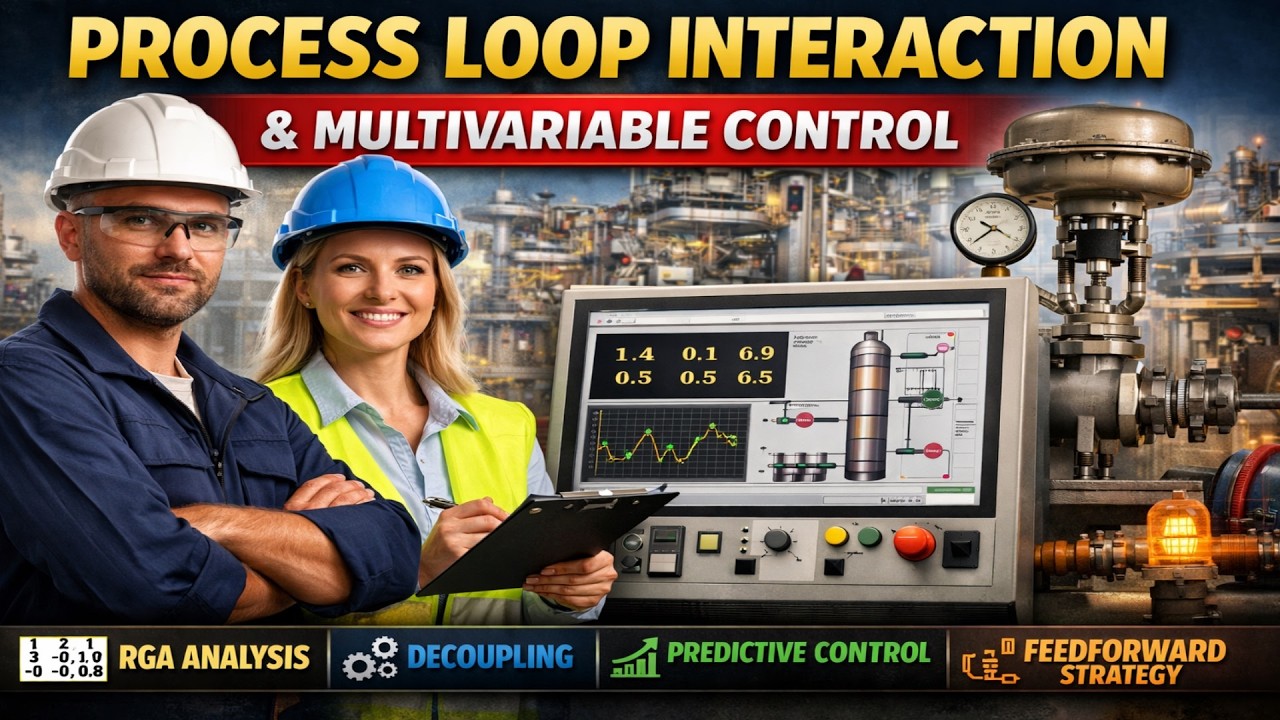
In industrial process control, the effectiveness of a feedback control loop depends fundamentally on selecting the correct controller algorithm. Many control problems are not caused by bad tuning but by choosing the wrong controller mode in the first place. This learning podcast explains how Process Engineers and Control Engineers can select the right control algorithm starting from the simplest solution and progressing toward advanced PID control strategies.
The discussion begins with the principle that the simplest controller capable of achieving the control objective is usually the best choice. On Off control remains widely used in industrial protection systems and large slow processes where precision is not required. It offers simplicity and reliability but always produces cycling behavior and increased mechanical wear.
Proportional control represents the minimum continuous control strategy capable of balancing process supply and demand. Properly tuned proportional control eliminates the continuous switching of On Off control but introduces steady state offset. This episode explains why offset exists and how process gain and dead time determine proportional controller behavior.
Integral control is introduced as the mechanism that eliminates steady state error. Engineers will learn how integral action gradually drives the process toward the set point and why excessive integral action leads to instability and windup. The discussion includes when integral only control is appropriate such as trim loops and slow processes.
Proportional Integral control is explained as the most widely used industrial controller because it combines fast response with zero steady state error. This episode explains why PI control is ideal for most flow pressure level and temperature loops and how dead time and capacity influence tuning decisions.
Derivative control is presented as the predictive component of PID control. Engineers will learn how derivative action improves stability reduces overshoot and allows faster control but also amplifies measurement noise. Practical guidelines are provided for deciding when derivative action is beneficial and when it should be avoided.
The complete PID algorithm is explained as a balanced control strategy combining present past and predicted error. Real plant considerations such as dead time capacity self regulating and non self regulating processes are discussed to help engineers match controller modes to real processes.
This episode also explains tuning criteria used in industry including overdamped critically damped and underdamped responses. Engineers will learn practical tuning targets such as quarter amplitude decay and integral error minimization methods including IAE ITAE and ISE.
Industrial tuning methods including Ziegler Nichols Cohen Coon process reaction curve and closed loop cycling methods are explained with clear engineering context. The discussion includes proportional band gain reset time and rate time adjustments and how each parameter influences loop behavior stability and robustness.
This learning session is ideal for Process Engineers Control Engineers and Automation Engineers who want a deeper understanding of controller algorithm selection PID tuning and real industrial loop behavior.
Understanding controller fundamentals leads to more stable plants lower energy consumption longer valve life and improved production reliability.
#ProcessControl
#PIDControl
#AutomationEngineering
#ControlEngineering
#ProcessEngineering
#IndustrialAutomation
#Instrumentation
#ProcessAutomation
#ControlSystems
#PIDTuning
#EngineeringEducation
#ChemicalEngineering
#PlantEngineering
#IndustrialEngineering
#EngineeringLearning
Повторяем попытку...

Доступные форматы для скачивания:
Скачать видео
-
Информация по загрузке: